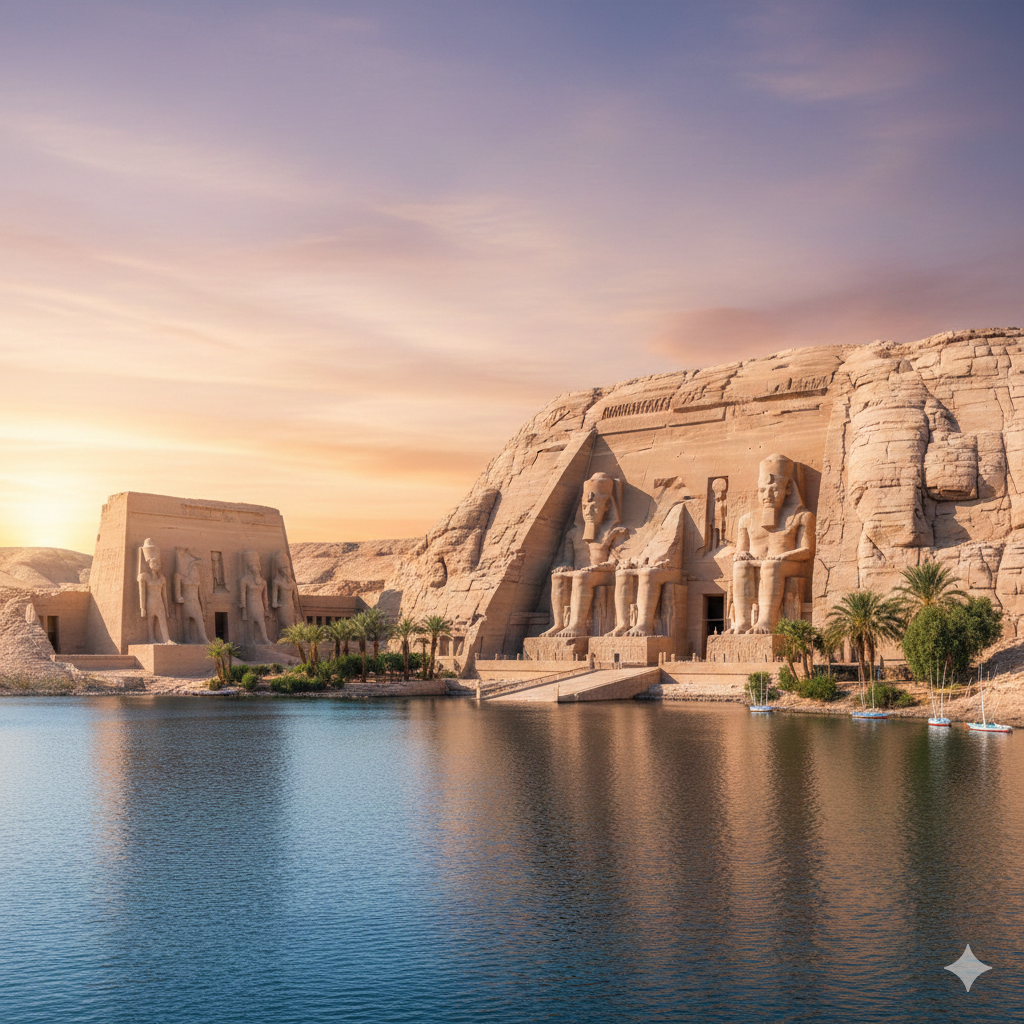
Planning a visit to Abu Simbel? The temples are open daily, the official booking portal currently lists standard foreign-adult tickets at EGP 822, and the normal last-entry time is 4:00 PM. Most visitors arrive early from Aswan and spend about two hours exploring the Great Temple of Ramesses II, the Small Temple of Hathor and Nefertari, and the lakeside setting.
This practical Abu Simbel visitor guide brings the information tourists need into one place: verified ticket prices, opening and last-entry times, official booking rules, the best time to visit, the Sun Alignment dates, what to see inside, photography, accessibility, safety and what to pack.
Visitor information reviewed: October 2026. Egyptian monument prices and hours can change without much notice, so recheck the official booking portal shortly before your visit.
Abu Simbel visitor information at a glance
| Planning question | Quick answer |
|---|---|
| Where is Abu Simbel? | On the western shore of Lake Nasser in southern Egypt, about 280 km from Aswan. |
| Normal opening time | 6:00 AM daily. |
| Normal last entry | 4:00 PM; the Ministry information page lists the site closing at 5:00 PM. |
| Ramadan hours | 7:00 AM opening and 3:00 PM last entry on the official portal. |
| Foreign adult online ticket | EGP 822 at the time of checking. |
| Foreign student online ticket | EGP 445.50; valid student ID required and the portal states age must not exceed 24. |
| Sun Alignment dates | February 22 and October 22; special tickets and larger crowds apply. |
| Time needed at the site | About 1.5–2.5 hours for most first-time visitors. |
| Best time to arrive | Early morning for cooler temperatures and softer light. |
Abu Simbel opening hours and last entry
The Egyptian Ministry of Tourism and Antiquities lists Abu Simbel as open every day from 6:00 AM to 5:00 PM. The official ticket-booking portal gives the more important operational detail: last entry is 4:00 PM in both summer and winter.
These times are not contradictory. The site may remain open until 5:00 PM, but visitors should pass the entrance before the 4:00 PM cutoff. The booking portal recommends arriving at least one hour before closing; for a worthwhile visit, arriving much earlier is better.
Abu Simbel Ramadan opening hours
As of 1 October 2026, the official transaction portal lists the same operational window for Ramadan as its summer and winter entries: 6:00 AM with last entry at 4:00 PM. Because Ramadan schedules can be changed operationally, confirm again shortly before travel.
| Period | Opening | Last entry | Planning advice |
|---|---|---|---|
| Normal summer hours | 6:00 AM | 4:00 PM | Arrive in the morning to avoid peak heat. |
| Normal winter hours | 6:00 AM | 4:00 PM | Bring a light layer for a very early start. |
| Ramadan | 6:00 AM | 4:00 PM | Recheck shortly before the visit. |
Abu Simbel ticket prices in 2026
At the time of checking, the official Abu Simbel booking portal displays the following payable prices for visitors of “Other Nationality”:
| Ticket category | Foreign adult | Foreign student |
|---|---|---|
| Standard admission | EGP 822 | EGP 445.50 |
| Sun Alignment: February 22 or October 22 | EGP 1,272 | EGP 670.50 |
The Ministry’s general information page currently shows lower base figures—EGP 750 for a foreign adult and EGP 375 for a foreign student—while the transaction portal displays EGP 822 and EGP 445.50. For budgeting and payment, use the amount shown in the official checkout when you book. The difference may reflect portal updates or added charges, but neither official page clearly explains it.
Important: the listed portal prices were observed on 21 July 2026. Do not copy them into a fixed itinerary without rechecking, because Egyptian monument fees can change.
Student tickets and free entry
The official portal states that students must present valid student identification and must not be older than 24. It also lists free entry for children below six. Eligibility rules can be applied at the gate, so bring the original supporting document rather than relying only on a phone photograph.
Are transport and guide fees included?
No. The entrance ticket covers admission to the archaeological site. Your transfer from Aswan, tour guide, meals and any accommodation are separate unless a tour description explicitly includes them.
How to book Abu Simbel tickets
Use the official Egyptian monuments portal, select Abu Simbel Temple, choose the date and ticket category, and review the displayed total before payment. Keep the confirmation accessible offline because mobile data can be unreliable during a long travel day.
- Open the official Abu Simbel ticket page.
- Select “Other Nationality” or the correct nationality category.
- Choose standard admission or the Sun Alignment date.
- Enter the visitor details exactly as required.
- Review the date, category and final EGP total.
- Save the ticket or QR code on the phone and as a screenshot.
Online booking is especially useful for February 22, October 22 and other busy periods. On an ordinary day, tickets may also be obtainable at the site, but booking in advance reduces uncertainty after a three- to four-hour road journey.
Where are the Abu Simbel Temples?
Abu Simbel is in the Aswan Governorate near Egypt’s southern border, on the western bank of Lake Nasser. The official Sound and Light site describes it as about 280 km from Aswan. The location is remote, so visiting requires more planning than monuments within Cairo, Luxor or Aswan city.
Most travelers use Aswan as their base. For a detailed comparison of shared minibus, private car, public bus and flight options, read our separate Abu Simbel from Aswan day-trip guide. That page covers transport; this guide remains focused on tickets, hours and the experience inside the archaeological site.
Can you visit Abu Simbel from Cairo or Luxor in one day?
It is theoretically possible only with carefully timed flights and transfers, but it is not the most reliable plan. Aswan is the logical starting point. Travelers combining Cairo, Luxor and Aswan should first plan their Upper Egypt route, then reserve a separate Abu Simbel day.
Our Luxor-to-Aswan Nile cruise guide explains typical cruise timing. If you are building a longer first trip, compare the 10-day Egypt itinerary and 12-day Egypt itinerary.
Best time to visit Abu Simbel
Best months
October through April generally offers the most comfortable temperatures. Early winter mornings can feel cool, particularly if you leave Aswan before dawn, but the site becomes warmer quickly after sunrise. From May through September, heat and direct sun can be intense.
Best time of day
Early morning is best for most visitors because the temperature is lower and the light on the façades is more attractive. However, many shared road tours arrive in a similar morning wave. Staying one night near Abu Simbel can provide access closer to opening time and makes the evening Sound and Light Show practical.
If weather comfort is central to your plans, consult our best time to visit Egypt month by month.
How long do you need at Abu Simbel?
Allow 1.5 to 2.5 hours at the archaeological site. Two hours is enough for both temples, their interiors and photographs without rushing. Visitors who use a guide, study the reliefs carefully or visit during a crowded event may need closer to three hours.
A practical two-hour route
- Great Temple façade: pause for the four colossal statues and the fallen head at the base.
- Great Temple interior: walk through the pillared hall and decorated chambers toward the sanctuary.
- Small Temple: examine the façade of Ramesses II and Queen Nefertari, then visit the interior.
- Lakeside and wide views: step back to appreciate the artificial cliff and Lake Nasser setting.
- Final photographs and facilities: leave enough time to return to your vehicle without delaying the group.
If a group tour allows only 60–90 minutes, enter the Great Temple first, then the Small Temple, and take wide exterior photographs last. Do not spend the entire visit photographing the first façade.
What to see at Abu Simbel
The Great Temple of Ramesses II
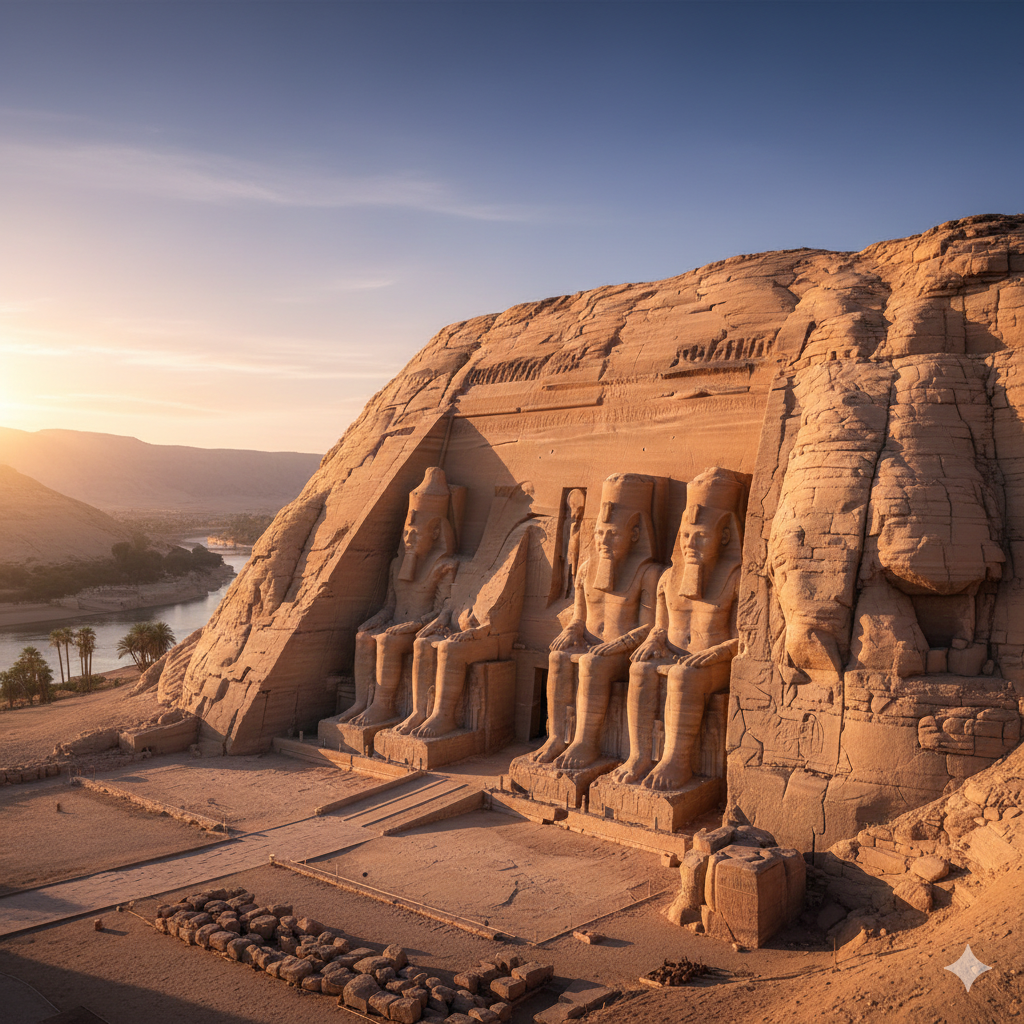
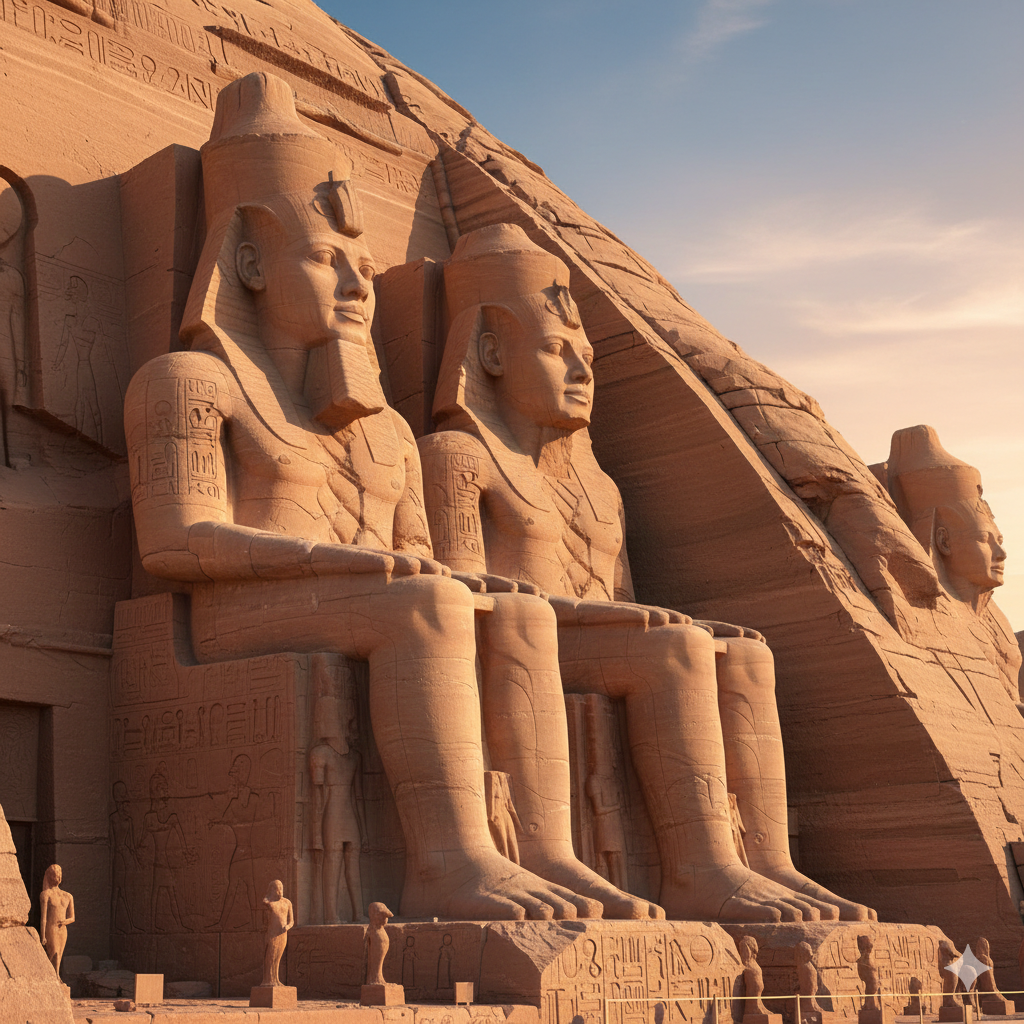
The Great Temple was carved into living rock for Ramesses II in the 13th century BCE. Four seated colossi dominate the façade; one was damaged by an ancient earthquake, and its broken pieces remain below. Inside, monumental Osiride figures line the main hall, while reliefs present royal and religious scenes leading toward the sanctuary.
The sanctuary contains figures of Amun-Ra, Ra-Horakhty, the deified Ramesses II and Ptah. The temple’s orientation creates the famous twice-yearly solar illumination.
The Small Temple of Hathor and Nefertari
The neighboring Small Temple is dedicated to the goddess Hathor and Queen Nefertari. Its façade is remarkable because Nefertari’s statues appear at the same monumental scale as those of Ramesses II—an unusual visual statement in ancient Egyptian royal art.
Do not skip this temple even when time is short. Its more intimate scale and surviving interior decoration provide a useful contrast with the political grandeur of the Great Temple.
The Abu Simbel Sun Alignment
According to the Ministry of Tourism and Antiquities, sunlight penetrates the Great Temple and reaches the sanctuary on February 22 and October 22. The rays illuminate the innermost figures while Ptah, associated with darkness, remains less illuminated.
These dates attract a festival atmosphere, larger crowds, controlled visitor flow and higher special-event ticket prices. Book early, arrange an overnight stay if possible, and expect security and access procedures to take longer than on a normal day.
The phenomenon is often described online with claims about Ramesses II’s birthday and coronation. Those interpretations are widely repeated but not established as securely as the observable alignment itself. Present the dates and the architectural effect as fact; treat claims about their original symbolic purpose as interpretation.
How Abu Simbel was moved
Abu Simbel’s modern story is nearly as extraordinary as its ancient construction. The creation of the Aswan High Dam and Lake Nasser threatened to submerge the Nubian monuments. UNESCO launched an international rescue campaign in 1960.
According to UNESCO’s account of the rescue, the temples were cut into more than a thousand blocks, moved and reassembled inside an artificial cliff about 64 metres above and 180 metres inland from the original location. Abu Simbel opened at its new site in September 1968. The Nubian Monuments from Abu Simbel to Philae entered the World Heritage List in 1979.
The same international campaign saved monuments associated with Philae. Continue planning with our Philae Temple and Aswan High Dam visitor guide.
Abu Simbel Sound and Light Show
The evening show projects light and narration across the temples and tells the story of Ramesses II, Nubia and the relocation. It is a separate ticket and is difficult to combine with a standard road day trip from Aswan because most shared vehicles return in the afternoon.
The official Sound and Light website currently shows performances at 8:00 PM and 9:00 PM, subject to minimum attendance and schedule changes. It lists a regular ticket at US$20 and a child ticket for ages 6–12 at US$11. Recheck the selected date before arranging accommodation.
Stay overnight near Abu Simbel if the show matters to you. Do not assume a normal Aswan day tour will wait for an evening performance.
Photography rules at Abu Simbel
The official booking portal states that mobile-phone photography is free. Rules for flash, tripods, professional cameras and commercial equipment may differ or change, so follow signs and staff instructions at the entrance and inside each temple.
- Use a phone or compact camera unless you have confirmed professional-equipment rules.
- Turn off flash when instructed; it can disturb visitors and harm the experience.
- Do not block narrow interior routes for long photographs.
- Bring a lens cloth because dust is common.
- Ask before photographing staff, security personnel or local residents.
Accessibility, facilities and heat
The exterior approach is broad, but the site involves sun exposure, walking and uneven surfaces. Temple interiors can feel narrow, dark and crowded. Travelers with limited mobility should ask their tour operator about the distance from the parking area, availability of assistance and whether the vehicle can use the closest permitted drop-off point.
Shade is limited and the southern Egyptian sun is strong. Toilets and basic refreshments are generally available near the visitor area, but do not depend on finding every product you need at this remote site.
What to bring
- ticket screenshot and booking confirmation;
- passport details or identification requested by the tour operator;
- valid student ID if using a student ticket;
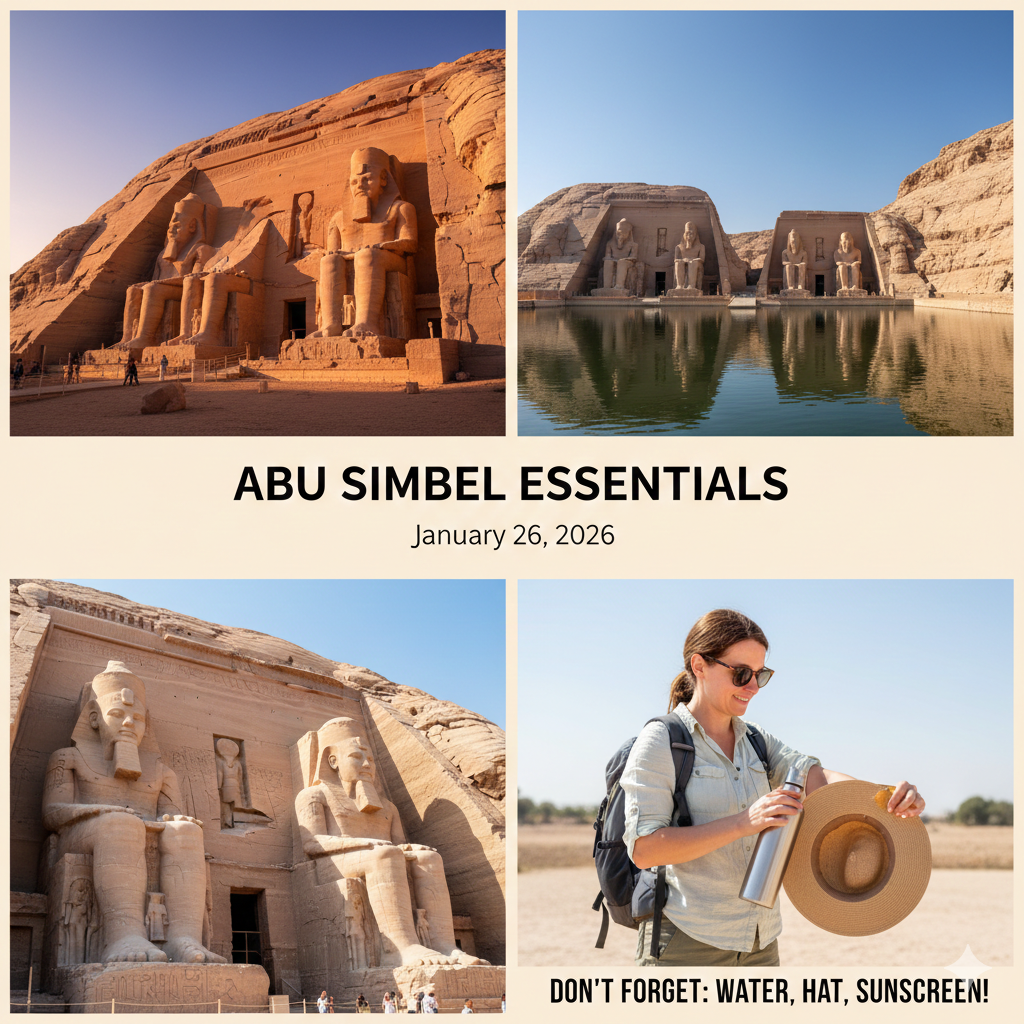
- water, hat, sunglasses and high-SPF sunscreen;
- comfortable shoes with grip;
- snacks if you have dietary needs;
- small Egyptian-pound notes for minor purchases and tips;
- power bank and charging cable;
- a light jacket for a winter pre-dawn departure.
For the wider journey, use our complete Egypt packing list.
Is Abu Simbel safe for tourists?
Abu Simbel is an established tourist site with visible security and routine road controls. As of 21 July 2026, the UK FCDO’s Egypt advice specifically lists Aswan and Abu Simbel among the exceptions to its broader “all but essential travel” warning for parts of the Western Desert. That does not guarantee risk-free travel, and government advice differs by nationality.
Check your own government’s current Egypt advisory, use an established transport provider, wear a seat belt, carry water and follow instructions at checkpoints. Avoid unplanned travel toward remote border areas beyond normal tourist routes.
Read our broader Egypt safety guide for current practical precautions.
Combining Abu Simbel with Aswan
A balanced plan gives Aswan at least two full sightseeing days in addition to the Abu Simbel excursion. One day can cover Philae Temple and the High Dam; another can include the Nubian Museum, a felucca experience or a carefully chosen community visit.
If local culture interests you, read our Nubian Village Aswan guide. Travelers who prefer a ready-made Upper Egypt framework can review the 8-day Cairo, Aswan and Luxor tour with Nile cruise and ask whether Abu Simbel can be added to the itinerary.
Frequently asked questions
What are the Abu Simbel opening hours?
The Ministry page lists daily hours from 6:00 AM to 5:00 PM. The official booking portal lists last entry at 4:00 PM. As of 1 October 2026, its Ramadan entry also lists 6:00 AM opening and 4:00 PM last entry.
How much is the Abu Simbel entrance fee for foreigners?
On 1 October 2026, the official booking portal displayed EGP 822 for a foreign adult and EGP 445.50 for an eligible foreign student. Confirm the live checkout price before visiting.
Why does the Ministry page show a different ticket price?
The Ministry information page displays EGP 750 for foreign adults, while the transaction portal shows EGP 822. Use the official checkout total for payment because official pages may update at different times or the portal total may include additional charges.
Do I need to book Abu Simbel tickets in advance?
Advance booking is recommended for convenience and is particularly important for February 22, October 22 and busy travel periods. Save the ticket offline.
Are children free at Abu Simbel?
The official booking portal lists free entry for children below six. Check the current policy and bring proof of age if needed.
Who qualifies for the Abu Simbel student ticket?
The official portal requires valid student ID and states that the student’s age must not exceed 24.
How long should I spend at Abu Simbel?
Most visitors need 1.5–2.5 hours. Allow more time if you use a guide, visit during a festival or want to study the reliefs carefully.
How far is Abu Simbel from Aswan?
Official tourism information commonly gives the distance as about 280 km. The road journey usually takes roughly three to four hours each way depending on stops and conditions.
What is the best way to visit Abu Simbel from Aswan?
A shared minibus is usually the least expensive; a private car offers more control; flights depend on the live schedule. Compare them in the dedicated Abu Simbel from Aswan guide.
When is the Abu Simbel Sun Alignment?
The official dates are February 22 and October 22. Special tickets, larger crowds and controlled access should be expected.
Can I take photos inside Abu Simbel?
The official portal states that mobile-phone photography is free. Follow current signs and staff instructions for flash, tripods and professional equipment.
Is Abu Simbel worth the long trip from Aswan?
For travelers interested in ancient Egyptian architecture, Ramesses II, Nubian heritage or UNESCO conservation, it is one of Egypt’s most rewarding sites. The long journey is the main trade-off.
Common Abu Simbel planning mistakes
Confusing closing time with last entry
Seeing “open until 5:00 PM” does not mean you can arrive at 4:55 PM. The official booking portal currently gives 4:00 PM as normal last entry. Build the day around the cutoff and allow extra time for parking, security and walking to the entrance.
Booking transport without checking the visit window
A very cheap shared tour may allow only a short time at the site. Before paying, ask for the planned arrival time, departure time and approximate number of minutes at the temples. Also confirm whether hotel pickup, guide service and entrance tickets are included.
Assuming a Nile cruise automatically includes Abu Simbel
Abu Simbel is often an optional excursion rather than a standard cruise stop. Cruise schedules in Aswan may leave limited time for the long road journey. Ask the operator in writing and do not book a separate transfer until you know the ship’s arrival and departure times.
Planning the evening show after a normal road tour
Most shared day trips return to Aswan long before the Sound and Light Show. If the evening performance is important, stay near Abu Simbel and confirm both the show booking and accommodation before arranging transport.
Skipping the Small Temple
The Great Temple receives most of the attention, but the Small Temple is part of what makes the site exceptional. Reserve enough time to enter it and examine Nefertari’s monumental representation rather than treating it as a background for photographs.
Arriving unprepared for heat or a cold departure
Summer heat can become severe soon after sunrise, while winter road tours may begin in surprisingly cool pre-dawn conditions. Dress in removable layers, carry more water than you expect to drink and protect your head and skin even during cooler months.
Relying on an old screenshot of ticket prices
Prices on blog posts, social media and even different official pages may not match. Check the live official checkout before the visit and budget from the final amount shown there. Keep enough payment flexibility in case the portal or gate price has changed.
Final planning checklist
- Keep the existing morning or overnight travel plan separate from the entrance ticket.
- Check the official portal for the live ticket price and last-entry time.
- Book early for February 22 and October 22.
- Save the ticket offline and carry required ID.
- Allow around two hours at the temples.
- Bring water, sun protection and suitable shoes.
- Confirm transport inclusions and the amount of on-site time in writing.
- Recheck official travel advice before departure.
With those details settled, Abu Simbel becomes far easier to enjoy: arrive early, visit both temples, look beyond the famous façade, and leave time to appreciate one of the world’s greatest heritage-rescue stories.