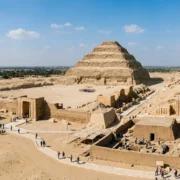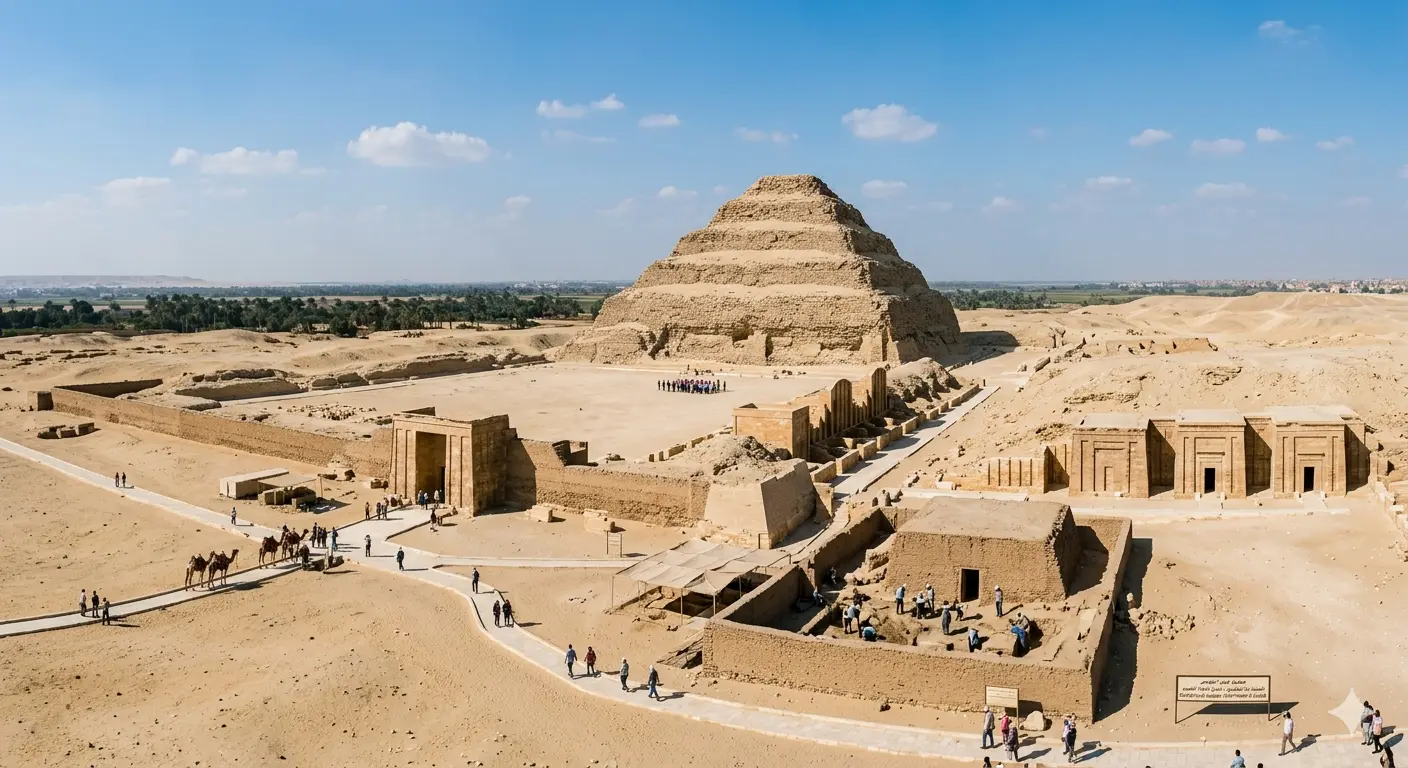
Saqqara is where it all began. Before Giza, before the Great Pyramid, before the entire tradition of Egyptian pyramid building, there was Saqqara — and specifically, there was the Step Pyramid of Djoser, the world’s oldest large-scale stone monument and the prototype for everything that followed. Built around 2650 BCE by the architect Imhotep for Pharaoh Djoser, it is not merely a pyramid but the moment in history when human beings first decided to build something permanent, large-scale, and entirely in stone.
Combining Saqqara with the nearby ancient city of Memphis — once the capital of a unified Egypt and one of the ancient world’s great metropolises — creates one of the most rewarding and underrated day trips available from Cairo.
For planning context, see our Egypt 10-Day Itinerary and our Giza Pyramids Guide for comparison.
Why Saqqara Is More Important Than Most People Realize
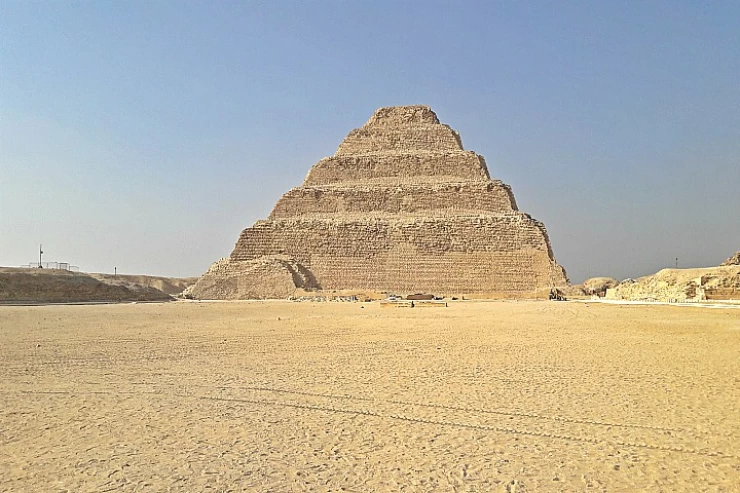
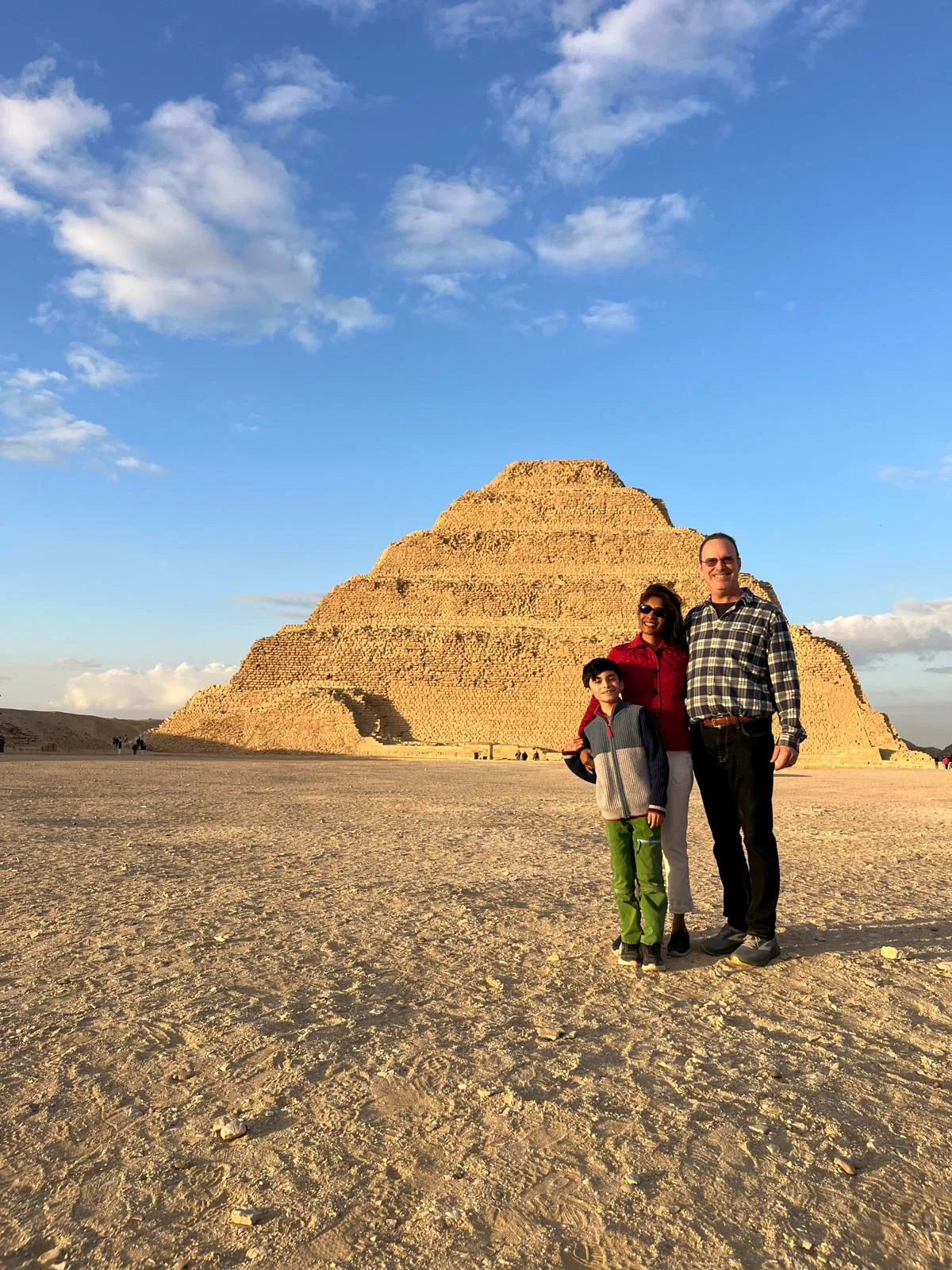
The Pyramids of Giza get all the attention, but Saqqara tells the story that makes Giza comprehensible.
The history of Egyptian pyramid building begins not with the smooth-sided, mathematically perfect monuments at Giza, but with the experimental, stepped structure at Saqqara. Djoser’s Step Pyramid was built by expanding a series of mastabas (flat-topped rectangular tombs) upward into six successive steps, creating a structure approximately 62 meters tall — the first time stone had been used at such scale in human history.
The architect Imhotep — history’s first named engineer and architect — was responsible for this revolution. He was so revered for his achievement that he was later deified and worshiped as a god of medicine and wisdom for over a thousand years after his death. The Greeks equated him with Asclepius, their god of medicine.
The Saqqara site is also one of Egypt’s most active archaeological zones — new discoveries continue to emerge. In recent years, archaeologists have found extraordinary caches of mummies, intact wooden coffins, and ritual objects that have rewritten aspects of Egyptological understanding.
For the latest discoveries, the Egyptian Ministry of Tourism and Antiquities publishes regular updates.
What’s at Saqqara
The Step Pyramid Complex of Djoser
The Step Pyramid and its surrounding enclosure wall cover an area approximately 600 x 300 meters — a miniature city of the dead. The complex was designed to replicate, in stone, the royal palace and its surroundings that the pharaoh would need in the afterlife.
The pyramid itself: Six steps rising to approximately 62 meters. Originally cased in polished white limestone (most now missing). Oriented with unusual astronomical precision.
The enclosure wall: A 10.5-meter-high wall with 14 doors — only one actually functional, the rest false doors carved in stone, creating the impression of a great palace. The wall extends for over 1.6 km.
The Heb-Sed Court: A large courtyard in which the pharaoh’s ritual race was held — a ceremony designed to demonstrate the king’s continued physical vigor and renew his right to rule. Stone markers and chapels border the court.
The South Tomb: A shaft descending 28 meters below ground, decorated with vivid blue-green faience tiles in diamond patterns — one of the earliest and most beautiful examples of decorative tilework from ancient Egypt.
The Serdab: A sealed chamber containing an early copy of Djoser’s seated statue (the original is in the Egyptian Museum) — through two small eye holes, the king’s spirit could observe the offerings and rituals performed outside.
The newly restored Pyramid: After decades of careful work, significant parts of the Step Pyramid and its complex have been restored and are now more accessible than they’ve been in modern times. The interior of the pyramid (accessible on a separate ticket) provides an extraordinary experience of the ancient burial chambers.
Other Pyramids at Saqqara
Saqqara is not only Djoser’s pyramid — the plateau contains ruins of at least 17 pyramid structures spanning the Old Kingdom period. Other notable pyramids:
The Pyramid of Unas (5th Dynasty, approximately 2350 BCE): Contains the first-ever written religious texts inside a royal tomb — the Pyramid Texts, the oldest religious corpus in the world. These are the ancestors of all later Egyptian funerary literature including the Book of the Dead.
The Pyramid of Teti (6th Dynasty): Another pyramid containing Pyramid Texts, with somewhat better preservation of the interior chambers.
The Bent Pyramid and Red Pyramid at Dahshur (accessible on the same day trip): Two pyramid types that represent the transition from the step pyramid to the smooth-sided Giza form. The Bent Pyramid’s kink halfway up reflects a mid-construction change in angle when the original angle proved too steep. The Red Pyramid (its limestone now exposed to the reddish granite core) is the first true smooth-sided pyramid — the direct predecessor of the Great Pyramid at Giza. Both are accessible to visitors.
The Mastaba Tombs
Surrounding the royal pyramids are hundreds of mastabas — the rectangular flat-topped tombs of officials, nobles, and courtiers. Many contain extraordinary painted relief scenes of daily life in the Old Kingdom.
The Mastaba of Ti: One of the finest and most accessible non-royal tombs at Saqqara, decorated with vivid scenes of farming, fishing, hunting, and craftwork that provide an unparalleled window into everyday life in ancient Egypt around 2400 BCE.
The Mastaba of Kagemni: Another well-preserved official’s tomb with exceptional painted reliefs.
The Mastaba of Mereruka: The largest private tomb in Egypt — 32 decorated chambers belonging to a 6th Dynasty vizier.
The Serapeum
One of Saqqara’s most remarkable and atmospheric sites — a series of underground galleries containing the burial places of Apis bulls, sacred to the god Ptah. Each Apis bull was revered as a living god during its lifetime and buried with enormous ceremony in massive granite sarcophagi weighing up to 70 tons each.
The underground galleries are dimly lit, dramatically atmospheric, and still contain several of the original giant sarcophagi — extraordinary objects that convey the religious devotion they represented.
Memphis — Egypt’s First Capital
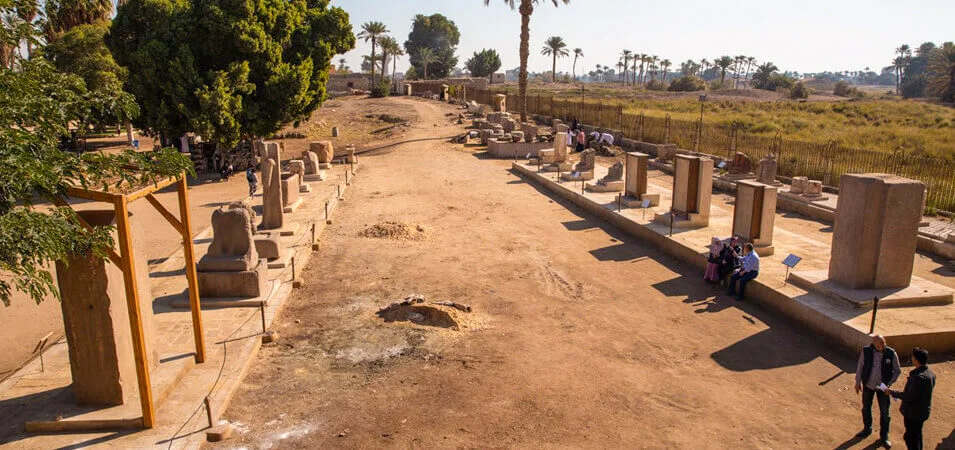
Memphis (the ancient Egyptian city known as Ineb-Hedj — “White Walls”) was Egypt’s first capital after the unification of Upper and Lower Egypt around 3100 BCE. For much of ancient Egyptian history, it was the country’s most important administrative and religious city.
Today, ancient Memphis has largely disappeared beneath the agricultural fields of the modern village of Mit Rahina. What survives is collected in the small but important Memphis Open-Air Museum, approximately 25 km from Saqqara.
The Memphis Open-Air Museum Highlights
The Colossal Statue of Ramesses II:
The most spectacular object at the Memphis museum — a 10-meter limestone statue of Ramesses II, displayed lying on its back in a dedicated building (the lower portion is missing). The scale, preservation of detail (facial features, jewelry, crown inscription), and craftsmanship make this one of the most impressive royal statues in Egypt.
The Second Colossus:
A second, smaller limestone colossus of Ramesses II stands upright in the open-air courtyard.
The Alabaster Sphinx:
An 8-meter sphinx carved from a single block of alabaster — the largest alabaster sphinx in the world. Dating to the New Kingdom period, its face is believed to represent Amenhotep II or Ramesses II.
The Apis Bull Burial:
A large granite sarcophagus used for the burial of an Apis bull, displayed in the open-air museum — similar to those in the Serapeum, providing context for understanding the Apis cult.
How to Organize the Day Trip
Route and Logistics
The most efficient day trip from Cairo visits Saqqara and Memphis in sequence. All sites are located in the same general area (approximately 25 km south of Cairo):
Recommended order:
- Saqqara (3–4 hours) — arrive early for cool temperatures and few crowds
- Memphis (1–1.5 hours) — shorter stop for the open-air museum
- Dahshur pyramids (1 hour, optional addition) — if time permits
Transport options:
Uber/Careem or private taxi (Best option): Cairo → Saqqara → Memphis → Cairo in a single day. Approximately 2–3 hours of driving total plus site time. Negotiate a half-day rate for the driver to wait at each site.
Private guided tour: Book through Egypt Travel Ways — transport, guide, entrance fees, and timing all handled. The most stress-free option.
Public transport: Possible but complex — metro to Giza, microbus to Badrashin, taxi to Saqqara. Not recommended for a day trip with limited time.
Tickets and Entrance Fees (2027)
| Site | Approximate Cost (USD) |
|---|---|
| Saqqara general admission | $12–18 |
| Step Pyramid interior | $8–12 extra |
| Mastaba of Ti | $5 extra |
| Serapeum | $5 extra |
| Memphis Open-Air Museum | $5–10 |
| Dahshur pyramids (optional) | $5–10 |
Best Time to Visit
Time of day: Early morning — Saqqara is best at 8:00–11:00 AM before the midday heat. The site has minimal shade.
Season: November through April. Summer (June–August) visits to open-air Saqqara are very challenging due to heat — if visiting in summer, start at 7 AM and finish by 11 AM.
Combining with the Giza Pyramids
Saqqara and the Giza Pyramids are approximately 12 km apart. Some visitors try to combine both in a single day — possible but exhausting. The better approach:
Option A: Devote a full day to each separately (Giza one day, Saqqara+Memphis another)
Option B: Saqqara+Memphis in the morning, then drive to the Giza Panorama Point for sunset photographs
For the Giza experience itself, see our Giza Pyramids Complete Guide.
External Resources
- Egyptian Ministry of Tourism — Saqqara — Official site information and latest discovery announcements
- UNESCO — Memphis and Necropolis — World Heritage documentation
- Imhotep Museum at Saqqara — Small museum at Saqqara site containing extraordinary small objects from the complex
- Britannica — Saqqara — Historical overview
15 People Also Ask Questions About Saqqara and Memphis
1. Is Saqqara worth visiting?
Yes, absolutely. Saqqara is one of Egypt’s most historically significant and atmospherically extraordinary sites. The Step Pyramid is where human monumental stone architecture began — it is older than the Great Pyramid of Giza by approximately a century. The site is less crowded than Giza, more varied in what it offers, and provides essential context for understanding why the Giza pyramids exist at all.
2. How far is Saqqara from Cairo?
Saqqara is approximately 25–30 km south of central Cairo. The drive takes approximately 45–60 minutes depending on traffic. It’s easily reachable by private car, taxi, or as part of a guided day trip.
3. What is the Step Pyramid of Saqqara?
The Step Pyramid of Djoser at Saqqara is the world’s oldest large-scale stone monument, built around 2650 BCE by the architect Imhotep for Pharaoh Djoser. It rises in six steps to approximately 62 meters — the world’s first stone building of significant scale. It predates the Great Pyramid of Giza by approximately 100 years and is the prototype for the entire pyramid-building tradition.
4. Who built the Step Pyramid?
The Step Pyramid was built for Pharaoh Djoser of the 3rd Dynasty, commissioned around 2650 BCE. The architect responsible was Imhotep — one of history’s great individuals and the first named architect. Imhotep was so revered that he was later deified and worshiped as a god of medicine and wisdom for over a thousand years, eventually being equated by the Greeks with Asclepius.
5. Can you go inside the Step Pyramid?
Yes — after extensive restoration work, the interior of the Step Pyramid is accessible to visitors with a separate additional ticket. The internal chambers are not as spectacular as those in the Giza pyramids (they are largely bare corridors and chambers) but the experience of being inside the world’s oldest stone building is profound.
6. Is Memphis worth visiting from Cairo?
Yes, particularly for the Colossal Statue of Ramesses II and the Alabaster Sphinx. Memphis is typically combined with Saqqara as a half-day addition. The open-air museum is small and takes approximately 1 hour. For context on why Memphis was so important to ancient Egypt, a licensed guide is invaluable.
7. How do I get from Cairo to Saqqara?
The easiest options are private taxi/Uber (negotiate a half-day rate with waiting time) or a guided tour through Egypt Travel Ways. Public transport involves the metro to Giza and then local minibuses — possible but time-consuming and complex.
8. Can I visit Saqqara and the Giza Pyramids on the same day?
It is possible but very tiring — the sites are 12 km apart and both require several hours to see properly. We recommend separate days for each. If combining, visit Saqqara in the morning (arriving by 8:00 AM) and the Giza Panorama Point for sunset photographs in the afternoon.
9. What is the Serapeum at Saqqara?
The Serapeum is a series of underground galleries containing the burial places of the sacred Apis bulls — massive black bulls revered as the living embodiment of the god Ptah. Each Apis bull was buried in a granite sarcophagus weighing up to 70 tons. The dimly lit underground galleries with their enormous sarcophagi still in place create one of Saqqara’s most atmospheric experiences.
10. What are Pyramid Texts?
The Pyramid Texts are the oldest religious corpus in the world — a collection of spells and hymns inscribed on the walls of burial chambers beginning with the Pyramid of Unas at Saqqara around 2350 BCE. They describe the pharaoh’s journey to and existence in the afterlife, and are the direct ancestors of all subsequent Egyptian funerary literature including the Coffin Texts and the Book of the Dead.
11. What is the best thing about visiting Saqqara versus Giza?
Saqqara is less crowded, more historically layered, and arguably more intellectually interesting than Giza. Where Giza impresses with scale, Saqqara impresses with variety and depth — step pyramid, mastaba tombs, the Serapeum, the recently discovered caches — each offering a different window into ancient Egyptian civilization. Serious history enthusiasts often rate Saqqara their favorite Egypt experience.
12. How long should I spend at Saqqara?
Allow 3–4 hours minimum for the main Saqqara highlights (Step Pyramid complex, Mastaba of Ti, Serapeum). A thorough visit including multiple mastabas and the Imhotep Museum takes 4–5 hours. Add 1–1.5 hours for the Memphis open-air museum.
13. Is there food at Saqqara?
Limited food options exist near the site — mainly small cafes near the entrance selling water, soft drinks, and basic snacks at inflated tourist prices. Bring your own water (at least 1.5 liters per person) and snacks from Cairo. There are better restaurants in the nearby village of Mit Rahina (Memphis).
14. What is the Dahshur pyramid?
Dahshur contains two important pyramids — the Bent Pyramid (which changes angle halfway up due to a construction modification) and the Red Pyramid (the first true smooth-sided pyramid, direct predecessor of Giza’s Great Pyramid). Both date to Pharaoh Sneferu’s reign (approximately 2600 BCE). They can be added to a Saqqara+Memphis day trip.
15. Do I need a guide at Saqqara?
A licensed guide is highly recommended for Saqqara — particularly for the Step Pyramid complex and the Pyramid of Unas’s Pyramid Texts. Understanding what you’re looking at — why Imhotep was a genius, what the scenes in the mastaba tombs mean, why the Serapeum exists — requires expert interpretation that signage alone cannot provide.
Book Your Saqqara Day Trip with Egypt Travel Ways
Egypt Travel Ways organizes private Saqqara, Memphis, and Dahshur day trips from Cairo with licensed Egyptologist guides who bring the site’s extraordinary history to life.
Contact Egypt Travel Ways today to book your Saqqara, Memphis & Giza Pyramids Private Day Tour.