Philae Temple & Aswan High Dam Guide 2027 – Tickets, History & Tips
Last fact-checked: 1 October 2026. Philae ticket prices, last-entry times, boat charges and Sound & Light schedules can change. The figures below use the current Ministry of Tourism & Antiquities pages and official booking platforms.
Two of Aswan’s most significant sites — one ancient, one modern — tell the story of Egypt’s relationship with the Nile across thousands of years. The Temple of Philae, dedicated to the goddess Isis, represents the final flowering of pharaonic religious tradition — it was the last operating ancient Egyptian temple, functioning until the 6th century CE. The Aswan High Dam, completed in 1971, represents Egypt’s most consequential modern infrastructure decision — the engineering achievement that ended the ancient cycle of annual Nile flooding and transformed the country’s agriculture and electricity supply forever.
Combining both in a single half-day tour makes one of Aswan’s most satisfying excursions — and this comprehensive 2027 guide tells you everything you need to know.
For broader Aswan planning, see our Nubian Village Aswan Guide and Abu Simbel from Aswan Day Trip. For the complete Aswan experience, see our Nile Cruise Luxor to Aswan Guide.
Philae Temple Opening Hours & Tickets
The Ministry of Tourism & Antiquities lists Philae as open daily from 7:00 AM to 4:00 PM. The official transaction portal currently shows 3:00 PM as last entry and advises visitors to arrive at least one hour before closing.
- Foreign adult: EGP 550
- Foreign student: EGP 275
- Temple panorama add-on, foreign adult: EGP 200
- Temple panorama add-on, foreign student: EGP 100
Student eligibility requires valid ID and the official portal states the student age must not exceed 24. Recheck the live booking platform before travel.
Philae Temple — The Last Ancient Egyptian Temple
A Temple Dedicated to Isis
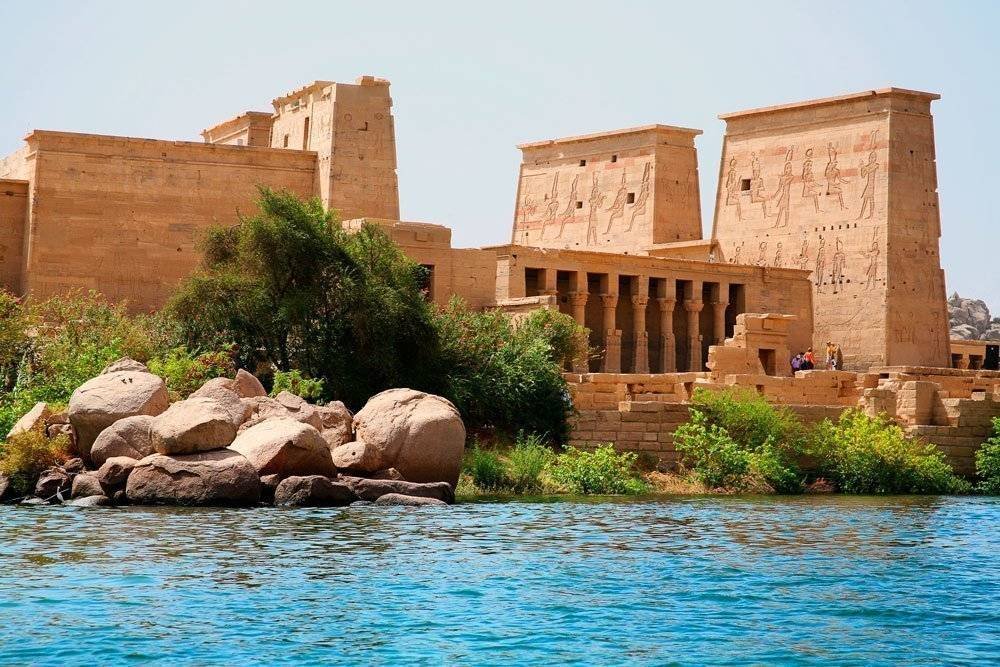
Philae Temple — more precisely, the Temple of Isis on the Island of Agilkia — is dedicated to Isis, one of ancient Egypt’s most beloved and enduring deities. Goddess of magic, healing, motherhood, and protection, Isis was worshiped across the ancient world for over 3,000 years. Her cult survived the arrival of Christianity in Egypt by several centuries, with the Philae temple complex serving as an active religious center until Emperor Justinian finally ordered it closed in 551 CE — making it literally the last functioning ancient Egyptian temple.
The main structure at Philae was built primarily during the Ptolemaic period (305–30 BCE) and the early Roman period. This late construction date explains both its excellent preservation and the hybrid quality of its art — combining pharaonic Egyptian traditions with Hellenistic and Roman influences in fascinating ways.
The Extraordinary Relocation Story
The most remarkable thing about Philae Temple in 2027 is not where it is, but where it isn’t. The original island of Philae — the “Pearl of Egypt,” as ancient travelers called it — lies permanently submerged beneath the waters of Lake Nasser, victim of the flooding that followed the construction of the first Aswan Dam in the early 20th century.
Between 1972 and 1980, in one of UNESCO’s most ambitious archaeological rescue operations, the entire Philae temple complex — every stone, every carved relief, every column drum — was cut apart, lifted out of the flood zone, and meticulously reconstructed on the nearby island of Agilkia, which was reshaped to replicate the topography of the original Philae.
The operation required 50 UNESCO member nations and $30 million (equivalent to over $100 million today). It is considered one of the greatest international cultural preservation achievements in history.
Today’s temple looks exactly as the ancient temple did. The reconstruction was so precise that the views, orientations, and spatial relationships between buildings were all preserved. What you are visiting is genuinely the ancient temple — just in a new location.
For the UNESCO documentation on the Philae rescue: UNESCO World Heritage — Philae.
The Key Structures at Philae
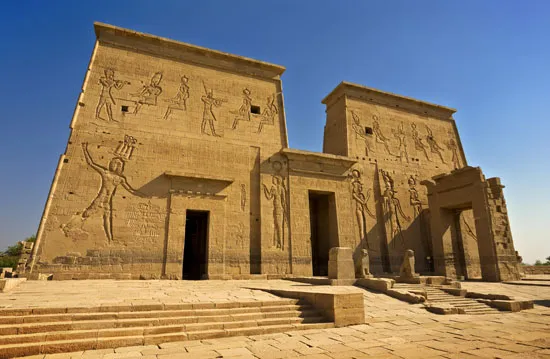
The Outer Temple Court and First Pylon
The main entrance to the Philae complex is through a long colonnade leading to the First Pylon — the great entrance gateway decorated with relief scenes of Ptolemy XII smiting his enemies before the gods. The scale and condition of these reliefs is excellent.
The Birth House (Mammisi)
A small temple celebrating the divine birth of Horus, son of Isis and Osiris. The wall reliefs showing the nursing of the infant Horus are particularly delightful — among the most charming images in ancient Egyptian art. Birth houses were a standard feature of Ptolemaic temples and represented the ritual perpetuation of the divine royal lineage.
The Temple of Isis (Main Temple)
The primary structure at Philae — a series of halls and chambers leading to the inner sanctuary of Isis. The painted reliefs on the walls and columns, in their Ptolemaic style, combine Egyptian religious iconography with a Hellenistic sensibility.
The inner sanctuary (the holiest space) contained a gilded boat housing the sacred statue of Isis. The boat was carried in procession on important festival days.
The Kiosk of Trajan (Pharaoh’s Bed)
The most photographed structure at Philae — an elegant open-sided pavilion with 14 columns topped by floral capitals, built by the Roman Emperor Trajan (98–117 CE). Despite its informal appearance (it was never completed, and the walls between the columns were never filled), the Kiosk of Trajan is one of the most graceful structures in late Egyptian architecture.
Its nickname, “Pharaoh’s Bed,” comes from the imaginative interpretation of early European travelers who saw it as a royal resting place.
The Coptic Church (Historical Layer)
Inside the main temple, early Coptic (Egyptian Christian) communities converted one of the halls into a church — carving crosses into the columns and erasing some pharaonic relief faces. This is not vandalism from a historical perspective but evidence of the living continuity of sacred space across religions — the same location was holy to Isis, then to Christ, then abandoned together.
The Philae Sound and Light Show
The official Sound & Light website currently lists Philae performances at 8:00 PM and 9:00 PM, with languages varying by day. It lists a regular ticket at US$20 and a child ticket for ages 6–12 at US$11. The site notes that dates are subject to change and that some second shows depend on minimum attendance.
Check the live schedule before arranging an evening visit: official Philae Sound & Light schedule.
Getting to Philae Temple
The temple is on an island accessible only by motorboat from the Shellal boat dock, approximately 6 km south of Aswan city center.
From the boat dock: Motorboats carry groups of visitors to the island landing dock (approximately 10 minutes). The boats are shared — you pay per person rather than renting an entire boat (though renting a private boat is possible for a premium).
Boat crossing: Boat charges are separate from the temple admission and can vary by arrangement. Agree the full return-boat price before boarding.
Current Philae admission: the Ministry of Tourism & Antiquities currently lists foreign adult entry at EGP 550 and foreign student entry at EGP 275. The optional temple panorama is listed at EGP 200 for foreign adults and EGP 100 for foreign students.
Aswan High Dam — Engineering That Changed Egypt
Why the Dam Was Built
For 7,000 years, the Nile’s annual flood cycle was the heartbeat of Egyptian civilization. Each year between June and September, the Nile flooded its banks, depositing nutrient-rich silt across the agricultural land and providing the water that made farming possible in a desert climate. The ancient Egyptians organized their entire calendar around the flood.
But the flood was also unpredictable. Too little water meant drought and famine — ancient records document years when the flood failed and mass starvation followed. Too much meant catastrophic flooding that destroyed crops, livestock, and communities.
The Aswan Low Dam, completed in 1902, was the first attempt to control the Nile’s behavior. But it was insufficient for Egypt’s rapidly growing population and agricultural needs in the mid-20th century. President Gamal Abdel Nasser decided to build something far more ambitious.
The High Dam: Vital Statistics
Construction began in 1960 with Soviet technical and financial support (the United States had withdrawn from the project over political disagreements). The dam was completed in 1971.
- Height: 111 meters
- Length: 3,830 meters
- Volume: 43 million cubic meters of material
- Reservoir (Lake Nasser): 5,250 km² surface area, 500 km long — one of the world’s largest artificial lakes
- Hydroelectric capacity: 2,100 megawatts — approximately 10 billion kilowatt-hours per year, representing a significant portion of Egypt’s electricity supply
- Cost: Approximately $1 billion in 1960s USD
What the Dam Achieved
Flood control: The annual Nile flood ended permanently. Egyptian agriculture became year-round rather than seasonal. Two or three harvests per year replaced one. Famine caused by flood failure became a historical memory.
Electricity: The dam’s hydroelectric stations generate electricity for millions of Egyptian homes and industries.
Irrigation: Lake Nasser stores enough water to sustain Egyptian agriculture through multiple years of low Nile flow.
Navigation: Year-round navigability of the Nile for commercial shipping.
The Human and Environmental Cost
The dam’s achievements came at significant cost:
Nubian displacement: Over 100,000 Nubian people were displaced from their ancestral villages south of Aswan, most of which are now permanently submerged under Lake Nasser. This displacement — which severed communities from their land, culture, and livelihoods — is considered one of Egypt’s most painful modern tragedies. The Nubian community’s story is documented at the Nubian Museum in Aswan.
Loss of Nile silt: The annual flood that deposited fertile silt on Egyptian agricultural land no longer occurs. Egypt’s Nile Delta is gradually losing fertility without the annual silt replenishment, requiring increasing amounts of artificial fertilizer.
Archaeological loss: Dozens of ancient sites, temples, and monuments were submerged by Lake Nasser. The international rescue operation to save what could be saved — including the Abu Simbel temples and the Philae temples — was the largest archaeological rescue in history.
Ecological impact: The loss of the annual flood has affected the ecology of the Nile Delta and the eastern Mediterranean, reducing the sardine catch off the Egyptian coast and altering coastal dynamics.
Visiting the High Dam
The dam is a working infrastructure facility and visits are from viewing areas rather than interior tours.
What to see:
- The dam’s scale viewed from the road/viewing platform
- Lake Nasser stretching to the horizon to the south
- The Aswan Low Dam (the original 1902 dam) visible to the north from certain viewpoints
- The Soviet-Egyptian Friendship Monument — a stylized lotus flower erected to commemorate Soviet-Egyptian cooperation in construction
Time needed: 30–45 minutes is sufficient.
Entrance: Approximately $5 USD.
Photography: Generally permitted from public viewing areas; military installations nearby prohibit photography of certain angles.
Combining Philae Temple and the High Dam
Most Aswan visitors combine both sites in a single half-day tour. The logical sequence:
Aswan High Dam first (30–45 minutes):
The dam is 3 km south of the Shellal boat dock for Philae — visit it first, then proceed directly to the boat dock.
Philae Temple second (1.5–2 hours):
The centerpiece of the combined visit. After the dam’s modern engineering context, Philae’s ancient religious architecture provides a powerful contrast.
Optional addition: Sound and Light Show (evening):
Return to Philae in the evening for the Sound and Light Show — arriving by boat in the dark for the dramatic first view of the illuminated island.
Practical Tips for Both Sites
Wear comfortable shoes. The Philae island has stone pathways that become slippery near water. Closed-toe shoes with grip are strongly recommended.
Bring sun protection. Philae island is mostly unshaded. SPF 50+, hat, and sunglasses are essential.
Negotiate your boat price before boarding. Shared boat rates are fixed; private boat rates are negotiable. Agree before stepping in.
Visit Philae in the late afternoon. The light on the honey-colored sandstone columns in the late afternoon is exceptional for photography. The evening Sound and Light Show extends the visit beautifully.
Hire a guide for Philae. The myths of Isis and Osiris, the story of the temple’s operation until 551 CE, and the detail of the UNESCO rescue operation are all significantly enriched by expert commentary.
External Resources
- UNESCO World Heritage — Nubian Monuments — Documentation of the Philae rescue and Nubian monuments
- Aswan High Dam history — Encyclopedia Britannica — Comprehensive dam history
- Nubian Museum Aswan — Museum dedicated to Nubian civilization and displacement
- EgyptAir Domestic Flights to Aswan — Flights from Cairo to Aswan
15 People Also Ask Questions About Philae Temple and the High Dam
1. Where is Philae Temple?
Philae Temple is on the island of Agilkia in the Nile River near Aswan, approximately 6 km south of Aswan city center. The island is accessible only by motorboat from the Shellal boat dock. The original Philae island is now submerged beneath Lake Nasser — the temple was relocated to Agilkia by UNESCO between 1972 and 1980.
2. Was Philae Temple moved?
Yes — in one of the greatest archaeological rescue operations in history. As the original Philae island was increasingly submerged by the rising waters of Lake Nasser after the construction of the first Aswan Dam, and then faced permanent submersion after the High Dam, UNESCO coordinated the relocation of the entire temple complex to the nearby island of Agilkia between 1972 and 1980. Every stone was numbered, removed, and precisely reconstructed.
3. What deity is Philae Temple dedicated to?
Philae Temple is primarily dedicated to Isis — one of ancient Egypt’s most important and widely worshiped deities, goddess of magic, healing, motherhood, and protection. Isis was one of the most enduring gods of the ancient world; her cult spread throughout the Roman Empire and her worship continued at Philae until 551 CE — 80 years after the official Christianization of Egypt.
4. When was the last ancient Egyptian temple in operation?
The Temple of Isis at Philae continued operating until approximately 551 CE, when the Byzantine Emperor Justinian I finally ordered it closed and converted to a Christian church. This makes it literally the last functioning ancient Egyptian temple — operating some 80 years after the rest of Egypt’s ancient temples had been officially closed following the Edict of Thessalonica (380 CE) that made Christianity the Roman Empire’s official religion.
5. What is the Kiosk of Trajan at Philae?
The Kiosk of Trajan, nicknamed “Pharaoh’s Bed,” is an elegant open-sided pavilion with 14 floral-capital columns built by the Roman Emperor Trajan around 100 CE. It was never completed — the spaces between columns were never filled. Despite its unfinished state, it is one of the most beautiful and photographed structures in late Egyptian architecture, combining Egyptian column forms with a Roman architectural sensibility.
6. What is the Aswan High Dam?
The Aswan High Dam (in Arabic: السد العالي, As-Sadd al-Aali) is a 111-meter high embankment dam across the Nile, completed in 1971 under President Nasser with Soviet assistance. It controls the Nile’s flow, prevents flooding, provides irrigation water for year-round agriculture, and generates approximately 2,100 megawatts of hydroelectric power. It created Lake Nasser — one of the world’s largest artificial lakes — at the cost of displacing over 100,000 Nubian people.
7. What happened to the Nubian people because of the High Dam?
The construction of the Aswan High Dam necessitated the displacement of over 100,000 Nubian people from ancestral villages south of Aswan, most of which are now permanently submerged under Lake Nasser. Families were relocated to areas north of Aswan without equivalent agricultural land or cultural infrastructure. This displacement is considered one of Egypt’s most painful modern tragedies and its consequences continue to affect Nubian communities.
8. Can you swim at Philae Temple?
No — Philae Temple is a protected archaeological site and swimming is not permitted. The boat crossing is by motorboat that docks at the island landing. Swimming in this section of the Nile is also not recommended due to boat traffic and currents.
9. How long does a visit to Philae Temple take?
A thorough visit to Philae Temple takes approximately 1.5–2 hours. This allows time to see the main temple, Birth House, Kiosk of Trajan, and colonnade. Combined with the boat crossing time (10 minutes each way), budget 2–2.5 hours from the boat dock.
10. Is there a Sound and Light Show at Philae?
Yes — one of Egypt’s most dramatic Sound and Light shows is held at Philae Temple on specific evenings. The show involves arriving by motorboat in the dark for a theatrical first view of the illuminated island, followed by a narrated light show telling the story of Isis and Osiris. Check current language schedules (English, French, Arabic) at your hotel or with Egypt Travel Ways.
11. Can I visit Philae Temple independently?
Yes — take any taxi from Aswan to the Shellal boat dock (approximately 6 km south of the city center), pay for a shared motorboat to the island, buy an entrance ticket at the gate, and explore independently. Alternatively, book through Egypt Travel Ways for transport, licensed guide, and Sound and Light Show tickets if desired.
12. Is the Aswan High Dam worth visiting?
Yes — a 30-45 minute stop provides context for one of the 20th century’s most consequential engineering decisions. The scale of the dam and the sight of Lake Nasser stretching to the horizon are genuinely impressive. Combined with the Philae Temple visit, the two sites create a powerful narrative about Egypt’s ancient and modern relationships with the Nile.
13. Is the original island of Philae visible?
The original Philae island is now mostly submerged beneath the waters between the Aswan Low Dam and the High Dam. The area between the two dams has variable water levels — during low water periods, parts of the original island may become visible above the waterline. The reconstructed temple on Agilkia is typically what visitors refer to as “Philae.”
14. What is the best time to visit Philae Temple?
Late afternoon (4:00–6:00 PM) for beautiful light on the sandstone and the possibility of transitioning to the evening Sound and Light Show. Morning visits (9:00–11:00 AM) are also good for photography before the heat peaks. Avoid midday in summer.
15. How do I combine Philae Temple and the High Dam in one day?
The standard Aswan day combination is: Aswan High Dam first (30–45 minutes) → drive 3 km to Shellal dock → motorboat to Philae Temple (1.5–2 hours) → optional evening return for Sound and Light Show. Add the Nubian village visit and a felucca sunset ride to create a comprehensive Aswan full-day experience.
Book Your Aswan Full Day Tour with Egypt Travel Ways
Egypt Travel Ways organizes private Aswan day tours combining the High Dam, Philae Temple, and the optional Sound and Light Show — with licensed Egyptologist guides and seamless transport logistics.
Contact Egypt Travel Ways today to book your Aswan Full Day Tour — Philae, High Dam & Nubian Village.