

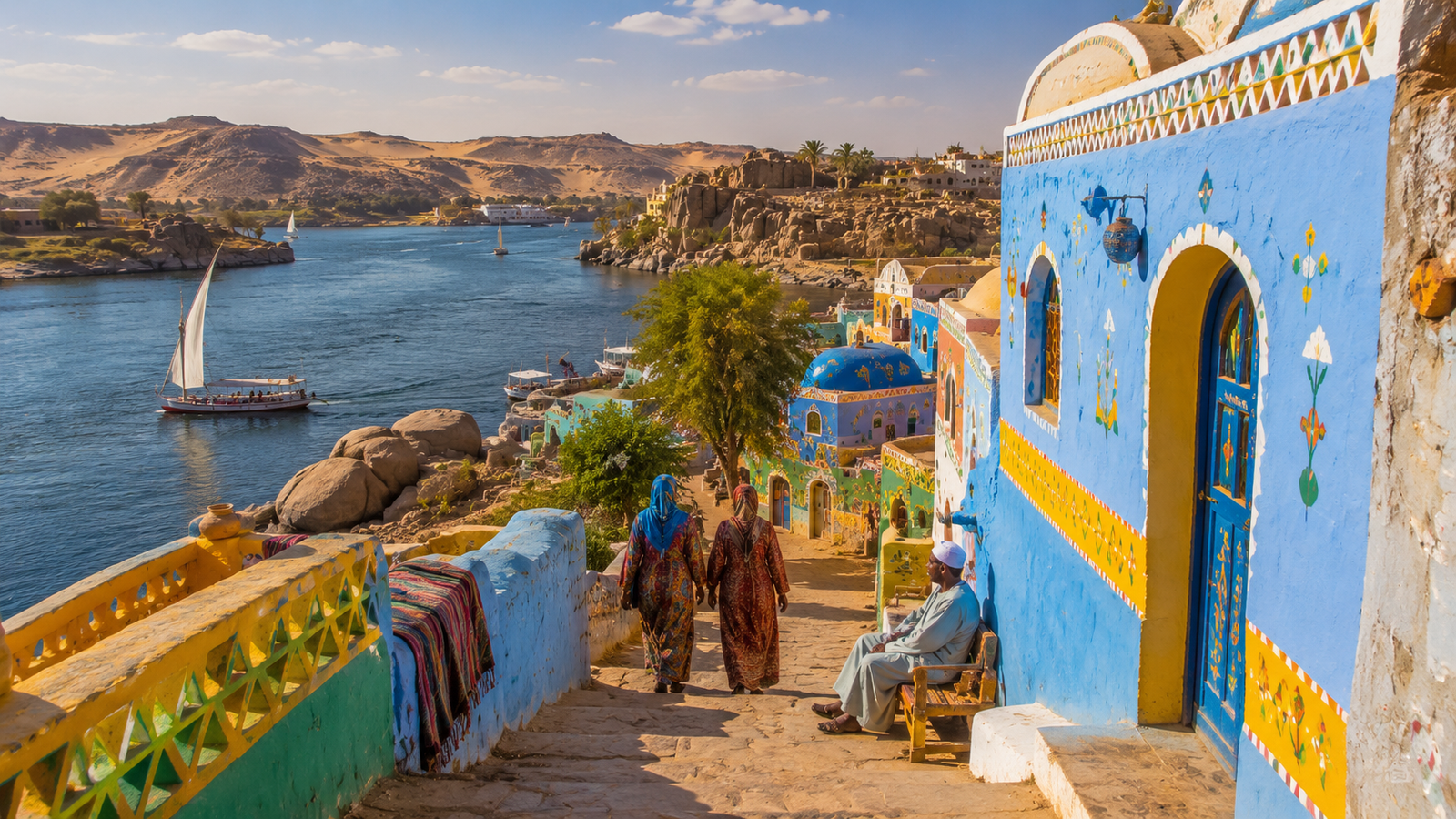
Nubian Village Aswan – A Complete Guide to Visiting
Nubian Village Aswan 2027 – How to Visit, What to Expect & Best Tours
Last fact-checked: 1 October 2026. Boat fares and tour prices are negotiated or operator-specific and can change quickly. Confirm the total before boarding or booking.
Aswan is Egypt’s most southern major city, and it has a character unlike anywhere else in the country. This difference is largely Nubian — the ancient civilization that flourished along the Nile south of Aswan for millennia, with its own language, culture, architecture, and traditions that are distinctly different from Arab Egyptian culture. Visiting a Nubian village from Aswan is one of the most culturally rich and visually distinctive experiences available in Egyptian tourism, and this complete 2027 guide tells you everything you need to know.
For context on Aswan’s other major attractions, see our Philae Temple & Aswan High Dam Guide and our Abu Simbel from Aswan Day Trip Guide.
Who Are the Nubians?
The Nubians are one of Africa’s oldest civilizations — their history along the Nile predates even pharaonic Egypt and intertwines with it throughout ancient history. Ancient Nubia (known to the Egyptians as “Kush” or “Wawat”) controlled vital trade routes for gold, ivory, ebony, and incense that the Egyptians depended upon. The relationship between Egypt and Nubia oscillated between conquest, trade, alliance, and cultural exchange over three millennia.
During the 25th Dynasty (approximately 747–656 BCE), Nubian kings actually conquered and ruled Egypt as pharaohs — the so-called “Black Pharaohs” — a period of remarkable cultural sophistication that produced some of ancient Egypt’s finest artistic work.
Modern Nubians in Egypt are the descendants of communities that lived along the Nile south of Aswan. Their culture maintains distinct elements: the Nubian language (related to Nilo-Saharan language families), a tradition of brightly painted houses in vivid blues, greens, and yellows, distinctive music and dance, specific culinary traditions, and a community structure based around extended family networks.
The displacement: One of modern Egypt’s most painful chapters involves the Nubian displacement caused by the construction of the Aswan High Dam (1960–1971). As Lake Nasser filled behind the dam, over 100,000 Nubian people lost their ancestral villages — most of which now lie beneath the lake’s waters. Many were resettled in areas north of Aswan that lack the agricultural land, cultural landmarks, and community cohesion of their original homes. This displacement is a source of ongoing grief and cultural loss that Nubian communities continue to navigate.
How to Get to the Nubian Village
Most Nubian villages visited from Aswan are located on the banks of the Nile or on islands near the city. The two most common ways to reach them:
By Motorboat
The most common and convenient option. Motorboats operate from the Aswan Corniche waterfront, taking visitors to the nearest Nubian village communities. The crossing takes approximately 15–20 minutes.
Cost: Boat fares vary by departure point, waiting time, route and whether the boat is shared or private. Agree the full return price, waiting time and drop-off point before boarding.
Booking: Through your hotel, through a reputable tour operator like Egypt Travel Ways, or directly from boat operators on the Corniche waterfront.
By Felucca
For a more atmospheric approach, take a traditional felucca (a wooden sailboat) from Aswan to the Nubian village area. The slower pace and silence of a sailing vessel contrasts beautifully with the motorboat option.
See our Felucca Ride on the Nile Guide for details on arranging felucca transport.
As Part of a Guided Tour
The easiest option, particularly for first-time visitors. Egypt Travel Ways organizes Aswan tours that combine the Nubian village with Philae Temple, a felucca sunset ride, and other Aswan highlights — all logistics handled. See contact us to book.
What to Expect at the Nubian Village
The Architecture
The most immediately striking thing about Nubian villages is the extraordinary color. Houses are painted in vivid blues, greens, pinks, yellows, and geometric patterns — a visual tradition with practical and spiritual dimensions. The blue in particular is associated with protection against the “evil eye” and reflects sky and Nile water, creating a distinctive aesthetic quite unlike any other Egyptian architecture.
Many homes have hand-painted murals on exterior walls depicting significant life events — the Hajj (pilgrimage to Mecca), boats, family portraits, and geometric patterns. These murals are both decorative and communicative, announcing the family’s history and values to the community.
The houses are typically built around a central courtyard — a shaded communal space where family activities take place. Some visitor-oriented homes display crocodiles as part of local tradition and tourism. Treat them as wild animals rather than pets and avoid handling them.
Meeting Families and Community Life
Unlike many tourist attractions, a Nubian village visit involves genuine cultural encounter. Visitors are typically welcomed into family homes, offered Nubian hospitality (tea, sometimes food), shown the living spaces, and given the opportunity to talk with family members.
Nubian tea: The traditional welcome is a glass of tea — often with fresh mint, hibiscus, or spices. It is both a genuine gesture of hospitality and a cultural ritual. Accepting it politely is the appropriate response.
Crocodiles: Some homes or visitor stops display crocodiles. For safety and animal welfare, do not handle, hold or pose with them. You can still learn about the tradition without direct contact.
Music and Dance
Nubian music is distinctly different from mainstream Egyptian Arabic music — it uses different scales, instruments (including the kora, similar to a West African instrument), and rhythmic patterns. Traditional Nubian musical performances are sometimes arranged for tour groups, or you may encounter spontaneous music during village visits.
What to Buy at the Nubian Village
The village has small shops and stalls selling Nubian crafts and produce. Worth considering:
Nubian textiles and baskets: Handwoven palm leaf baskets and woven textile items in distinctive geometric patterns.
Henna: Traditional Nubian henna body painting — intricate geometric patterns quite different from Arabic henna designs. Many women in the village offer henna services.
Local food products: Hibiscus (karkade), locally grown spices, Nubian cooking pastes and preserves.
Handmade jewelry: Silver and beaded jewelry in traditional Nubian styles.
Pottery: Hand-thrown and decorated pottery items in traditional forms.
Prices and bargaining: Prices in the Nubian village are generally more reasonable than in Aswan’s main market and significantly more reasonable than in Cairo’s tourist markets. Light bargaining is acceptable; aggressive haggling is inappropriate in a community context.
Food and Eating in the Nubian Village
Many Nubian village visits include or offer traditional Nubian food:
Fool bel lamoun (fava beans with lemon): A Nubian variation on Egypt’s national breakfast dish.
Asida: A thick porridge made from ground sorghum, often served with a stew of dried fish or meat — a staple of traditional Nubian cuisine.
Grilled Nile fish: Tilapia and other Nile fish grilled fresh — the fish of the Nile has been central to Nubian cooking for millennia.
Karkade (hibiscus tea): Cold or hot hibiscus tea — brightly crimson, slightly tart, and refreshing.
Nubian bread: Flatbreads baked in traditional clay ovens.
Some tours arrange lunch at a Nubian family home — an extraordinary experience that provides insight into domestic Nubian life and food culture.
Best Time for a Nubian Village Visit
Morning visits (9:00–11:00 AM): Community is active, morning light is excellent for photography, and the village has maximum energy.
Sunset visits (4:00–6:00 PM): The most atmospheric time — golden light on the painted houses, the Nile glittering, families gathering in courtyards. Combining a Nubian village visit with a sunset felucca ride creates one of Aswan’s most beautiful experiences.
Season: October through April is ideal for weather. Summer visits (June–August) are hot but possible — the village itself provides shade and the water provides cooling.
Combining the Nubian Village with Other Aswan Sites
A complete Aswan day typically combines:
Morning: Aswan High Dam (30 minutes) + Philae Temple (1.5 hours)
Midday: Aswan market and Corniche lunch
Afternoon/Sunset: Nubian village visit + felucca sunset ride
This creates a rich, varied day combining the ancient (Philae), the modern historical (High Dam), and the culturally immersive (Nubian village).
Tips for a Respectful and Enjoyable Visit
Ask permission before photographing individuals. Nubian communities welcome photography of their architecture and general scenes, but photographing individuals — particularly women — without asking first is impolite. A smile and gesture toward your camera, with “mumkin?” (Arabic for “may I?”) is sufficient.
Dress modestly. As with all non-resort areas of Egypt, covered shoulders and knees are respectful. Light, loose clothing is practical in the heat.
Accept hospitality graciously. If you are offered tea or a tour of the home, accepting politely honors the cultural tradition of Nubian hospitality. If you genuinely cannot eat or drink something offered, a gentle “shukran, ana shabaaan” (thank you, I’m full/satisfied) is acceptable.
Buy something if you enter a shop. Not obligatory, but visiting a small Nubian craft shop and leaving without any purchase when the shopkeeper has given you their time is considered rude. Small items (a basket, a bag of hibiscus, a small ceramic piece) are affordable and meaningful.
Tip your boat operator. Boat operators earn their living from tips and fares. A tip of 20–50 EGP per person is appropriate and appreciated.
External Resources
- Nubian Museum Aswan — Excellent museum dedicated to Nubian civilization, located in Aswan
- UNESCO — Nubian Monuments — Documentation of Nubian cultural heritage
- Human Rights Watch — Nubian Displacement — Background on the Nubian displacement issue
- Ancient Egypt Online — Nubia — History of ancient Nubia and its relationship with Egypt
15 People Also Ask Questions About Nubian Villages in Aswan
1. What is a Nubian village?
A Nubian village is a settlement of the Nubian people — an ancient African civilization with roots along the Nile south of Aswan. Nubian villages near Aswan are characterized by brightly painted houses in vivid blues, greens, and yellows, a distinctive culture with its own language and traditions, and a warm hospitality tradition. Visiting a Nubian village from Aswan gives insight into one of Egypt’s most distinctive indigenous cultures.
2. How do I visit a Nubian village from Aswan?
The most common way is by motorboat from the Aswan Corniche waterfront (15–20 minutes crossing, approximately 50–150 EGP). Felucca sailboats are a more atmospheric alternative. Most visitors book through their hotel or a tour operator like Egypt Travel Ways, who organize combined tours including Philae Temple, the Nubian village, and a sunset felucca ride.
3. Is it safe to visit a Nubian village in Aswan?
Yes, Nubian village visits are very safe. These are welcoming community tourism destinations, and Nubian communities have a strong tradition of hospitality. The main considerations are cultural respect (dress modestly, ask before photographing individuals) rather than any safety concern.
4. What can I do at a Nubian village?
Activities at Nubian villages include: touring painted family homes, holding pet crocodiles for photographs, buying handmade crafts (baskets, textiles, jewelry), trying traditional Nubian food and hibiscus tea, watching or participating in traditional Nubian music, and getting traditional henna body painting.
5. Can I hold a crocodile at the Nubian village?
Yes — many Nubian households keep small, domesticated Nile crocodiles (typically juveniles of 60–90 cm) as symbols of good fortune. Visitors are usually invited to hold them for photographs. This is a longstanding Nubian cultural practice. If you prefer not to handle a crocodile, simply decline politely.
6. What should I wear to visit a Nubian village?
Modest dress is appropriate — covered shoulders and knees for both men and women. Light cotton or linen clothing is comfortable in the heat. A headscarf is not required but some women carry one as a courtesy. Comfortable shoes are recommended as the village pathways are sometimes sandy or uneven.
7. How long should I spend at the Nubian village?
A typical visit lasts 1.5–2 hours. This allows time to tour one or two homes, visit craft shops, eat and drink, and take photographs. If you arrange a Nubian lunch as part of your visit, add 1 hour.
8. Where is the Nubian village in Aswan?
Most Nubian villages visited from Aswan are on the western bank of the Nile or on islands near the city center. They are accessible by a short motorboat or felucca ride from the Aswan Corniche waterfront. Your hotel or tour operator can direct you to the appropriate departure point.
9. Is there a Nubian museum in Aswan?
Yes — the Nubian Museum in Aswan is one of Egypt’s finest regional museums, dedicated entirely to Nubian civilization from prehistoric times through the modern era. It provides excellent context for understanding Nubian culture before or after a village visit. The museum is particularly moving in its documentation of the displacement caused by the construction of the Aswan High Dam.
10. What food can I try at a Nubian village?
Traditional Nubian food you may encounter: asida (thick sorghum porridge with stew), grilled Nile fish (tilapia), fool bel lamoun (fava beans with lemon), fresh Nubian flatbread, and the ubiquitous karkade (hibiscus tea). Some tours arrange traditional Nubian family lunches — an extraordinary cultural experience.
11. Why are Nubian houses so colorful?
The brilliant colors of Nubian houses — particularly vivid blues, greens, and yellows — reflect a rich decorative tradition that combines aesthetic preference, community identity, and spiritual beliefs. Blue is associated with protection against the “evil eye” and connects to sky and river. The hand-painted murals on house walls communicate family history and significant life events to the community.
12. What happened to the Nubian people because of the Aswan High Dam?
The construction of the Aswan High Dam (1960–1971) and the subsequent creation of Lake Nasser forced the displacement of over 100,000 Nubian people from their ancestral villages south of Aswan, most of which are now submerged under the lake. Families were relocated to areas north of Aswan that lacked the agricultural land, community bonds, and cultural infrastructure of their original homes. This displacement is regarded as a cultural tragedy and its legacy continues to affect Nubian communities in Egypt and Sudan.
13. Is it appropriate to photograph Nubian villages?
Photography of Nubian architecture, painted houses, and general village scenes is welcomed. For photographing individuals — particularly women — always ask permission first. A smile and “mumkin?” (Arabic for “may I?”) is the appropriate way to seek consent. Children often enjoy being photographed and will crowd around your camera; adults deserve more consideration of personal preferences.
14. Can I combine the Nubian village with a felucca ride?
Yes — and this is one of the most popular and beautiful Aswan experiences. A felucca sail to the Nubian village at sunset combines the serenity of traditional Nile sailing with the cultural richness of the village visit, arriving as the evening light turns golden on the painted houses. Egypt Travel Ways organizes this combined experience as part of our Aswan tours.
15. How much does a Nubian village tour cost?
Prices vary by boat type, guide, waiting time, included stops and whether the tour is private or shared. Ask for the current total and a written list of inclusions before booking.
Book Your Nubian Village Tour with Egypt Travel Ways
Egypt Travel Ways organizes private Aswan experiences combining the Nubian village with a felucca sunset sail — creating one of the most beautiful and culturally rich afternoons available in all of Egyptian tourism.
Contact Egypt Travel Ways today to book your Aswan Nubian Village & Felucca Sunset Tour.

Recent Posts
Tipping in Egypt (2026–2027): Guides, Drivers, Nile Cruises & Hotels
What’s Included in an Egypt Nile Cruise? Cruise-Only vs Guided Packages
Grand Egyptian Museum vs Egyptian Museum vs NMEC: Which Should You Visit?
All Categories
- Abu Simbel
- Abu Simbel from Aswan
- Airport
- Articles
- Aswan
- Best Time to Visit Egypt
- cairo
- Coptic Cairo
- Desert & Oasis
- Dive into the Magic of Sharm’s Underwater World
- Egypt Honeymoon Guide
- Egypt Safari
- Egypt Tourist Scams
- Egypt Travel Budget
- Egypt Travel Planning
- Felucca Ride on the Nile
- Grand Egyptian Museum
- Honeymoon
- hot air balloon luxor egypt
- Hurghada
- Is Egypt Safe for Tourists
- Islamic Cairo Walking
- Karnak Temple
- Khan El Khalili Bazaar
- luxor egypt
- Nile Cruise
- Nubian Village Aswan
- old cairo
- pyramids giza
- Sharm El Sheikh
- Siwa Oasis
- Siwa’s Simplicity
- Solar Eclipse Egypt
- The White Desert A Dream Sculpted by Time
- The Wonders of Saqqara
- Transport
- tutankhamun treasures
- Uncategorized
- White Desert Egypt Safari