Abu Simbel from Aswan Day Trip 2027 – Tours, Flights & Complete Guide
Last fact-checked: 1 October 2026. Road arrangements, flight schedules and fares can change. Abu Simbel ticket prices and opening times are covered in our separately maintained Abu Simbel visitor guide.
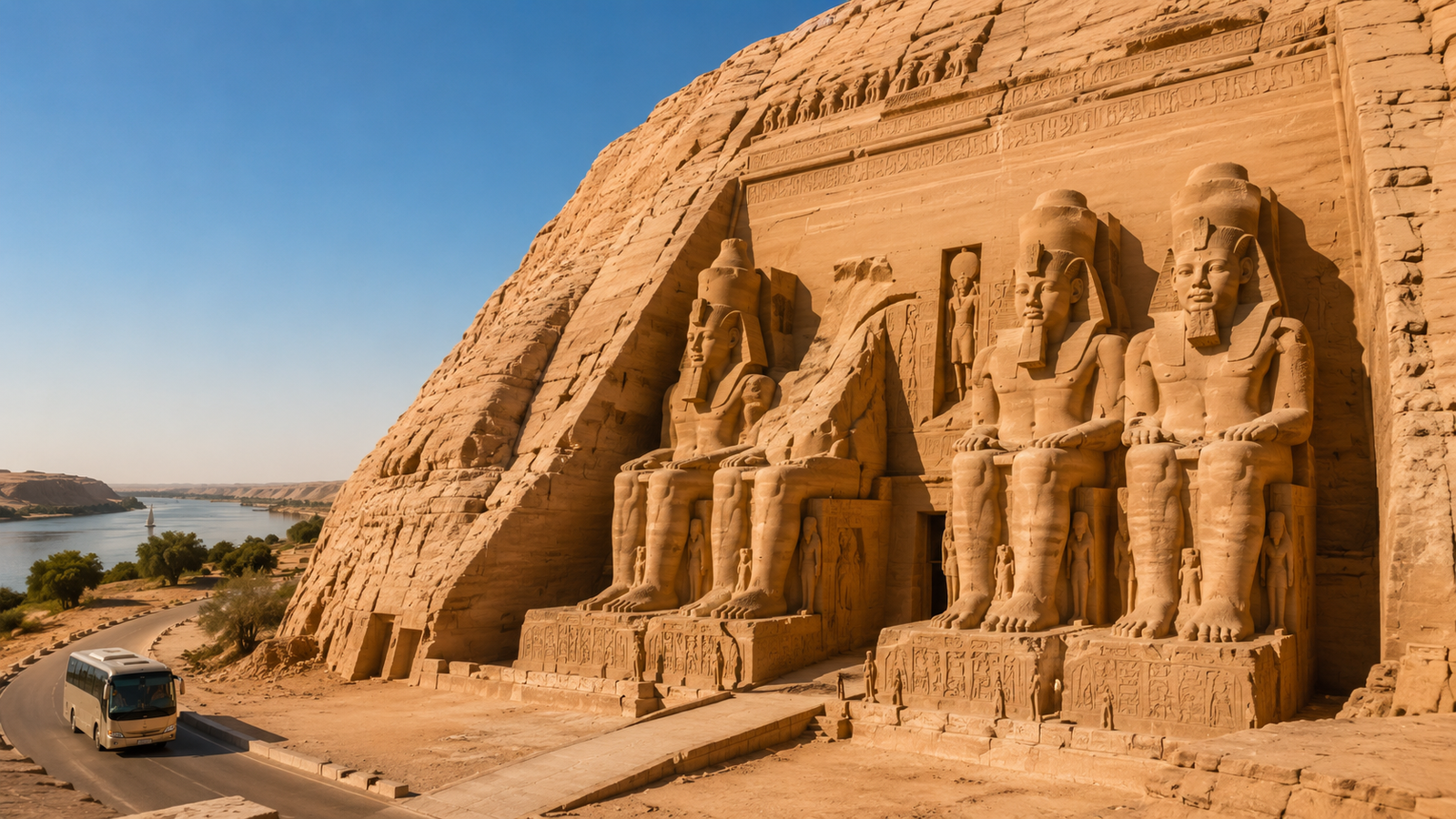
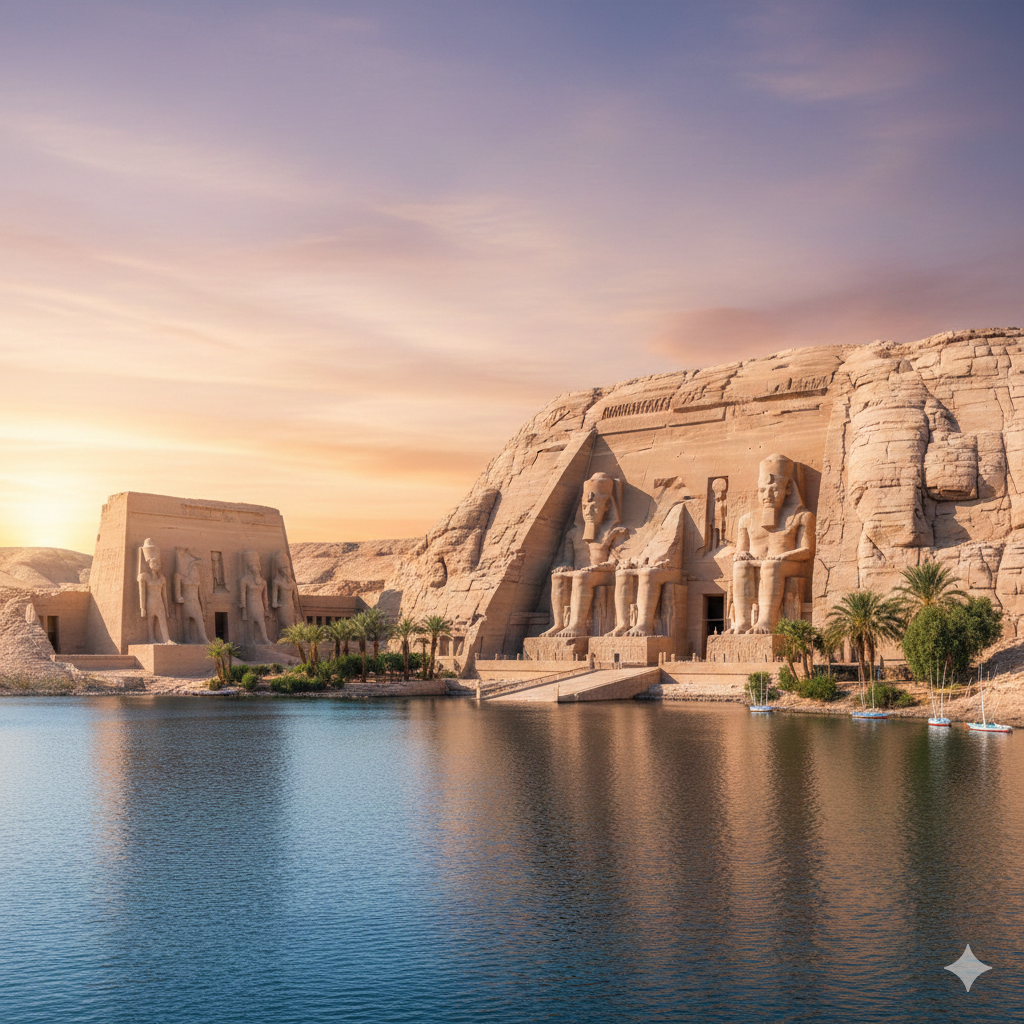
Abu Simbel is not merely impressive — it is jaw-dropping. Four colossal seated statues of Ramesses II, each standing 20 meters tall, guard the entrance to a temple carved entirely into a sandstone cliff overlooking Lake Nasser. The scale is almost incomprehensible until you’re standing in front of it, watching other tourists become tiny figures at the statue’s feet. And then there is the story of the temples themselves — moved, stone by stone, to save them from rising floodwaters in one of the 20th century’s most extraordinary engineering achievements.
A day trip from Aswan to Abu Simbel is one of the greatest excursions available in Egyptian tourism, and this complete 2027 guide tells you everything you need to know to make it unforgettable.
For broader planning context, see our Aswan High Dam and Philae Temple Guide and our comprehensive Egypt 10-Day Itinerary.
Why Abu Simbel Is Worth the Journey
Built by Ramesses II around 1264 BCE, the Great Temple of Abu Simbel was one of the most ambitious construction projects in ancient Egypt. Its purpose was clear: to announce Egyptian power to Nubia and the lands beyond, to demonstrate the divine status of the pharaoh, and to honor the gods Ra, Amun, and Ptah.
The four seated statues at the entrance — each 20 meters tall, carved directly from the living rock — are the largest free-standing statues ever created in ancient Egypt. Between the legs of the statues stand smaller figures of Ramesses’ family, dwarfed to ankle height by the pharaoh’s colossal scale.
Inside, the temple extends 63 meters into the cliff. Painted reliefs cover every surface — battle scenes, ritual offerings, images of gods and pharaohs — executed with extraordinary skill and remarkable preservation.
The smaller temple beside the great one was built by Ramesses for his beloved queen, Nefertari, and the goddess Hathor. This gesture was extraordinary — temples were almost never dedicated to queens — and the six standing figures on its facade (four of Ramesses, two of Nefertari) are among the most graceful sculptures in ancient Egyptian art.
The Greatest Engineering Story
What makes Abu Simbel’s story uniquely modern as well as ancient is the UNESCO rescue operation of 1964–1968. As the Aswan High Dam rose and Lake Nasser began to fill behind it, both temples faced permanent submersion. The international response was unprecedented.
An international consortium, coordinated by UNESCO, undertook one of the most technically complex and logistically challenging archaeological rescue operations in history. Both temples were cut into blocks weighing up to 30 tons each, and every single block was numbered, lifted out, and reassembled 65 meters higher on an artificial hill specifically constructed to replicate the original cliff face. The entire operation took four years and cost approximately $42 million (equivalent to several hundred million today).
The result is that the temples look exactly as they did in antiquity — except that the cliff behind them is artificial, and the original location is now under 40+ meters of water.
For further reading on the UNESCO rescue: The UNESCO World Heritage Centre documentation on Abu Simbel provides comprehensive details on both the original construction and the relocation.
Getting from Aswan to Abu Simbel
Abu Simbel is 280 km south of Aswan, on the shores of Lake Nasser near the Sudanese border. There are two main ways to make the journey:
Option 1: By Plane ✈️ — HIGHLY RECOMMENDED
Duration: 45 minutes each way
By air: Domestic schedules and fares vary by date. Check the live EgyptAir timetable for your travel day rather than relying on a fixed departure time or fare.
Airline: EgyptAir
Why this is the better option:
- You arrive at Abu Simbel at 7:00–8:00 AM, before the heat and the crowds
- You have 3–4 hours at the temples rather than 1.5–2 hours
- The aerial views of Lake Nasser from the plane are spectacular
- You’re back in Aswan by noon, with the entire afternoon free
Booking: Book through EgyptAir directly or through Egypt Travel Ways as part of a combined Aswan + Abu Simbel package.
Option 2: By Road Convoy 🚌
Duration: 3.5 hours each way (7 hours total driving)
Cost: $20–50 USD per person (shared vehicle) to $100–150 USD (private car)
Departure: The police-escorted convoy departs Aswan at 3:30 AM and again at 11:00 AM. Most tours take the 3:30 AM convoy.
How the convoy works: For security on the remote desert road, vehicles traveling to Abu Simbel must join a police-escorted convoy at designated checkpoints. Independent vehicles cannot travel to Abu Simbel outside these convoy times.
The experience: The early convoy departs Aswan in the middle of the night, drives through 280 km of Nubian desert (increasingly dramatic as dawn approaches), and arrives at Abu Simbel around 7:00–8:00 AM. After approximately 2 hours at the temples, the return convoy departs and you’re back in Aswan by early afternoon.
Choosing between road and air: Flying can reduce road time when the schedule works, while a road transfer is simpler to arrange on many dates. Compare the live flight schedule, total door-to-door time, price and your preferred pace.
Entrance Fees (2027)
Use the current official ticket price rather than a USD estimate. Our Abu Simbel tickets and opening-hours guide was fact-checked on 1 October 2026 and links directly to the official monument booking platform.
The Great Temple of Ramesses II — A Detailed Guide
The Facade
The four colossal seated statues of Ramesses II are the most immediately imposing thing about Abu Simbel. At 20 meters each, they would have been visible across the Nile from a great distance — an intentional statement of pharaonic power to travelers approaching by water from Nubia.
The third statue from the left was damaged in antiquity by an earthquake; its upper section collapsed and still lies at the statue’s feet, partially restored. This accident gives the site a human dimension — reminding you that even a pharaoh who saw himself as a living god could not prevent the forces of nature.
Between the legs and beside the statues stand smaller figures of Ramesses’ family: his mother Tuya, his wife Nefertari, and several of his children — all reduced to ankle height beside the pharaoh’s divine scale.
Above the entrance is a niche containing a relief of the falcon-headed sun god Ra-Horakhty. The name Ramesses II, written in hieroglyphs, forms a visual pun with this figure — a sophisticated piece of royal propaganda embedded in the architecture itself.
The Interior
The temple extends 63 meters into the cliff, descending through successive halls to the innermost sanctuary.
First Hypostyle Hall: Eight columns in the form of Osiris (the god of death and rebirth), each bearing the face of Ramesses, line the main corridor. The walls carry relief scenes of Ramesses’ military campaigns — the most famous being the Battle of Kadesh (approximately 1274 BCE), the largest chariot battle in ancient history.
Second Hypostyle Hall: A smaller chamber with four columns and more ritual scenes. The painted colors here are remarkably vivid.
Vestibule: The transitional space before the inner sanctuary, with scenes of Ramesses making offerings to the gods.
Inner Sanctuary: The holiest space in the temple — four statues sitting side by side in the darkness: Ra-Horakhty, Ramesses II himself, Amun-Ra, and Ptah. On two days per year (February 22 and October 22), the rising sun penetrates the entire length of the temple to illuminate three of these four statues (Ptah, the god of darkness, remains in shadow even on these days). This solar alignment is one of the most extraordinary architectural achievements in ancient Egypt.
The Solar Alignment Events
If you can arrange to be at Abu Simbel on February 22 or October 22, witnessing the solar alignment — when the rising sun’s light travels 63 meters through the temple to illuminate the inner statues — is one of the most remarkable things you can experience in Egypt.
These dates were traditionally associated with Ramesses’ birthday (February 22) and his coronation (October 22). Large crowds gather for both events. Book accommodation at Abu Simbel’s small lodge months in advance for these dates — demand far exceeds supply.
The Temple of Hathor (Nefertari’s Temple)
The smaller temple to the north of the Great Temple was dedicated by Ramesses to his Great Royal Wife, Nefertari, and to the goddess Hathor. Its scale (29 meters wide, 12 meters high) is modest compared to the Great Temple but its construction was deeply significant: dedicating an entire temple to a queen was almost unprecedented.
Six standing figures on the facade — four of Ramesses and two of Nefertari — are depicted at equal scale, an extraordinary gesture of honor to the queen. The accompanying inscription reads: “For whom the sun does shine.”
Inside, the decoration focuses on Hathor’s mythology and the divine role of the queen. The colors are better preserved here than in the Great Temple.
Best Time to Visit Abu Simbel
Time of day: Early morning (7:00–9:00 AM) is ideal — cooler temperatures, better light for photography, and fewer crowds. Most tour groups arrive later in the morning.
Season:
Special dates:
- February 22: Solar alignment event — spectacular but very crowded
- October 22: Second solar alignment — similar conditions
Photography at Abu Simbel
The facade of the Great Temple is best photographed in the early morning (7:00–8:00 AM) when the light falls at an angle that emphasizes the depth and texture of the carved statues. Midday sun creates flat, harsh shadows.
Best shots:
- Full facade at a distance (need a wide-angle lens for all four statues)
- Close-up of individual statues — stand at the base and look up
- Interior corridor shots (bring a high-ISO camera — flash is not permitted)
- The smaller Nefertari temple with the Great Temple partially visible in the background
- Lake Nasser viewpoint — the artificial hill backdrop with the lake beyond
Photography inside: Flash is prohibited. Use ISO 3200–6400 and a steady hand or lean against a column.
Practical Tips for Your Abu Simbel Visit
If you plan to fly, check the schedule early. Domestic availability varies by date. Book through EgyptAir once your Aswan dates are fixed and keep enough buffer around transfers.
Arrive at the temples before 9:00 AM. The site becomes noticeably more crowded as the morning progresses and tour groups from the convoy arrive.
Bring water and snacks. Food options near the temples are limited and expensive. Pack your own supplies from Aswan.
Sun protection is essential. Even in winter, the sun at Abu Simbel is intense. SPF 50+, hat, and sunglasses are mandatory.
Allow 2–3 hours at the site. A rushed 90-minute visit covers the basics; 2.5–3 hours allows a thorough exploration of both temples and the lake viewpoint.
Visit the Lake Nasser viewpoint. Walk around to the back of the artificial hill for spectacular views of the lake and a different perspective on the temples’ relocated position.
Combining Abu Simbel with Other Aswan Experiences
Abu Simbel is typically combined with other Aswan sites for a comprehensive visit. See our guides:
External Resources
- UNESCO World Heritage — Abu Simbel Temples — Official UNESCO documentation
- NASA Eclipse Explorer — For the 2027 Solar Eclipse path that passes near Abu Simbel
- EgyptAir Domestic Flights — Book Aswan to Abu Simbel flights
- Ancient Egypt Online — Abu Simbel — Historical and archaeological information
15 People Also Ask Questions About Abu Simbel
1. Is Abu Simbel worth visiting from Aswan?
Absolutely yes. Abu Simbel is consistently rated among Egypt’s top three attractions (alongside the Pyramids and the Valley of the Kings) and is one of the most dramatic ancient sites in the world. The journey from Aswan is long, but the temples themselves are completely extraordinary and the UNESCO relocation story adds a remarkable modern dimension to the experience.
2. How do I get from Aswan to Abu Simbel?
The main options are a domestic flight when a suitable service operates, or a road transfer from Aswan. By road, allow roughly three to four hours each way. Check the live flight schedule and current road departure arrangements before choosing.
3. How long does the Abu Simbel trip take from Aswan?
By plane: approximately 5–6 hours total (early morning departure, ~45 min flight each way, 2.5–3 hours at the temples, return by noon). By road convoy: a full day (depart 3:30 AM, arrive back mid-afternoon after 7 hours of driving plus temple time).
4. What is the best time to visit Abu Simbel?
Early morning year-round, ideally 7:00–9:00 AM before crowds and heat build up. October through April is the most comfortable season temperature-wise. February 22 and October 22 are special solar alignment dates worth planning around if your schedule allows.
5. What is the Abu Simbel solar alignment?
On two days per year — February 22 and October 22 — the rising sun aligns perfectly with the temple’s axis, and its light travels the full 63-meter length of the Great Temple to illuminate three of the four innermost sanctuary statues. These dates are traditionally associated with Ramesses II’s birthday and coronation. It is one of the most sophisticated astronomical achievements in ancient architecture.
6. Were the Abu Simbel temples moved?
Yes — between 1964 and 1968, both temples were cut into approximately 1,040 blocks weighing up to 30 tons each, moved 65 meters higher up the cliff, and precisely reassembled on an artificial hill above the rising waters of Lake Nasser. The operation was coordinated by UNESCO and cost approximately $42 million. The relocation preserved the temples’ original orientation including the solar alignment phenomenon.
7. How tall are the statues at Abu Simbel?
The four colossal seated statues of Ramesses II on the facade of the Great Temple each stand 20 meters (65 feet) tall. They are the largest free-standing statues ever created in ancient Egypt. Between and beside the statues stand smaller figures of Ramesses’ family — dwarfed to ankle height by the pharaoh’s divine scale.
8. Can I see Abu Simbel without a tour?
Yes — you can hire a private taxi or book a flight independently and visit Abu Simbel independently. If traveling by road, confirm any current checkpoint or departure procedures with your licensed transport provider. Many visitors find that booking through a tour operator (like Egypt Travel Ways) simplifies logistics considerably, particularly when combining the Abu Simbel trip with other Aswan sites.
9. Is Abu Simbel inside Egypt or Sudan?
Abu Simbel is inside Egypt, approximately 50 km north of the Sudanese border, on the shores of Lake Nasser. The site is well within Egyptian territory and fully accessible with a standard Egyptian tourist visa.
10. How much does the Abu Simbel trip cost?
The total depends on the live airfare or transfer quote plus the current official temple ticket. Compare the complete price for your date, including hotel pickup, guide and entrance if applicable.
11. What is the smaller temple at Abu Simbel?
The Temple of Hathor, also known as Nefertari’s Temple, is the smaller temple at Abu Simbel. It was built by Ramesses II in honor of his beloved Great Royal Wife, Nefertari, and the goddess Hathor. Its facade shows six standing figures (four Ramesses, two Nefertari) at equal scale — an extraordinary honor for a queen. The interior contains beautiful painted reliefs focused on Hathor’s mythology.
12. Is photography allowed inside Abu Simbel?
Photography is permitted at Abu Simbel, including inside the temples. Flash photography is prohibited to protect the painted reliefs. For indoor photography, use a high ISO setting (3200–6400) and a steady hand or lean against a column for support.
13. What is Lake Nasser at Abu Simbel?
Lake Nasser is the enormous artificial lake created by the damming of the Nile at Aswan by the Aswan High Dam (completed 1970). It is the world’s largest artificial lake by surface area — approximately 5,250 square kilometers — and extends from Aswan in Egypt approximately 550 km south into Sudan. The rising waters of Lake Nasser in the 1960s threatened to permanently submerge the Abu Simbel temples, triggering the UNESCO rescue operation.
14. Can I combine Abu Simbel with a Nile cruise?
Some extended Nile cruises (particularly those operating on Lake Nasser rather than the main Nile) include Abu Simbel as part of their itinerary. Standard Luxor-to-Aswan Nile cruises do not include Abu Simbel, but operators (including Egypt Travel Ways) can organize a flying day trip from Aswan at the end of your cruise.
15. Who built Abu Simbel and when?
Abu Simbel was built by the ancient Egyptian Pharaoh Ramesses II (also known as Ramesses the Great) during his reign of approximately 1279–1213 BCE. Construction began around 1264 BCE and took approximately 20 years to complete. Ramesses II is considered one of Egypt’s greatest pharaohs — he ruled for 66 years, fought numerous military campaigns, and commissioned more statues, temples, and monuments than any other Egyptian ruler.
Book Your Abu Simbel Day Trip with Egypt Travel Ways
Egypt Travel Ways organizes private Abu Simbel day trips from Aswan by both plane and road convoy, handling all logistics — flight booking, airport transfers, temple entrance, and licensed guide.
Contact Egypt Travel Ways today to book your Abu Simbel day trip — one of the most extraordinary experiences Egypt has to offer.