Nile Cruise Luxor to Aswan 2027 – The Complete Guide
Last fact-checked: 1 October 2026. Nile cruise sailing days, embarkation times, included excursions and prices vary by ship and season. Treat sample itineraries as typical patterns, not guaranteed schedules.
A Nile cruise between Luxor and Aswan is widely regarded as one of the greatest travel experiences on Earth. For thousands of years, the Nile has been the lifeblood of Egypt — and traveling along its ancient waters between two of the world’s most important archaeological cities is an experience that combines extraordinary history, genuine luxury, and breathtaking natural beauty in a way that no other journey can replicate.
If you are planning a trip to Egypt in 2027, a Nile cruise deserves a central place in your itinerary. This comprehensive guide covers everything you need to know: routes, duration options, what to see at each stop, how to choose the right ship, costs, packing tips, and honest advice on getting the most out of your journey.
Why a Nile Cruise Is the Best Way to Experience Upper Egypt
Upper Egypt — the stretch of the Nile Valley between Luxor and Aswan — contains the highest concentration of ancient monuments anywhere on Earth. Within this 200-kilometer corridor, you will find the Valley of the Kings, Karnak Temple, the Temple of Horus at Edfu, the double temple of Kom Ombo, the magnificent Temple of Philae, and dozens of other sites spanning 4,000 years of continuous civilization.
Traveling this route by cruise ship offers several unique advantages over a land-based tour:
Wake up at a new ancient site every morning. Rather than spending time on buses and in airports, a Nile cruise delivers you directly to temple doorsteps. You step off the ship and walk straight into history.
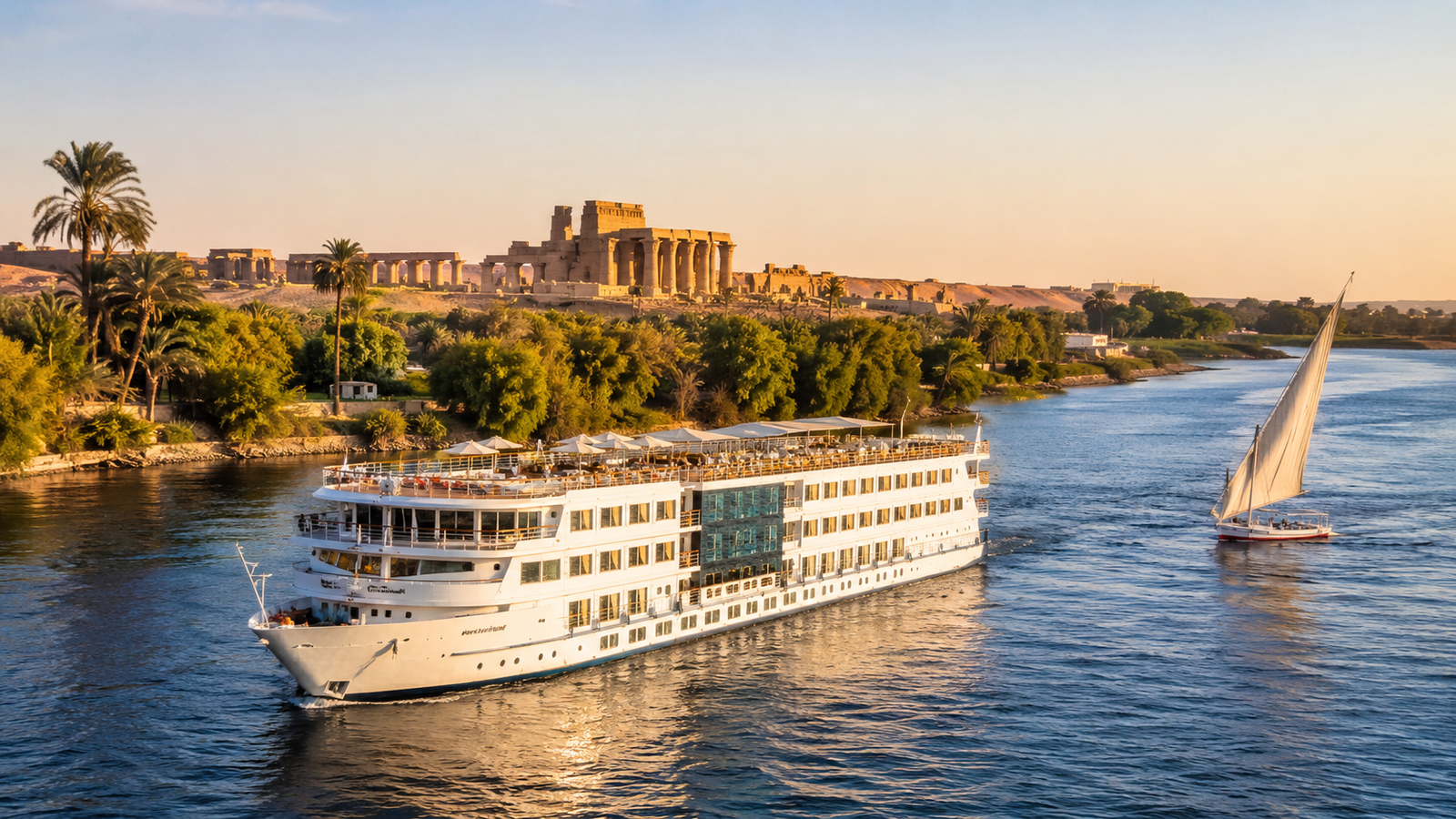
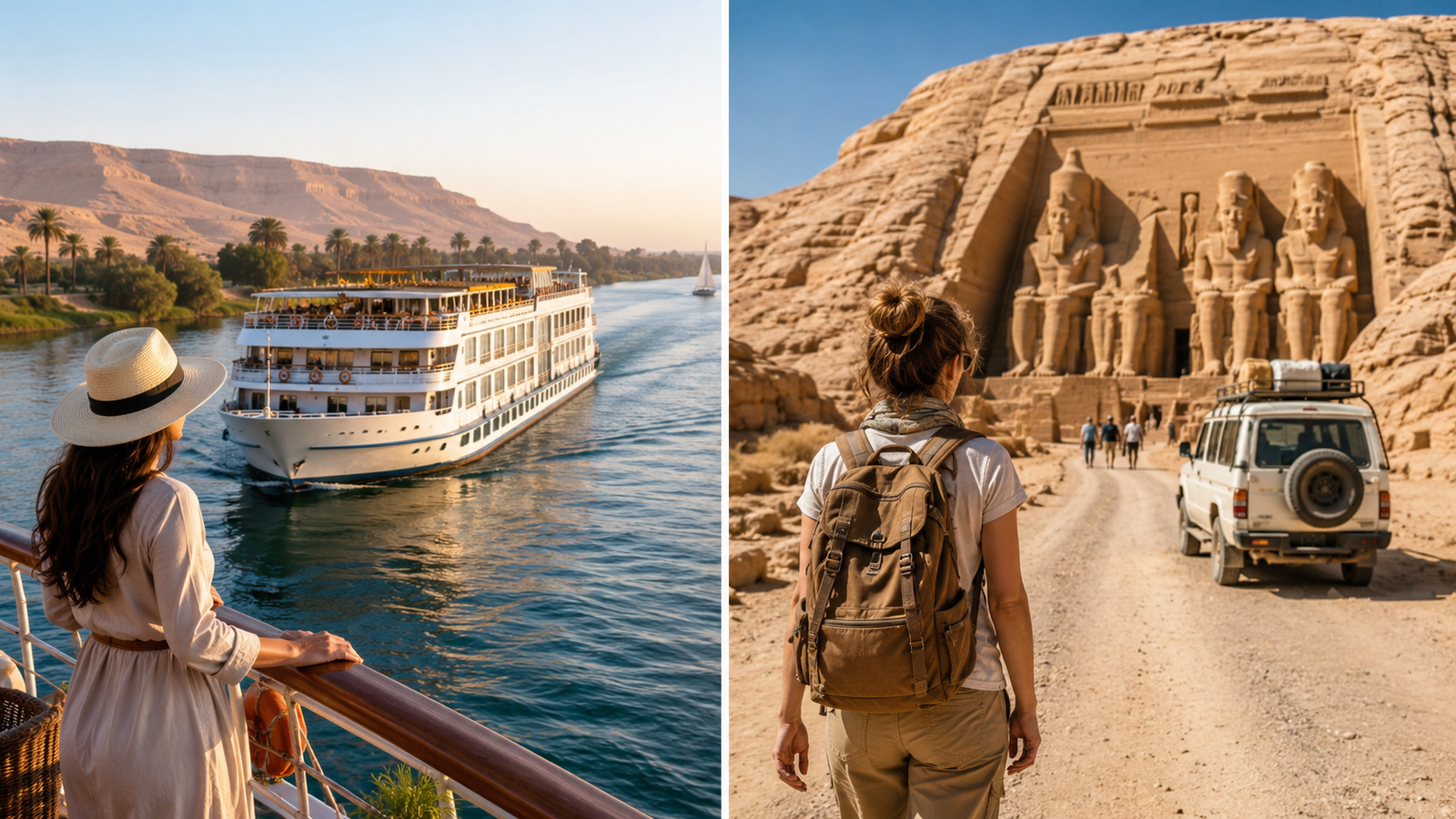
The river itself is the experience. The Nile between Luxor and Aswan is extraordinarily beautiful — green agricultural fields give way to golden desert cliffs, traditional fishing villages dot the banks, and felucca sailboats drift past in the evening light. This is Egypt as it has looked for millennia.
Comfort and convenience. A quality Nile cruise ship provides excellent accommodation, all meals, and guided excursions — all moving with you as you travel. You unpack once and sleep in the same comfortable cabin each night.
Time efficiency. A 4-night cruise covers the same distance and attractions that would take 6–7 days of independent overland travel to organize.
Nile Cruise Routes and Duration Options
The Classic Route: Luxor to Aswan (4 Nights / 5 Days)
This is the most popular Nile cruise itinerary and the one most travelers experience. It departs from Luxor on day one and arrives in Aswan on day four, stopping at Esna, Edfu, and Kom Ombo along the way.
The Reverse Route: Aswan to Luxor (4 Nights / 5 Days)
Exactly the same sites in reverse order. Some travelers prefer this direction because it ends in Luxor — closer to Cairo flights — and because the Edfu and Karnak excursions feel fresh on the final day rather than the first.
The Extended Cruise: 7 Nights / 8 Days
For travelers with more time, a 7-night cruise adds:
- More time at each site without rushing
- An Abu Simbel day trip from Aswan (usually included in 7-night itineraries)
- Time for optional activities: hot air balloon over Luxor, felucca overnight
- A more relaxed pace that suits families and older travelers
The Dahabiya Experience
For a completely different type of Nile journey, the traditional wooden dahabiya — a two-masted sailboat carrying 8–16 passengers maximum — offers an intimate, slower-paced experience. Dahabiyas follow the wind rather than a fixed schedule, stopping at villages and sites rarely visited by larger cruise ships.
Best for: Honeymoon couples, photography enthusiasts, travelers who want to escape mass tourism entirely
Cost: Significantly more expensive than standard cruises — typically $200–400 USD per person per night
What to See: A Detailed Guide to Each Stop
Luxor — The World’s Greatest Open-Air Museum
Luxor was known to the ancient Egyptians as Waset (the City of the Scepter) and to the Greeks as Thebes. It served as Egypt’s capital during the New Kingdom period (1550–1070 BCE) — arguably the greatest era of ancient Egyptian power and cultural achievement. The city and its surroundings contain more ancient monuments than anywhere else on Earth.
East Bank (the living city):
Karnak Temple Complex: The largest religious complex ever constructed, covering over 100 hectares — roughly the size of a medium-sized city. The Great Temple of Amun at its core took over 2,000 years to build, with dozens of pharaohs adding their own structures over the centuries. The Great Hypostyle Hall — a forest of 134 columns, the largest standing at 23 meters — is one of the most extraordinary architectural spaces ever created. Allow at least 2 hours; hire a guide to understand what you’re seeing.
Luxor Temple: A more intimate and unified temple than Karnak, built primarily by Amenhotep III and Ramesses II. The Avenue of Sphinxes connecting it to Karnak has been recently excavated and restored. Visit in the late afternoon and stay for the evening illumination — the golden light on the sandstone columns is extraordinary.
West Bank (the city of the dead):
Valley of the Kings: The royal necropolis of the New Kingdom pharaohs, with 63 known tombs carved into the limestone cliffs. The general admission ticket includes entry to three tombs; additional tickets are required for premium tombs including Tutankhamun (KV62), Ramesses VI (KV9), and Seti I (KV17). The painted walls depicting scenes from the Book of the Dead are extraordinarily vivid — some tombs look as if they were decorated yesterday.
Hatshepsut Temple (Deir el-Bahari): The mortuary temple of Egypt’s most famous female pharaoh, built into the dramatic cliffs of the West Bank. Three colonnaded terraces rise against the pale limestone, creating an architectural statement as powerful as any pyramid.
Colossi of Memnon: Two massive seated statues of Amenhotep III, 18 meters tall, standing alone in the agricultural fields — all that remains of what was once Egypt’s largest temple.
Esna — The Temple of the Ram God
Most cruises stop at Esna briefly, typically early morning. The town’s main attraction is the Temple of Khnum — the ram-headed creator god who was believed to have fashioned human beings on his potter’s wheel. The temple is unusual because it’s below street level — excavated from the accumulated debris of centuries — and is remarkably well-preserved due to this burial. The ceiling retains much of its original painted astronomical decoration.
Time needed at Esna: 1–1.5 hours
Edfu — The Best-Preserved Temple in Egypt
The Temple of Horus at Edfu is consistently voted one of Egypt’s most impressive ancient sites — and with good reason. Built between 237 and 57 BCE during the Ptolemaic period, it is the best-preserved major ancient Egyptian temple in existence, largely because it was buried under desert sand and river silt until the 19th century.
The scale and completeness of the temple is extraordinary. The enormous entrance pylon — 36 meters tall — is decorated with relief carvings of Ptolemy XII smiting his enemies. Inside, successive halls lead to the inner sanctuary, where a reconstructed granite shrine once housed the sacred golden statue of Horus.
The famous “sacred drama” of Horus and Set — the eternal battle between order and chaos — plays out across the temple walls in a complex series of relief carvings that tell one of ancient Egypt’s most important mythological stories.
Access note: Edfu is reached from the ship by horse-drawn carriage (calèche) — a 10-minute ride through the town. Agree on prices for the carriage before getting in.
Time needed at Edfu: 1.5–2 hours
Kom Ombo — The Double Temple
Kom Ombo Temple sits dramatically on a bend in the Nile, visible from the water as your ship approaches — one of the most scenic temple arrivals on the entire cruise. What makes Kom Ombo unique among Egyptian temples is that it is a dual temple — dedicated equally to two separate gods with duplicate sanctuaries, halls, and entrances side by side.
The right side (facing the sanctuary) belongs to Sobek, the crocodile god, associated with fertility and protection. The left side belongs to Haroeris (Horus the Elder), associated with the sun and kingship.
The temple also houses the Crocodile Museum — a small but fascinating collection of mummified crocodiles that were sacred to Sobek, found nearby.
Evening light: Kom Ombo is often visited in the late afternoon or evening when it’s beautifully illuminated, and the Nile views from the temple are spectacular.
Time needed at Kom Ombo: 1–1.5 hours
Aswan — Egypt’s Most Beautiful City
Aswan is widely considered the most beautiful city in Egypt. The southernmost major city on the Nile before Sudan, it sits at the point where the river narrows between pink granite boulders, creating a landscape of extraordinary contrasts: golden sand, black granite, blue water, and the lush green of Elephantine Island.
The city has a distinct Nubian character, with many residents descended from ancient Nubian civilization. The atmosphere is noticeably more relaxed and less crowded than Cairo or Luxor.
Philae Temple: One of the most beautifully situated temples in Egypt, Philae sits on an island accessible by motorboat. Dedicated to the goddess Isis, it was the last bastion of ancient Egyptian religious practice, operating until the 6th century CE. The temple was relocated to its current island by UNESCO after the Aswan High Dam threatened to flood its original location. Visit in the late afternoon for the best light; the evening Sound and Light Show is highly recommended.
Aswan High Dam: The 1970-completed dam that ended the annual Nile flood cycle, transformed Egypt’s water management, and created Lake Nasser — the world’s largest artificial lake. A 30-minute stop gives sufficient time to appreciate the engineering scale.
Nubian Village: Take a motorboat to a traditional Nubian village for a glimpse of Nubian culture, architecture (characteristically painted in vibrant colors), and hospitality. Most visits include tea and the opportunity to hold a Nile crocodile — kept domestically as pets in some Nubian homes.
Felucca on the Nile: The quintessential Aswan experience — sailing on a traditional white-sailed felucca at sunset, with the Nile islands and granite boulders drifting past in the golden light.
Abu Simbel — The Optional Extension
Many 4-night cruises offer an optional extension to Abu Simbel, located 280 km south of Aswan on the shores of Lake Nasser. The twin temples of Ramesses II — four colossal 20-meter statues guarding the entrance — are among Egypt’s most dramatic ancient sites.
Access is either by an early morning convoy (3.5 hours each way) or by plane from Aswan Airport (45 minutes each way). The plane option is strongly recommended if available in your itinerary.
Choosing the Right Nile Cruise Ship
Nile cruise ships range from basic budget vessels to floating luxury hotels. Understanding the differences helps you choose the right ship for your expectations and budget.
Ship Categories
Recommended Ships by Category
Luxury:
- Oberoi Philae — One of the finest floating hotels on the Nile, with 27 luxuriously appointed cabins and impeccable service
- Sonesta Star Goddess — A boutique 18-cabin luxury ship with excellent food and guiding
- Steigenberger Omar El Khayam — Well-established luxury operator with consistently high standards
Mid-Range:
- Movenpick MS Royal Lotus — Excellent value, Swiss management, reliable quality
- Sonesta St. George — A large, professionally run ship with good facilities
- MS Mayfair — Popular with European tour operators, solid mid-range option
Key Factors in Choosing a Ship
Cabin size and type: Standard cabins on older ships can be cramped. Upper deck cabins with larger windows and better light are worth the premium.
Group size: Smaller ships (18–50 cabins) offer a more intimate experience; larger ships (100+ cabins) offer more facilities but can feel like a resort hotel.
Guide quality: The single most important factor in the quality of your cruise experience. Ask specifically about the Egyptologist guide’s qualifications before booking.
Age of ship: Older ships (pre-2000) may have outdated facilities. Newer ships generally have better air conditioning, more comfortable bathrooms, and higher design standards.
Practical Information: What to Expect on a Nile Cruise
Meals and Food
Most Nile cruises operate on a full-board basis — three meals per day included. Breakfast and lunch are typically served as buffets; dinner may be buffet or plated service depending on the ship’s category.
Food quality varies significantly between ship categories. Budget ships offer adequate but basic buffet food; luxury ships serve genuinely excellent Egyptian and international cuisine.
Dietary requirements: Most ships can accommodate vegetarian, vegan, and common food allergies with advance notice. Halal food is standard on Egyptian ships.
Drinks: Soft drinks, water, tea, and coffee are usually included. Alcoholic beverages are typically available at additional cost on most ships.
On-Board Facilities
Sun deck: All ships have a sun deck with loungers — perfect for watching the scenery drift past between temple visits.
Pool: Most mid-range and luxury ships have a small rooftop pool.
Lounge/Bar: Evening entertainment typically includes Egyptian music and dance (Nubian music, whirling dervish performances on some ships).
Wifi: Available on most mid-range and luxury ships, though connectivity can be patchy in remote stretches of the river.
Tipping Culture
Tipping is an essential part of the service economy on Nile cruises. Budget approximately:
- Guide: $5–10 USD per person per day
- Cabin steward: $3–5 USD per person per day
- General crew: $2–3 USD per person per day
Many ships provide an envelope at the end of the cruise for collective tipping. US dollars are widely preferred.
Best Time for a Nile Cruise
Peak season (December–February) is the most popular and most expensive. Book 4–6 months in advance for quality ships.
Shoulder season (March–April, October–November) offers excellent value with temperatures still comfortable for outdoor sightseeing.
Special 2027 consideration: The Total Solar Eclipse on August 2, 2027 crosses the Luxor area, while Aswan city itself will see a deep partial eclipse rather than totality. Travelers who want to combine the event with a river journey should read our Nile Cruise Solar Eclipse 2027 planning guide and compare the 7-Day Nile Cruise & Solar Eclipse 2027; the final eclipse-viewing position must be confirmed at a location inside the path of totality.
How to Book a Nile Cruise
Through a Tour Operator (Recommended)
Booking through a reputable tour operator like Egypt Travel Ways guarantees quality control, properly licensed guides, and support if anything goes wrong. A tour operator can also create a combined package: Cairo + Nile Cruise + Red Sea, with all logistics handled.
Direct with Cruise Companies
Booking directly with cruise lines is possible and can sometimes save money, but requires more independent research and offers less support.
Online Travel Agencies
Sites like Viator, GetYourGuide, and Booking.com list Nile cruises, but quality can vary significantly. Always read recent reviews (within 6 months) before booking.
15 People Also Ask Questions About Nile Cruises
1. Is a Nile cruise worth it?
Yes — a Nile cruise is consistently rated as one of the world’s great travel experiences. Sailing the river that sustained one of history’s greatest civilizations, waking up to ancient temples every morning, and watching the Egyptian landscape drift past in golden light is genuinely extraordinary. Most travelers who do a Nile cruise say it’s the highlight of their entire Egypt trip and often their most memorable travel experience.
2. How long is a Nile cruise from Luxor to Aswan?
The standard cruise takes 4 nights and 5 days. Extended itineraries of 7 nights are also popular and allow for a more relaxed pace with additional time at each site. The sailing distance between Luxor and Aswan is approximately 200 kilometers.
3. What is the best month for a Nile cruise?
November through February offers the most comfortable temperatures for a Nile cruise, with daytime highs of 20–28°C perfect for outdoor temple visits. December and January are peak season — book well in advance. October and March–April are excellent shoulder season alternatives with slightly lower prices.
4. What is included in a Nile cruise package?
Most Nile cruise packages include accommodation in a private cabin, all meals (full board), guided excursions to all temples along the route, entrance fees, and port charges. International flights, visas, gratuities, alcoholic drinks, and optional activities (like Abu Simbel flights or hot air balloons) are typically not included. Always confirm exactly what’s included before booking.
5. How much does a Nile cruise cost?
A 4-night Nile cruise costs approximately $350–600 USD per person for mid-range ships, $600–1,000 USD for luxury ships, and $200–350 USD for budget vessels. These prices are typically per person based on double occupancy and usually include full board and guided excursions. Solo travelers pay a single supplement.
6. Is a Nile cruise safe?
Yes, Nile cruises are very safe. The route between Luxor and Aswan is heavily traveled, well-monitored, and has an excellent safety record. Ships are inspected and regulated, all temple sites have security, and reputable cruise operators maintain high standards of vessel maintenance and safety equipment.
7. What should I pack for a Nile cruise?
Key items include comfortable walking shoes (for temple sites with uneven terrain), light cotton or linen clothing for hot weather, a warmer layer for cool evenings on the sun deck, sunscreen SPF 50+, a hat, a reusable water bottle, insect repellent (particularly for evenings near the river), and smart-casual clothing for dinners on board. Full packing guide available in our Egypt Packing List article.
8. Do Nile cruise ships have pools?
Most mid-range and luxury Nile cruise ships have a small rooftop swimming pool, though these are typically compact plunge pools rather than full-size pools. They are refreshing during hot days on the river. Budget ships may not have pools.
9. Can children go on a Nile cruise?
Yes, children are very welcome on Nile cruises and the experience can be wonderful for families. The combination of sailing, temple visits, and the novelty of shipboard life tends to captivate children of all ages. Most ships accommodate children well; some luxury ships offer children’s programs. For very young children (under 3), consider whether the heat and temple visits are appropriate for the age.
10. What is the difference between a Nile cruise and a felucca trip?
A traditional Nile cruise travels on a large motor-powered ship with private cabins, restaurants, and facilities. A felucca is a small traditional Egyptian sailboat carrying 6–15 people, sleeping on deck or in simple accommodation on shore. Felucca trips are much cheaper and more adventurous but very basic. For comfort and the ability to visit all major sites, a cruise ship is recommended; for a genuine off-the-beaten-track experience on a budget, a multi-day felucca journey is a unique alternative.
11. Which is better — Luxor to Aswan or Aswan to Luxor direction?
Both directions visit exactly the same sites. The Luxor to Aswan direction is more popular because Luxor is more directly connected to Cairo (easier flight connections) and the route builds naturally from the East Bank temples to the West Bank sites to the southern monuments. That said, many travelers prefer the reverse — ending in Luxor means your final days include the Valley of the Kings, which some consider the emotional highlight of the journey.
12. Do I need travel insurance for a Nile cruise?
Yes, travel insurance is strongly recommended for any international trip including a Nile cruise. Your policy should cover medical emergencies (including evacuation), trip cancellation, and loss of luggage. Some cruise companies require proof of insurance before boarding.
13. Is there WiFi on Nile cruise ships?
Most mid-range and luxury ships now offer WiFi, though connectivity can be slow and patchy in remote stretches of the river. If consistent internet access is important to you, confirm the WiFi quality with your operator before booking. Consider a local Egyptian SIM card as a backup for data.
14. Can I do a Nile cruise as a solo traveler?
Absolutely. Solo travelers are welcome on all Nile cruises. The shared excursion model makes it easy to meet other travelers, and the small, enclosed environment of a cruise ship naturally creates a social atmosphere. The main consideration is the single supplement — most ships charge solo travelers 150–175% of the per-person double-occupancy rate. Some operators offer to match solo travelers sharing a cabin.
15. What is the best Nile cruise for a honeymoon?
For a honeymoon, luxury dahabiya cruises are the most romantic option — small wooden sailing vessels with 4–8 private cabins, personal butler service, and intimate itineraries stopping at secluded villages and lesser-known temples. Among standard cruise ships, the Oberoi Philae and Sonesta Star Goddess are consistently recommended for honeymooners. Look for ships offering sunset cocktails on the sun deck, candlelit dinners, and excursions without large group coach tours.
Book Your Nile Cruise with Egypt Travel Ways
A Nile cruise is not something you want to leave to chance. The difference between a transformative, life-changing experience and a disappointing one comes down to ship quality, guide expertise, and the care with which your itinerary is put together.
Egypt Travel Ways has been arranging Nile cruises for international visitors for years. We know every ship on the river, every guide by name, and every site by heart. We create custom itineraries that combine your Nile cruise with Cairo, the Red Sea, or desert adventures — a seamless, comprehensive Egypt experience tailored to your interests and budget.
Contact us today to book your Luxor to Aswan Nile Cruise — the journey of a lifetime awaits.