Tutankhamun Treasures at GEM – The Full Story 2027
Last fact-checked: 1 October 2026. GEM admission and visitor rules below use the museum’s official website and ticketing platform.
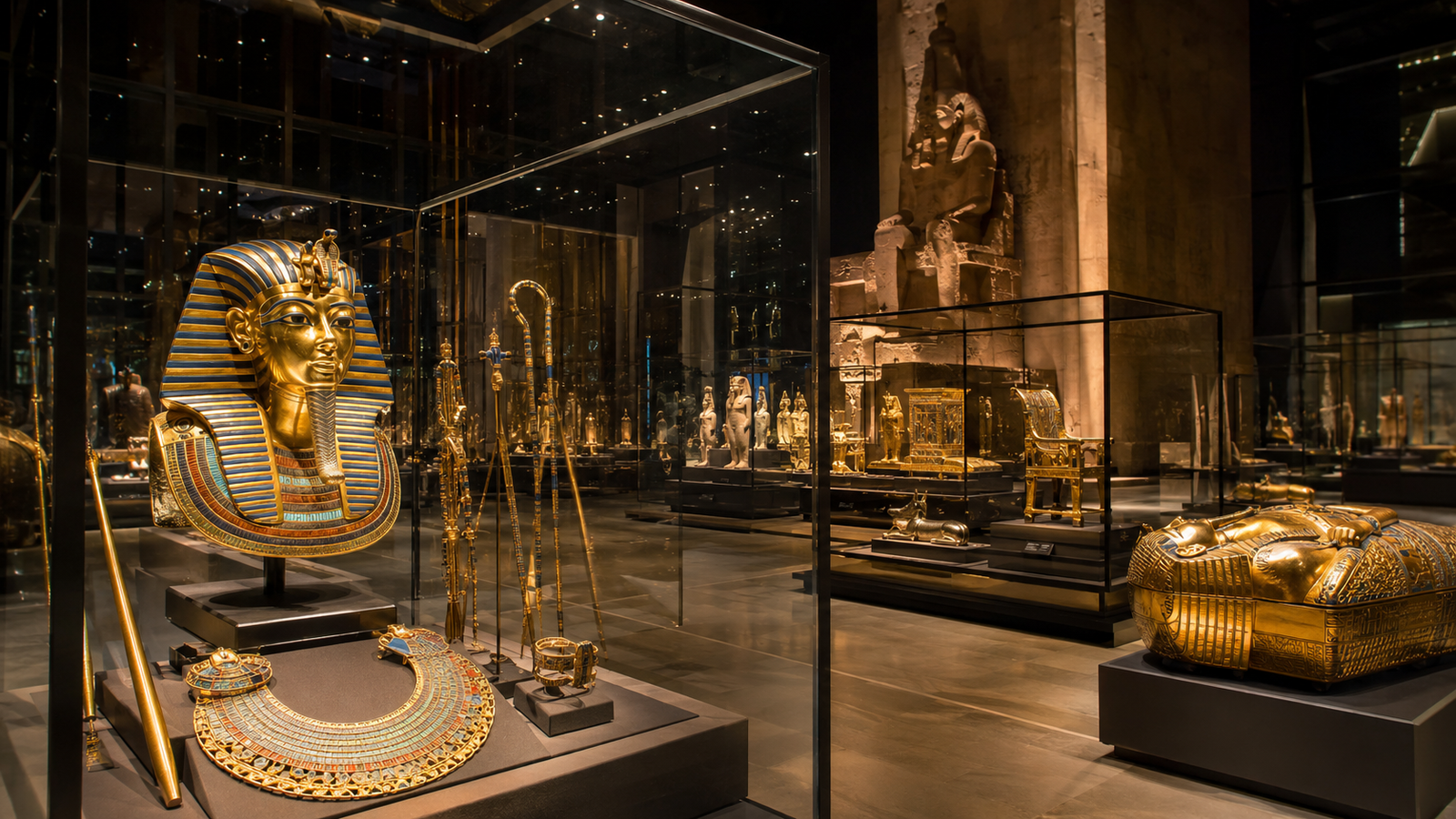
When Howard Carter peered through a small hole in a sealed doorway in the Valley of the Kings on November 26, 1922, and Lord Carnarvon asked what he could see, Carter replied: “Yes, wonderful things.” That discovery — the intact tomb of the boy pharaoh Tutankhamun, untouched for 3,245 years — remains the greatest archaeological find in history. In 2027, for the first time in the century since that discovery, all 5,000+ objects from Tutankhamun’s tomb are displayed together in one extraordinary place: the Grand Egyptian Museum in Giza.
This guide covers the full story of the discovery, the most significant objects, and how to plan your GEM visit to experience this incomparable collection.
For the detailed museum visitor guide, see our Grand Egyptian Museum Visitor Guide. For the Valley of the Kings context, see our Valley of the Kings Guide. For Giza planning, see our Egypt 10-Day Itinerary.
The Discovery That Changed Archaeology
By 1922, most Egyptologists believed the Valley of the Kings was exhausted — every royal tomb had been found and plundered. Howard Carter, funded by Lord Carnarvon, refused to accept this. His painstaking, methodical excavation paid off on November 4, 1922, when his team found the first of sixteen steps leading to a sealed doorway.
The tomb had been entered by robbers twice in antiquity, but both times the necropolis guards had resealed it. Then the construction of a later royal tomb covered the entrance with debris — and KV62 was forgotten for 3,245 years.
Carter and his team took ten years (1922–1932) to fully excavate and document the tomb’s 5,000+ objects. Each piece was photographed, measured, described, numbered, and carefully transported to Cairo. For decades, the most famous pieces were at the Egyptian Museum in Tahrir; thousands more languished in storage. The Grand Egyptian Museum changed everything — reuniting the complete collection in a purpose-built, world-class setting.
The Griffith Institute at Oxford University has digitized Carter’s complete excavation archives — an extraordinary resource available at griffith.ox.ac.uk/tutankhamun.
The Major Treasures at the GEM
The Golden Death Mask
The most recognized artifact in the history of archaeology. Solid gold weighing 10.23 kilograms, inlaid with lapis lazuli, turquoise, carnelian, obsidian, and colored glass. The eyes — obsidian pupils, quartz crystal whites — give the face an uncanny lifelike quality. The mask was placed directly over the royal mummy’s head and shoulders.
What to look for: On the back, an inscription from the Book of the Dead identifies each body part with a deity — a protection spell for the pharaoh’s journey through the underworld.
The Innermost Gold Coffin
Made of solid gold weighing approximately 110 kilograms — one of the most valuable objects ever created by human hands. The coffin depicts the king as Osiris, god of the dead, holding the crook and flail. Tutankhamun was buried in three nested coffins; the innermost is solid gold, the outer two gilded wood.
The Golden Throne
Perhaps the most emotionally affecting object in the collection. A gilded wooden throne decorated with a scene of extraordinary human intimacy: the young king seated while his wife Ankhesenamun applies perfumed oil to his shoulder. The Aten sun disk radiates its rays toward them, each ending in a small hand holding the ankh of life.
Tutankhamun was approximately 18–20 years old when he died; Ankhesenamun approximately 21–23. This is not a formal royal image — it is two young people in a private moment, preserved for 3,300 years.
The Celestial Scarab Pectoral
The central scarab of this extraordinary pectoral is carved from desert glass — natural glass formed by a meteorite impact millions of years ago. Modern analysis confirmed it is the earliest known example of human-worked extraterrestrial material. A piece of the cosmos, fashioned by ancient Egyptian hands, worn over a pharaoh’s heart.
The Six Ceremonial Chariots
The most complete collection of ancient Egyptian chariots in existence. Disassembled to fit through the tomb’s narrow doorway, they were painstakingly reassembled for display. The most elaborate is entirely covered in beaten gold decorated with bound foreign prisoners.
The Canopic Shrine
A magnificent gilded wooden shrine containing four alabaster containers (canopic jars) holding the king’s preserved internal organs. Four golden goddesses (Isis, Nephthys, Neith, Serket) stand at the corners with outstretched protective wings — among the most beautiful small sculptures in ancient Egyptian art.
The Ritual Beds
Three enormous gilded couches in the form of animal deities — a lion, a cow, and a composite hippo-headed creature — found packed into the antechamber. Their specific ritual purpose is still debated. Their visual impact is immediate and extraordinary.
143 Burial Ornaments
Within the mummy’s bandages, Carter found 143 individual gold amulets, rings, bracelets, diadems, and figurines placed at specific positions on the body according to ancient funerary texts. These form the most complete collection of royal mummification jewelry ever found.
Visiting the Tutankhamun Collection at the GEM
Ticket: The official GEM ticketing platform currently states that standard admission includes the Tutankhamun Galleries. As of 1 October 2026, the adult ticket for Arab or other nationalities is EGP 1,590. Book a timed admission through the official GEM ticketing website.
Time required: 1.5–2 hours minimum for the Tutankhamun galleries.
Tips:
- Arrive early in the morning — crowds build significantly by mid-morning
- Hire a licensed Egyptologist guide for the collection — the mythological context transforms the experience
- Personal photography is permitted subject to gallery-specific restrictions. Flash, tripods, monopods, selfie sticks, drones and external lighting are prohibited.
- Don’t rush — choose 8–10 objects and give each your full attention
For the complete GEM visitor guide: Grand Egyptian Museum Visitor Guide.
External Resources
- Griffith Institute Oxford — Carter Archive — Complete digitized excavation records
- Metropolitan Museum of Art — Tutankhamun Resources — Educational materials on the collection
- UNESCO Egypt Cultural Heritage — Documentation of Egyptian archaeological heritage
- GEM Official Ticket Booking — Advance ticket reservation
15 People Also Ask Questions About Tutankhamun at GEM
1. Where are Tutankhamun’s treasures in 2027?
All 5,000+ objects from Tutankhamun’s tomb are now displayed at the Grand Egyptian Museum (GEM) in Giza — the first time the complete collection has ever been shown together. Previously the most famous pieces were at the Egyptian Museum in Tahrir; the rest were in storage.
2. Where is Tutankhamun’s golden mask?
Tutankhamun’s golden death mask is displayed in the Grand Egyptian Museum’s Tutankhamun galleries in Giza. It was previously the centerpiece of the Egyptian Museum in Tahrir Square before being transferred to the GEM.
3. How much is Tutankhamun’s golden mask worth?
The intrinsic gold value of the mask (10.23 kg) is approximately $650,000–750,000 USD at current gold prices. As an archaeological artifact, it is priceless — Egyptian law prohibits its sale and it is the inalienable cultural property of Egypt.
4. How many objects were in Tutankhamun’s tomb?
Over 5,000 individual objects were found in the four chambers of KV62. They ranged from the three nested coffins and gilded shrines to tiny amulets found within the mummy’s bandages.
5. Why was Tutankhamun’s tomb so well preserved?
The tomb was accidentally buried under debris from a later royal tomb’s construction, making it effectively invisible. Ancient robbers entered twice but were interrupted; the necropolis guards resealed both times. The sealed environment then preserved organic materials for 3,245 years.
6. Who was Tutankhamun?
An 18th Dynasty pharaoh who ruled approximately 1332–1323 BCE. He came to the throne as a child (~9–10 years old) and died young (~18–20). Believed to be the son of Akhenaten, he reversed his father’s religious revolution and restored traditional Egyptian polytheism.
7. Where is Tutankhamun’s mummy?
The mummy remains in its tomb (KV62) in the Valley of the Kings at Luxor, displayed in the outermost coffin. Only the tomb’s objects moved to the GEM. Visitors to the Valley of the Kings can see the mummy by purchasing the KV62 premium ticket.
8. Was there a curse on Tutankhamun’s tomb?
The “Curse of the Pharaohs” is a myth comprehensively debunked by modern analysis. Lord Carnarvon died of an infected mosquito bite five months after the opening — he was already in poor health. Howard Carter lived until 1939, 17 years after the discovery. Statistical analysis of all those present shows no mortality anomaly.
9. How old was Tutankhamun when he died?
Modern CT scanning and DNA analysis establishes he was approximately 18–20 years old at death. He ruled for approximately 9–10 years. The cause of death remains debated — possible contributors include a broken leg, malaria, and a compromised immune system.
10. What is the significance of the desert glass scarab pectoral?
The scarab in Tutankhamun’s famous pectoral is carved from desert glass formed by a meteorite impact millions of years ago. Modern analysis confirmed it is the earliest known example of human-worked extraterrestrial material — a cosmic fragment fashioned by human hands and worn over a pharaoh’s heart.
11. How long did Carter’s excavation of the tomb take?
Ten years (1922–1932). Carter’s meticulous documentation of every object — individually photographed, measured, described, and numbered — represented an unprecedented level of archaeological rigor that set the standard for subsequent generations.
12. Can I see the complete Tutankhamun collection in one visit?
Yes — and for the first time in history, you can. The GEM’s Tutankhamun galleries display all 5,000+ objects. A thorough visit requires 1.5–2 hours minimum.
13. What was in the antechamber of Tutankhamun’s tomb?
The antechamber was packed floor to ceiling: three gilded funerary couches (lion, cow, hippo forms), dismantled chariots, dozens of boxes and chests, alabaster vessels, and two life-sized gilded guardian statues of the king flanking the sealed doorway to the burial chamber.
14. Is the Grand Egyptian Museum worth visiting just for the Tutankhamun collection?
Absolutely. The complete Tutankhamun collection is one of the greatest museum experiences in the world — comparable to the Elgin Marbles or the Vatican treasures. Even if the rest of the GEM didn’t exist, the Tutankhamun collection alone would justify the journey to Egypt.
15. How do I book the Tutankhamun Galleries at the GEM?
You do not currently need a separate Tutankhamun admission ticket. The official GEM ticketing website states that the standard museum ticket includes the Tutankhamun Galleries. Choose your visit date and timed entry at tickets.gem.eg.
Book Your Grand Egyptian Museum Tour with Egypt Travel Ways
Egypt Travel Ways offers private GEM tours with licensed Egyptologist guides who bring the Tutankhamun collection to life — explaining not just what each object is, but what it meant to the people who made it, and why it still matters 3,300 years later.
Contact Egypt Travel Ways today to book your Grand Egyptian Museum Private Tour — stand before the greatest treasures the ancient world ever produced.