

Coptic Cairo Complete Guide – Churches, History & Visitor Tips
Coptic Cairo Complete Guide 2027 – Hanging Church, Museums & History
Cairo is famous for its Islamic monuments, its ancient pyramids, and its vibrant modern neighborhoods. But within the old Roman fortress of Babylon, in the southern part of the city, lies one of the world’s most remarkable concentrations of early Christian heritage: Coptic Cairo. Here, within a few hundred meters, you’ll find some of the oldest Christian churches on Earth, one of the world’s greatest collections of Coptic art, a synagogue that may date back 2,000 years, and streets that have been continuously sacred to Christians, Jews, and Muslims for nearly two millennia.
This complete 2027 guide covers everything you need to know about visiting Coptic Cairo — the history, the highlights, the practical logistics, and how to combine it with Islamic Cairo for the definitive Old Cairo experience.
For broader Cairo context, see our Giza Pyramids Guide and Khan El Khalili Bazaar Guide. For safety context, see Is Egypt Safe 2027.
Who Are the Copts?
The word “Copt” derives from the Arabic “Qibt,” which itself derives from the Greek “Aigyptos” — Egypt. Coptic Christians are, literally, the original Egyptians: the descendants of ancient Pharaonic Egyptians who converted to Christianity in the 1st century CE, according to tradition through the missionary work of Saint Mark the Evangelist himself.
The Coptic Orthodox Church of Alexandria is one of the oldest Christian institutions in the world — older than the Roman Catholic Church, predating the Council of Nicaea, with a theological tradition that traces its authority directly to Saint Mark. The Coptic language, which was the native tongue of Egypt until Arabic became dominant after the 7th-century Islamic conquest, is still used in Coptic liturgy today — making it one of the last surviving forms of ancient Egyptian language.
Egypt’s Coptic community today represents approximately 10–15% of the Egyptian population — the largest Christian community in the Middle East.
For authoritative history: The Coptic Orthodox Diocese of the Southern United States and the Coptic Museum’s online resources provide comprehensive background on Coptic history and tradition.
The Historical Context: Roman Babylon Fortress
Coptic Cairo’s sacred concentration is not accidental — it developed within and around the Roman Fortress of Babylon, built approximately in the 1st century BCE and substantially expanded in the 1st century CE. The fortress controlled the narrowest crossing point of the Nile at this location, making it strategically critical.
Early Christians in Egypt found protection within and around the fortress walls — a pattern common throughout the Roman world, where Christian communities often established themselves in the margins of existing Roman infrastructure. As Christianity became Egypt’s state religion after the Edict of Thessalonica (380 CE), these early prayer spaces were formalized into permanent churches.
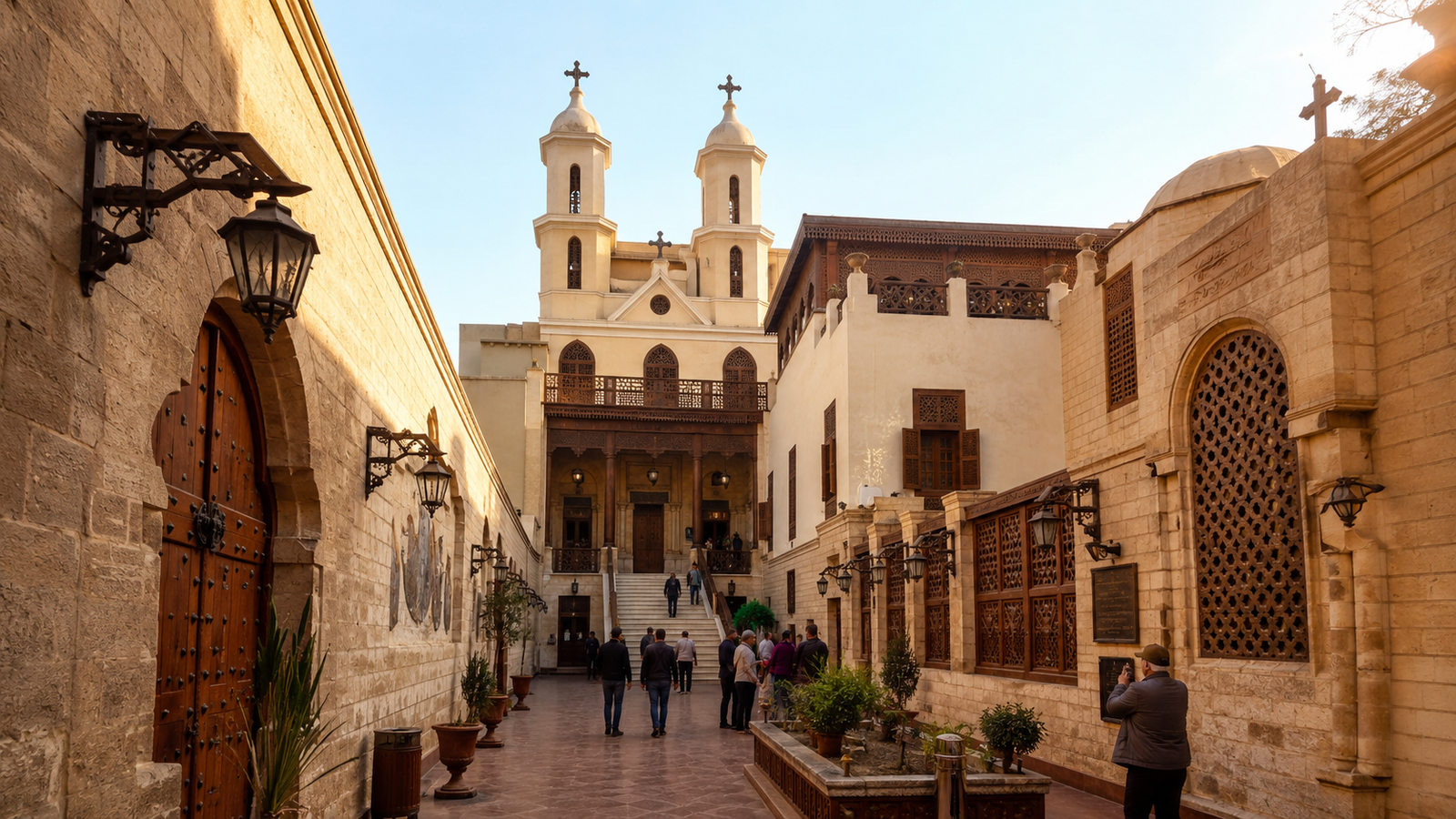
The towers of the Roman fortress are still visible today — the Hanging Church is built on top of the fortress’s southern gatehouse towers, its nave literally suspended above the ancient Roman structure below.
The Main Sites of Coptic Cairo
The Hanging Church (Al-Muallaqah)
The most famous church in Egypt and one of the most important in the Christian world, the Hanging Church takes its name from its unusual position — its nave is suspended (hung) over the gatehouse of the ancient Roman fortress of Babylon, with the floor extending over a void.
History: The Hanging Church is believed to have been founded in the 3rd or 4th century CE, though the current structure dates primarily from the 7th century with extensive renovations in the 9th, 11th, and 13th centuries. It served for centuries as the seat of the Coptic Patriarch of Alexandria — effectively the headquarters of the Coptic Church.
The Architecture: The church is reached by a staircase from the street (a precaution against ancient flooding). Inside, three naves are separated by 13 columns representing Christ and the 12 apostles. The central nave is higher than the others, filled with natural light and decorated with extraordinary icons.
The Icons: The Hanging Church contains some of Egypt’s finest Coptic icons — painted panels depicting Christ, the Virgin, and the saints in the distinctive flat, frontal style of Coptic Christian art. The ivory-inlaid ebony pulpit dating to the 11th century is considered one of the finest examples of medieval Christian furniture in existence.
The Crypt: Below the main church, a lower level contains the ancient Roman fortress walls and the direct support structure that the church hangs above. The contrast between Roman military engineering and Christian sacred space is palpable.
Practical note: Dress modestly (covered shoulders and knees). The church is an active place of worship and may be closed during services. Photography is generally permitted.
The Coptic Museum
The Coptic Museum, established in 1910, is one of the great specialized museums of the world — the largest collection of Coptic art and artifacts anywhere on Earth. Its 16,000 objects span 14 centuries of Coptic Christian civilization, from the 4th to the 19th century.
Collection highlights:
The Nag Hammadi Library: The museum holds original pages from the famous Nag Hammadi Codices — a collection of 13 early Christian texts discovered in Upper Egypt in 1945, including the Gospel of Thomas, that transformed modern understanding of early Christianity. The significance of these texts can hardly be overstated — they provide an extraordinary window into the diversity of early Christian thought.
For academic context, the Coptic Gnostic Library (Yale) provides resources on the Nag Hammadi texts.
Textiles: One of the museum’s greatest treasures is its extraordinary collection of Coptic textiles — woven fabrics from the 4th–10th centuries that preserve colors and patterns of extraordinary vibrancy. The Copts were master weavers; their textiles were traded across the Byzantine and Islamic worlds.
Sculpture and architectural fragments: Stone friezes, architectural details, and sculptural panels showing the development of Coptic artistic vocabulary — a fascinating blend of pharaonic, Hellenistic, and specifically Christian visual traditions.
Wooden objects: Elaborately carved wooden panels, church furniture, and domestic objects that demonstrate the extraordinary woodworking tradition of Coptic craftsmen.
The Museum Building: The museum building itself is beautiful — constructed in the traditional Coptic architectural style with carved wooden screens, mosaic floors, and a serene interior courtyard. The building won an architectural award when it was restored in the early 21st century.
Practical: Allow 1.5–2 hours. Entrance approximately $6–10 USD. Photography generally permitted.
The Church of Saint Sergius and Bacchus (Abu Serga)
One of the oldest churches in Egypt — traditionally identified as built over the cave where the Holy Family rested during their flight into Egypt. The Gospel of Matthew records that Joseph, Mary, and the infant Jesus fled to Egypt to escape Herod’s massacre; Egyptian Christian tradition preserves detailed accounts of their journey.
The current structure dates primarily from the 4th–5th century, though extensively rebuilt. A crypt beneath the church — sometimes flooded with Nile water — is venerated as the actual cave used by the Holy Family.
The Holy Family route: Coptic tradition traces the entire journey of the Holy Family through Egypt in extraordinary detail, from the Delta in the north to Assiut in Upper Egypt. The Egyptian Ministry of Tourism’s Holy Family Trail provides information on the full pilgrimage route.
The Church of Saint Barbara
Built in the 7th century over an earlier structure, the Church of Saint Barbara is one of Coptic Cairo’s most beautiful churches — less visited than the Hanging Church but comparable in artistic quality. It contains some of the finest medieval Coptic woodwork in existence and a magnificent marble sanctuary screen.
The church is dedicated to Saint Barbara, a 3rd-century Christian martyr whose story (though probably legendary) was widely venerated in the early Church.
Ben Ezra Synagogue
One of the oldest synagogues in Egypt — and according to one tradition, marking the site where the baby Moses was placed in the reed basket on the Nile. The current building dates from the 9th century (rebuilt on an older structure), but the site’s Jewish associations are ancient.
The Ben Ezra Synagogue achieved international fame in the late 19th century when the Cairo Geniza was discovered in its storeroom — a collection of over 300,000 Jewish manuscript fragments, including texts in Hebrew, Judeo-Arabic, and Aramaic, that has transformed scholarly understanding of medieval Jewish and Mediterranean history.
The synagogue is now maintained as a historical monument and museum rather than an active place of worship. Entrance is free; dress modestly.
For the Cairo Geniza: The Cambridge University Library holds the largest portion of the Geniza collection and provides online access to digitized fragments.
The Church of the Virgin Mary (Al-Adawiyya)
A small but historically significant church near the Babylon fortress entrance, believed to be among the oldest in Egypt. Less famous than the other Coptic Cairo churches but atmospherically intimate and often less crowded.
Visiting Coptic Cairo Practically
Location: Ma’adi Street, Old Cairo (Mar Girgis) — accessible from the Mar Girgis metro station on Cairo Metro Line 1.
Getting there: The Mar Girgis Metro Station is directly adjacent to the Coptic Cairo entrance — one of the easiest major tourist site accesses in Cairo. Alternatively, take Uber or another currently available ride-hailing service to “Coptic Museum Cairo.”
Opening hours: Most churches and the Coptic Museum are open 9:00 AM – 5:00 PM daily. The Hanging Church may have limited hours during services.
Entrance fees: Coptic Museum approximately $6–10 USD. Individual churches typically free or small donation requested.
Time needed: 2–3 hours for a thorough visit covering all main sites.
Dress code: Covered shoulders and knees for both men and women. The area is an active religious site.
Combining Coptic Cairo with Islamic Cairo
Coptic Cairo and Islamic Cairo are 15–20 minutes apart by taxi — making a combined day exploring both districts an extraordinary immersion in Cairo’s layered history:
Morning (Coptic Cairo, 9:00 AM – 12:00 PM):
Start at the Coptic Museum (1.5 hours), then walk the few hundred meters to the Hanging Church, Church of Saint Sergius, and Ben Ezra Synagogue.
Afternoon (Islamic Cairo, 1:00 PM – 5:00 PM):
Taxi or walk to Islamic Cairo. Visit the Citadel of Saladin and the Alabaster Mosque of Muhammad Ali, then walk down to Sultan Hassan Mosque and Al-Muizz Street. Finish the afternoon in Khan El Khalili for tea at El Fishawy.
For the full Islamic Cairo guide: Islamic Cairo Walking Tour Guide.
External Resources
- Coptic Museum Official Website — Collection information and visiting details
- UNESCO Historic Cairo World Heritage — World Heritage documentation
- Cambridge Cairo Geniza Collection — Ben Ezra Synagogue manuscript digitization
- Coptic Orthodox Church Official Website — History and theology of the Coptic Church
15 People Also Ask Questions About Coptic Cairo
1. What is Coptic Cairo?
Coptic Cairo is a historic district in southern Cairo, centered on the ancient Roman Fortress of Babylon, containing the highest concentration of early Christian (Coptic) churches, museums, and monuments in Egypt. Key sites include the Hanging Church (Al-Muallaqah), the Coptic Museum, the Church of Saint Sergius (Abu Serga), and the Ben Ezra Synagogue. It represents over 2,000 years of continuous Christian presence in Egypt.
2. What is the Hanging Church in Cairo?
The Hanging Church (Al-Muallaqah) is Egypt’s most famous Coptic Christian church, located in Coptic Cairo. Its name comes from its nave being literally suspended (hung) over the gatehouse towers of the ancient Roman Fortress of Babylon. The church is believed to have been founded in the 3rd or 4th century CE and served as the seat of the Coptic Patriarch for centuries. It contains extraordinary medieval icons and ivory-inlaid furnishings.
3. How do I get to Coptic Cairo?
Take Cairo Metro Line 1 to the Mar Girgis station — the station is directly adjacent to the Coptic Cairo entrance. Alternatively, use Uber or another currently available ride-hailing service to “Coptic Museum Cairo” or “Al-Muallaqah Church.” From downtown Cairo, the journey takes approximately 15–20 minutes.
4. What is the Coptic Museum?
The Coptic Museum, established in 1910, is the world’s largest collection of Coptic Christian art and artifacts. Its 16,000 objects span 14 centuries of Coptic civilization, including original pages from the Nag Hammadi Codices, extraordinary textiles, medieval woodwork, and architectural fragments. The building itself, in traditional Coptic architectural style, is beautiful.
5. Are the Copts descendants of ancient Egyptians?
Yes — Coptic Christians are the direct descendants of ancient Pharaonic Egyptians who converted to Christianity in the 1st century CE. The word “Copt” derives from the Greek “Aigyptos” (Egypt). The Coptic language preserved in Coptic liturgy today is a direct descendant of the ancient Egyptian language written in pharaonic hieroglyphs — making Coptic Christians a living link to ancient Egyptian civilization.
6. Is Coptic Cairo safe to visit?
Yes, Coptic Cairo is safe for tourists. The area has police and security presence and is visited by tourists and pilgrims from around the world. Follow standard big-city precautions (keep valuables secure, use official transport) and dress modestly out of respect for the active religious sites.
7. What is the Abu Serga Church?
The Church of Saint Sergius and Bacchus (Abu Serga) is one of the oldest churches in Egypt, traditionally built over the cave where the Holy Family rested during their flight into Egypt. A crypt beneath the church, sometimes submerged by Nile water, is venerated as the actual cave. The current structure dates primarily from the 4th–5th century CE.
8. What is the Ben Ezra Synagogue?
The Ben Ezra Synagogue in Coptic Cairo is one of Egypt’s oldest synagogues, dating in its current form to the 9th century. It achieved international scholarly fame through the discovery of the Cairo Geniza — over 300,000 Jewish manuscript fragments found in its storeroom in the late 19th century. The synagogue is now a historical monument; the largest portion of the Geniza manuscripts is held at Cambridge University Library.
9. How long should I spend at Coptic Cairo?
A thorough visit to Coptic Cairo covering the main sites (Coptic Museum, Hanging Church, Abu Serga, Ben Ezra Synagogue, Church of Saint Barbara) takes 2–3 hours. The Coptic Museum alone deserves 1.5 hours.
10. What is the significance of the Nag Hammadi texts at the Coptic Museum?
The Nag Hammadi Codices are a collection of 13 early Christian texts discovered in Upper Egypt in 1945, including the Gospel of Thomas. They provide an extraordinary window into the diversity of early Christianity and include texts unknown for over 1,500 years. The Coptic Museum holds original pages from these texts. Their discovery transformed modern understanding of early Christian history.
11. Can I visit Coptic Cairo independently or do I need a guide?
Independent visits are very manageable — the sites are within walking distance of each other and signage is reasonably good. However, a licensed guide significantly enriches the experience, particularly for the Coptic Museum and the theological/historical background of the churches. Egypt Travel Ways can arrange private guided Coptic Cairo tours.
12. What should I wear at Coptic Cairo?
Dress modestly — covered shoulders and knees for both men and women. The area is an active religious site with multiple churches in regular use for worship. Shoes must be removed in some churches. Respectful dress is both culturally appropriate and required for entry to active worship spaces.
13. Is the Coptic Museum worth visiting?
Absolutely. The Coptic Museum is one of Cairo’s great cultural institutions and an essential complement to any ancient Egypt experience. Understanding Coptic civilization — which bridges pharaonic Egypt and Arab Egypt with 14 centuries of Christian culture — is fundamental to understanding Egypt’s full historical depth.
14. What is the Holy Family Trail in Egypt?
The Holy Family Trail is a pilgrimage route tracing the journey of the Holy Family (Joseph, Mary, and the infant Jesus) through Egypt as described in the Gospel of Matthew. Egyptian Christian tradition preserves detailed accounts of their journey from the Delta in the north to Assiut in Upper Egypt. The Abu Serga Church in Coptic Cairo marks one of the key stopping points. The Egyptian Ministry of Tourism has designated the complete Holy Family Trail as a cultural heritage tourism route.
15. Can I combine Coptic Cairo with the Giza Pyramids in one day?
Yes — Coptic Cairo in the morning (2–3 hours) and the Giza Pyramids in the afternoon is a feasible single day, though it makes for a full and busy schedule. The two sites are approximately 30–40 minutes apart by Uber or another currently available ride-hailing service. A better combination for a more relaxed experience is Coptic Cairo combined with Islamic Cairo in a single Old Cairo day, and the Pyramids on a separate day.
Book Your Cairo Tour with Egypt Travel Ways
Egypt Travel Ways includes Coptic Cairo in our comprehensive Cairo city tours — combining the ancient heritage of the churches and museum with the Islamic monuments of the Citadel and Khan El Khalili.
Contact Egypt Travel Ways today to book your Old Cairo & Pyramids Full Day Tour.

Recent Posts
Tipping in Egypt (2026–2027): Guides, Drivers, Nile Cruises & Hotels
What’s Included in an Egypt Nile Cruise? Cruise-Only vs Guided Packages
Grand Egyptian Museum vs Egyptian Museum vs NMEC: Which Should You Visit?
All Categories
- Abu Simbel
- Abu Simbel from Aswan
- Airport
- Articles
- Aswan
- Best Time to Visit Egypt
- cairo
- Coptic Cairo
- Desert & Oasis
- Dive into the Magic of Sharm’s Underwater World
- Egypt Honeymoon Guide
- Egypt Safari
- Egypt Tourist Scams
- Egypt Travel Budget
- Egypt Travel Planning
- Felucca Ride on the Nile
- Grand Egyptian Museum
- Honeymoon
- hot air balloon luxor egypt
- Hurghada
- Is Egypt Safe for Tourists
- Islamic Cairo Walking
- Karnak Temple
- Khan El Khalili Bazaar
- luxor egypt
- Nile Cruise
- Nubian Village Aswan
- old cairo
- pyramids giza
- Sharm El Sheikh
- Siwa Oasis
- Siwa’s Simplicity
- Solar Eclipse Egypt
- The White Desert A Dream Sculpted by Time
- The Wonders of Saqqara
- Transport
- tutankhamun treasures
- Uncategorized
- White Desert Egypt Safari