

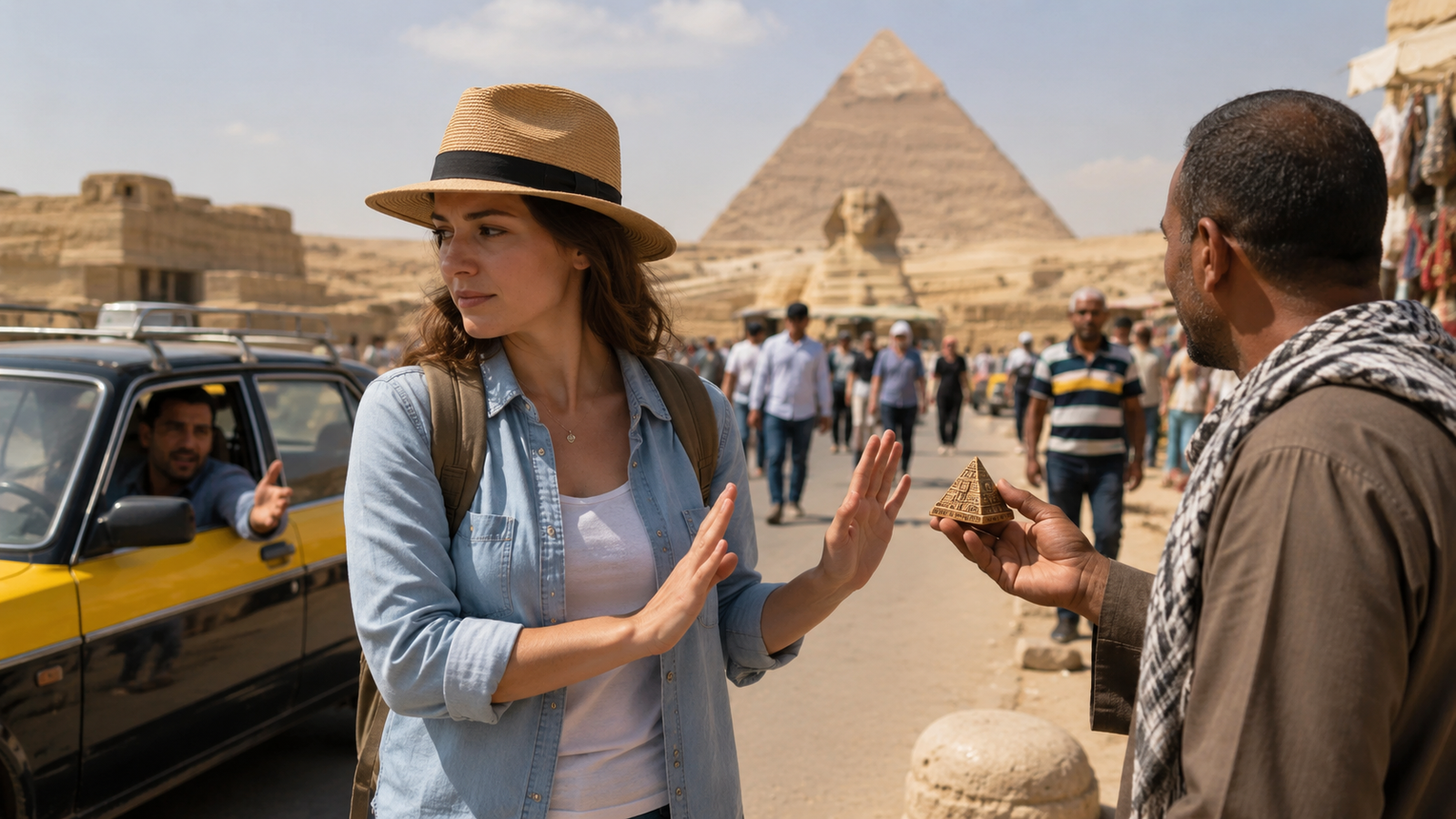
Egypt Tourist Scams – How to Avoid Them All
Egypt Tourist Scams 2027 – How to Avoid the Most Common Tricks
Every year, thousands of travelers arrive in Egypt and have absolutely wonderful experiences. And every year, a smaller number arrive and encounter situations that leave them frustrated, feeling cheated, or wondering what just happened. The difference, in most cases, is not luck — it’s preparation.
Egypt’s tourist scams are well-documented, largely predictable, and almost entirely avoidable with the right knowledge and mindset. None of them involve violence or serious danger. They are, at their core, sophisticated social engineering designed to take a small amount of money from an unprepared visitor. Understanding them removes their power entirely.
This complete 2027 guide covers every major scam encountered at Egypt’s tourist sites, the psychology behind why they work, and the specific responses that defuse them instantly. Consider this your essential pre-trip reading.
For more on general safety in Egypt, see our Is Egypt Safe for Tourists 2027 guide. For smooth logistics that minimize scam exposure, see our Egypt 10-Day Itinerary.
The Golden Rule: Understand the Social Dynamics
Before cataloguing specific scams, it helps to understand why they work at all. Egyptian tout culture operates on several psychological principles:
Reciprocity: If someone gives you something — a gift, a service, help with a photo — human psychology creates an obligation to reciprocate. Touts exploit this by initiating an unsolicited “gift” and then demanding payment.
Authority: Someone wearing official-looking clothing, speaking confidently, or appearing to be a guide creates an impression of legitimacy. Fake officials and fake guides exploit this.
Sunk cost: Once you’re on a camel, inside a shop, or in the middle of a tour, it becomes psychologically harder to refuse payment than if you’d said no at the start.
Embarrassment: Touts often create situations where saying “no” feels rude, aggressive, or unkind in front of other people. Social embarrassment is a powerful compliance tool.
Understanding these mechanisms makes the individual scams much easier to recognize and resist. The counter-principle is simple: you are under zero social obligation to anyone who approaches you unsolicited at a tourist site.
At the Pyramids of Giza
The Giza Pyramid Complex is Egypt’s most visited tourist destination and home to the highest concentration of tourist-focused scams. Be prepared.
Scam 1: The “Free Photo” / “Welcome” Scam
How it works: A friendly local approaches you and either takes your photo with their phone (then demands payment for it), places a traditional keffiyeh headscarf on your head or a baby camel in your arms (then demands payment for the “experience”), or enthusiastically helps you find the “perfect angle” (then presents a bill).
The psychology: By performing an unsolicited service, they create reciprocity pressure. Once the photo is taken or the scarf is on your head, refusing feels awkward.
The solution: Physically prevent items being placed on you by keeping moving and saying “no thank you” before anything touches you. If someone photographs you without permission, you’re not obligated to pay — and you can simply walk away.
Scam 2: The Unofficial Guide
How it works: A person presents themselves near the ticket office as an official guide or supplementary helper. They walk alongside you, pointing out features, providing commentary, and seem perfectly official. At the end of the visit, they expect substantial payment.
The tell: Official guides have PHOTO ID badges and are assigned through registered guiding companies. Someone approaching you spontaneously is not official.
The solution: Decide before entering whether you want a guide. If yes, hire one through a reputable operator like Egypt Travel Ways before your visit. If approached, politely say: “Thank you, I already have a guide” and keep walking.
Scam 3: The Camel / Horse Bait-and-Switch
How it works: An operator quotes an apparently reasonable price for a camel or horse ride. Once you’re mounted (literally on the camel, making dismounting awkward), the price changes — or they claim the quote was “one way” and demand double for the return. Sometimes they lead the camel to a remote spot and demand extra payment before returning.
The solution: Agree on ALL terms explicitly before mounting:
- Exact price for the full experience
- Duration
- Return included?
- What happens at the end?
Get a number, repeat it back, and have it verbally confirmed. And if you don’t want a ride, a simple “no thank you” while continuing to walk is completely sufficient.
Scam 4: The Closed Entrance
How it works: A “helpful” local approaches you before you reach the main entrance and tells you it’s closed, there’s a special event, VIP access is through a different gate, or security requires you to enter from another side. They offer to take you to the “correct” entrance — which conveniently passes through a perfume shop, papyrus gallery, or camel rental area.
The reality: The main entrance at the Giza Pyramid Complex is almost never closed during opening hours. If there’s a genuine exception (official events), it will be prominently announced with security barriers, not by a random passerby.
The solution: Ignore all claims about entrance closures from strangers. Walk to the official main entrance and verify directly. The ticket window is your single point of truth.
Scam 5: The Panoramic Point Driver
How it works: A driver offers to take you to the “panoramic point” where you can photograph all three pyramids in a line. This is a real and worthwhile viewpoint, but some drivers quote a price for the trip and then demand significantly more upon return, claim extras, or pressure you to visit a nearby “studio” or shop.
The solution: The Panorama Point is real and worth visiting. Negotiate the return trip price (including waiting time) before getting in. Use Uber or another currently available ride-hailing service if available, or use your hotel-arranged driver.
In Cairo and Islamic Cairo
Scam 6: The Friendly Guide to Nowhere
How it works: A friendly, well-spoken young Egyptian strikes up a conversation near Khan El Khalili or the Egyptian Museum, expresses admiration for your country, and offers to show you “the real Cairo” — a special tea shop, a rooftop view, a market tourists don’t normally see. The destination turns out to be a relative’s perfume shop, papyrus gallery, or carpet emporium. High-pressure selling follows. Sometimes a “donation” is expected even if you don’t buy.
The psychology: The approach feels like genuine friendship rather than a commercial transaction. By the time you realize what’s happening, social debt has been accumulated.
The solution: Politely decline all offers to be guided somewhere by strangers. If you want to see the bazaar, walk there yourself or book a licensed tour through Egypt Travel Ways. Genuine friendliness in Egypt absolutely exists — but spontaneous guided “tours” in tourist areas almost always have a commercial endpoint.
Scam 7: The Taxi Overcharge
How it works: An unlicensed taxi (often an older black-and-white Cairo taxi without a meter) quotes an enormous price to a tourist who doesn’t know local rates. Or accepts the ride and then claims the meter didn’t work, the price is different than agreed, or the destination has been misunderstood.
The solution: Use Uber or another currently available ride-hailing service for all city transport. Both apps show fixed prices before you confirm, track your journey, and eliminate negotiation entirely. The apps work excellently throughout Egypt’s tourist cities. See the apps’ official pages: Uber Egypt and Careem.
Scam 8: The Currency Confusion
How it works: You hand over money for a purchase and the vendor claims you gave them insufficient payment, a wrong note, or a torn bill that can’t be used. Sometimes they switch your note for a lower denomination and claim they received this.
The solution: Count your money clearly, hand it over with the denomination stated out loud (“that’s 200 pounds”), and watch the exchange carefully. Familiarize yourself with current Egyptian banknotes before travel — the Central Bank of Egypt has current note information.
At the Red Sea Resorts
Scam 9: The Snorkeling/Diving Extras
How it works: You book a snorkeling trip for an advertised price. On the boat, you discover that equipment rental is extra, a “national park fee” wasn’t included, or optional extras become de facto mandatory through social pressure.
The solution: Ask explicitly what is included before booking: “Does this price include mask, fins, and snorkel? Are there any park fees? Is lunch included?” Get a clear “yes” on each item. See our Snorkeling in Sharm El Sheikh Guide for what legitimate trips should include.
Scam 10: The “Free” Gift and Timeshare Presentation
How it works: A hotel staff member or beach vendor offers free excursions, meals, or gifts in return for attending a “brief 45-minute presentation.” The presentation is a high-pressure timeshare or holiday club sales pitch lasting several hours with significant difficulty extricating yourself.
The solution: There are no free gifts that come with conditions attached. Any “gift” requiring attendance at a presentation is a sales tool, not a gesture of hospitality.
At Markets and Bazaars
Scam 11: The Inflated Starting Price
This is technically not a “scam” in the dishonest sense — inflated starting prices in Egyptian markets are a standard and culturally expected negotiation starting point. However, tourists unfamiliar with this can substantially overpay.
How it works: Items in Khan El Khalili and other tourist markets are initially priced at 3–5 times the fair price. A vendor showing you a papyrus scroll for “only 500 pounds” may accept 100–150 pounds after negotiation.
The solution: Bargaining is expected and is part of the cultural experience. Never pay the first price. Counter at 20–30% of the asking price and work toward a middle point. Walk away (genuinely) if the price doesn’t reach your limit — they will often call you back. For guidance on fair prices in Khan El Khalili, see our Khan El Khalili Bazaar Guide.
Scam 12: The Fake Antique
How it works: A vendor sells a small figurine, scarab, or artifact as a “genuine ancient Egyptian antique — thousands of years old!” with an elaborate provenance story.
The legal reality: Egyptian law strictly prohibits the export of genuine antiquities. Any “genuine antique” available for tourist purchase is either a reproduction (legally fine) or stolen goods (illegal and not worth buying). The elaborate provenance stories are fictional.
The solution: Buy reproductions as decorative items — they’re often beautifully made. Don’t invest in objects presented as genuine antiques.
At Other Sites
Scam 13: The “Closed Today” at Luxor and Aswan
How it works: A taxi driver or local guide tells you that the Valley of the Kings (or another major site) is closed today — special maintenance, royal visit, holiday — and offers to take you somewhere “better” instead.
The reality: Major tourist sites in Luxor and Aswan are almost never closed during opening hours without official advance announcement. If there’s a genuine closure, your hotel will know about it.
The solution: Verify directly with your hotel or call ahead to the site. Don’t accept closure claims from drivers or strangers.
Scam 14: The Mandatory “Tip” for Security Guards
How it works: At ancient sites, unofficial security guards (or people presenting themselves as guards) approach you inside a tomb or monument and ask you to follow them for a “special area,” point out something significant, or shine a torch on a painting. They then present a strong expectation of payment.
Context: This isn’t entirely without legitimacy — guards do sometimes point out genuine features and a small tip (5–10 EGP) is normal. The issue is when the “service” was unsolicited and the demand is aggressive.
The solution: If you genuinely appreciated something a guard showed you, a small tip is courteous. If you didn’t ask for the service and don’t want to pay, a polite “la, shukran” (no thank you) and walking away is completely appropriate.
Scam 15: The Petrol Station Attendant
How it works: (More relevant if you’re renting a car). Attendants at petrol stations short-change tourists by pocketing the difference between the money given and what’s displayed on the pump, claiming the pump shows a different amount.
The solution: Watch the pump reset to zero before filling, watch the final amount on the pump, and count your change carefully. This is a minor issue but worth knowing if self-driving.
How to Significantly Reduce Scam Risk: Practical Summary
Book through reputable operators. Using Egypt Travel Ways for major site visits means licensed guides, official transport, and professional support — eliminating most scam scenarios before they arise.
Use Uber or another currently available ride-hailing service for city transport. Fixed prices, tracked journeys, zero negotiation.
Buy entrance tickets only at official ticket windows. Never from individuals outside the gates.
Say “no thank you” and keep walking. The most effective response to almost any unsolicited approach.
Learn “la, shukran.” The Arabic for “no thank you” — delivered with a smile and while continuing to walk — resolves most situations without confrontation.
Travel in groups for market visits. Solo travelers (particularly solo female travelers) attract more persistent attention. Having a companion changes the social dynamic significantly.
External Resources
- Tourist Police Egypt — Contact for tourist police: 126 (Egypt-wide hotline)
- US Embassy in Egypt — For US citizens requiring consular assistance
- UK Embassy in Egypt — For UK citizens
15 People Also Ask Questions About Egypt Scams
1. What are the most common scams in Egypt?
The most common scams target tourists at the Pyramids of Giza and include the “free photo” scam (unsolicited photo or object placed on you, then payment demanded), the unofficial guide scam, the closed entrance scam, and camel ride price-switching. In Cairo, the friendly guide to a relative’s shop and taxi overcharging are the most reported. In markets, inflated starting prices are universal (though not dishonest — it’s standard negotiating culture).
2. Is Egypt full of scammers?
No — the vast majority of Egyptians are genuinely welcoming and honest. Scams concentrate in tourist areas around major sites (particularly the Pyramids) and in tourist-oriented market areas. Once you understand the patterns, they’re easy to navigate. Outside tourist zones, you’ll encounter overwhelming genuine hospitality.
3. How do I avoid being scammed in Egypt?
The most effective strategies: use reputable tour operators for major site visits; use Uber or another currently available ride-hailing service for transport; buy tickets only at official windows; say “no thank you” firmly to unsolicited offers; don’t accept gifts or “services” you didn’t request; and learn the phrase “la, shukran” (no thank you in Arabic).
4. Are taxis safe in Egypt?
Licensed taxis are generally safe. The main issue is overcharging, not safety. Using Uber or another currently available ride-hailing service (both widely available in Egypt’s tourist cities) eliminates the overcharging risk entirely with fixed app prices and tracked journeys.
5. Is it safe to visit the Pyramids of Giza alone?
Yes, the Pyramids are safe to visit. The main challenges are touts and vendors rather than physical safety. Going alone or independently requires more confidence in saying “no” to unsolicited approaches. Booking a guided tour through a reputable operator eliminates most hassle.
6. What is the pyramid scam?
There are several pyramid scams. The most common involve: unofficial guides claiming official status, unsolicited photos or items placed on tourists followed by payment demands, claims that the main entrance is closed, and camel/horse ride price-switching after you’ve mounted. All are avoidable with the knowledge of how they work.
7. Should I bargain in Egyptian markets?
Yes — bargaining is expected and culturally appropriate in Egyptian bazaars, markets, and with taxi drivers who don’t use meters. Starting prices are set high with the expectation of negotiation. Counter-offer at 20–30% of the asking price and negotiate toward a fair middle. Fixed-price shops (supermarkets, official ticket offices) don’t negotiate.
8. What is baksheesh in Egypt?
Baksheesh is the widespread Egyptian tipping culture — small payments expected for services, assistance, and sometimes simply for being in a space (a guard in a tomb, a bathroom attendant, someone who helps carry your bag). Budget $5–10 USD equivalent per day for baksheesh across all interactions. Refusing expected baksheesh creates awkwardness; paying it maintains positive social relations.
9. Is Uber safe in Egypt?
Yes, Uber is safe and widely used by tourists and locals in Cairo, Luxor, Aswan, and other major cities. It’s actually one of the best safety tools for tourists — prices are fixed and shown before you confirm, the journey is tracked by GPS, and driver information is verified. Careem (the regional equivalent) offers the same benefits.
10. Do I need to worry about pickpockets in Egypt?
Pickpocketing exists in crowded areas (Cairo’s metro, Khan El Khalili, around major tourist sites) but is not at the level of, say, Rome or Barcelona. Standard precautions — keeping valuables in a front pocket or money belt, not displaying expensive cameras in crowded markets, not leaving bags unattended — are sufficient.
11. What should I do if I’ve been scammed in Egypt?
If the amount is small (under $20 USD), it’s usually not worth pursuing — the stress of confrontation or reporting exceeds the monetary loss. For significant amounts, contact the tourist police (hotline: 126). For serious incidents, contact your country’s embassy. Your tour operator (Egypt Travel Ways provides 24/7 support) can also assist with navigating local situations.
12. Are guides at ancient sites official?
Official licensed guides in Egypt carry a photo ID badge issued by the Egyptian Ministry of Tourism. Anyone approaching you spontaneously at a tourist site and offering to guide you is not an official guide and has no official standing. If you want a licensed guide, book through Egypt Travel Ways or hire one at the official guide counter at the ticket office.
13. Is the Valley of the Kings safe?
Yes, the Valley of the Kings is very safe for tourists. The site has heavy security presence and is well-monitored. The main concerns are the usual vendor persistence (people trying to sell items or photos at the entrance area) rather than any safety issue. For full information, see our Valley of the Kings Guide.
14. How do I know if a guide is licensed in Egypt?
Licensed Egyptian tour guides carry a photo ID badge with their licensing number, issued by the Egyptian Ministry of Tourism. The badge shows their name, photo, and license category (Egyptologist guide, local guide, etc.). Anyone who cannot produce this badge on request is not a licensed guide. Additionally, licensed guides from reputable agencies will have been pre-arranged through your tour operator — they don’t approach tourists spontaneously.
15. Are the Red Sea resorts (Sharm El Sheikh and Hurghada) full of scams?
The Red Sea resorts have fewer scams than the major ancient site areas, primarily because the all-inclusive resort model reduces exposure to street-level commerce. The main scam risks are excursion-related (hidden extras, inflated prices for snorkeling/diving trips) and timeshare-style “free gift” presentations. Booking excursions through reputable operators like Egypt Travel Ways rather than beach vendors significantly reduces this risk.
Travel Confidently with Egypt Travel Ways
The best defense against scams is professional guidance from people who know Egypt deeply. Egypt Travel Ways provides licensed guides, vetted transport, and transparent pricing — so you spend your time in Egypt experiencing its extraordinary history and beauty, not navigating tourist traps.
Contact Egypt Travel Ways today for a scam-free Egypt experience.

Recent Posts
Tipping in Egypt (2026–2027): Guides, Drivers, Nile Cruises & Hotels

What’s Included in an Egypt Nile Cruise? Cruise-Only vs Guided Packages
Grand Egyptian Museum vs Egyptian Museum vs NMEC: Which Should You Visit?
All Categories
- Abu Simbel
- Abu Simbel from Aswan
- Airport
- Articles
- Aswan
- Best Time to Visit Egypt
- cairo
- Coptic Cairo
- Desert & Oasis
- Dive into the Magic of Sharm’s Underwater World
- Egypt Honeymoon Guide
- Egypt Safari
- Egypt Tourist Scams
- Egypt Travel Budget
- Egypt Travel Planning
- Felucca Ride on the Nile
- Grand Egyptian Museum
- Honeymoon
- hot air balloon luxor egypt
- Hurghada
- Is Egypt Safe for Tourists
- Islamic Cairo Walking
- Karnak Temple
- Khan El Khalili Bazaar
- luxor egypt
- Nile Cruise
- Nubian Village Aswan
- old cairo
- pyramids giza
- Sharm El Sheikh
- Siwa Oasis
- Siwa’s Simplicity
- Solar Eclipse Egypt
- The White Desert A Dream Sculpted by Time
- The Wonders of Saqqara
- Transport
- tutankhamun treasures
- Uncategorized
- White Desert Egypt Safari