Grand Egyptian Museum Visitor Guide 2027 – Tickets, Tips & Highlights
Last fact-checked: 1 October 2026. Opening hours, ticket prices and booking rules can change; always confirm your visit on the official GEM website before travel.
The Grand Egyptian Museum is the world’s largest museum dedicated to a single civilisation, located near the Giza Pyramids at El Remayah Square. Its galleries now include the Tutankhamun Galleries, Main Galleries, Grand Hall, Grand Stairs and Khufu’s Boats Museum.
This comprehensive guide covers everything you need to know: what makes the GEM extraordinary, the must-see highlights, ticket prices, how much time to allow, practical visiting tips, how to combine it with the Pyramids, and what separates the Grand Egyptian Museum from Egypt’s other great museums.
What Makes the Grand Egyptian Museum Different?
Egypt has had an extraordinary archaeological museum for over a century — the Egyptian Museum in Tahrir Square, opened in 1902. But the Tahrir Museum was built for a different era, and its collections had long outgrown its capacity. Artifacts were crowded, storage was inadequate, and significant pieces languished in poorly lit cases or in basement storerooms.
The Grand Egyptian Museum changes everything. Built on a 450,000-square-meter site, the GEM was designed from the ground up as a world-class museum of the 21st century — with state-of-the-art conservation facilities, cutting-edge exhibition design, excellent visitor infrastructure, and enough space to display Egypt’s treasures in the context and grandeur they deserve.
Key facts:
- Size: The largest archaeological museum in the world
- Collection size: Over 100,000 artifacts on display
- Highlight: The complete Tutankhamun collection — 5,000+ objects, all displayed together for the first time in history
- Location: Al Remaya Square, Giza — 2 km from the Pyramids of Giza
- Investment: Several billion dollars invested in construction and curation
The GEM is not just a museum. It is Egypt’s statement to the world that its civilization — the longest continuously documented civilization in human history — deserves the finest possible home.
Essential Visitor Information
Location: Al Remaya Square, Al Haram, Giza
Opening Hours:
- Sunday, Monday, Tuesday, Thursday and Friday: GEM Complex 8:30 AM–7:00 PM; galleries 9:00 AM–6:00 PM; last entry 5:00 PM.
- Wednesday and Saturday: GEM Complex 8:30 AM–10:00 PM; galleries 9:00 AM–9:00 PM; last entry 8:00 PM.
Website: gem.eg
Official ticketing: tickets.gem.eg
Nearest Landmark: 2 km from the Giza Pyramids main entrance
Getting There:
- From the Pyramids: 5-minute drive or 20-minute walk
- From central Cairo: 30–45-minute drive (depending on traffic), or by Uber or another currently available ride-hailing service
- By tour: Most Egypt Travel Ways tours combine the GEM with the Pyramids in a single full-day Giza experience
Grand Egyptian Museum (GEM) Tour – Discover Egypt’s Newest Wonder
Tickets and Entrance Fees (2027)
Current foreign-adult admission: EGP 1,590 as shown on the official GEM ticketing platform on 1 October 2026. Child and student tickets for Arab or other nationalities are listed at EGP 800, subject to eligibility and valid identification.
What the standard admission includes: the official GEM ticketing website states that admission includes the Tutankhamun Galleries, Main Galleries, Grand Hall, Grand Stairs, Khufu’s Boats Museum, commercial area and exterior gardens.
Booking advice: GEM says tickets should be booked online in advance with a selected entry time. From 1 December 2025, online booking became the only ticket-purchase method. Use the official platform at tickets.gem.eg and re-check the current price when booking.
The Tutankhamun Collection: The Crown Jewel
The Tutankhamun collection is the single greatest reason the Grand Egyptian Museum exists and the single greatest reason you must visit it.
For decades, the approximately 5,000 objects from Tutankhamun’s tomb — discovered intact by Howard Carter in 1922 — were divided between the Egyptian Museum in Tahrir (the most famous pieces on display) and storage facilities (the rest). The Grand Egyptian Museum is the first institution in history to display the complete, entire collection together in a dedicated exhibition space.
The scale: 5,000+ objects occupy an enormous multi-room gallery. Visiting the complete Tutankhamun collection takes a minimum of 1.5–2 hours to experience properly.
The Most Important Objects in the Tutankhamun Collection
The Golden Death Mask
The most famous single object in ancient Egyptian history. A solid gold funeral mask weighing 10.23 kg, inlaid with lapis lazuli, turquoise, obsidian, and glass. The face — serene, beautiful, and haunting — is the defining image of ancient Egypt for billions of people worldwide.
The mask was placed directly over the mummy’s head and shoulders and is a masterpiece of ancient craftsmanship executed with astonishing technical precision. Standing before it in person is a genuinely powerful experience.
The Innermost Gold Coffin
The innermost of Tutankhamun’s three nested coffins is made of solid gold weighing approximately 110 kg. Its value in pure metal alone is extraordinary; as an artifact of ancient craftsmanship, it is priceless. The coffin is humanoid in form, with the king depicted as Osiris holding the crook and flail.
The Golden Throne
A gilded wooden throne decorated with scenes showing Tutankhamun and his wife Ankhesenamun in intimate domestic moments — among the most tender and human images to survive from ancient Egypt. The composition is extraordinary: the young queen applies perfumed oil to her husband’s shoulder, both bathed in the rays of the Aten (sun disk). The eyes inlaid with colored glass give both figures a startlingly lifelike quality.
The Ceremonial Chariots
Six complete chariots were found in Tutankhamun’s tomb — the most complete collection of ancient Egyptian chariots in existence. These beautifully decorated vehicles, used for ceremonial and possibly battle purposes, give a vivid sense of royal Egyptian life.
The Canopic Shrine
An exquisite gilded wooden shrine containing four alabaster containers (canopic jars) holding the king’s internal organs — his liver, lungs, stomach, and intestines, each protected by a deity’s spell carved into the alabaster. The four small golden goddesses (Isis, Nephthys, Neith, and Serket) standing with outstretched wings on the corners of the outer shrine are among the most beautiful small sculptures in ancient Egyptian art.
Tutankhamun’s Jewelry
Hundreds of pieces of jewelry — pectorals, bracelets, necklaces, rings, earrings — showcase the extraordinary skill of ancient Egyptian goldsmiths. The famous scarab pectoral is made from a piece of desert glass (created by a meteorite impact millions of years ago) — one of the first recognized uses of extraterrestrial material in human artwork.
The Ritual Beds and Beds
Three ceremonial couches in the form of animals (a lion, a cow, and a hippo-headed demon) were found in the antechamber — objects whose specific ritual purpose is still debated by scholars.
Grand Egyptian Museum (GEM) Tour – Discover Egypt’s Newest Wonder
Other Major Highlights of the GEM
The Grand Staircase
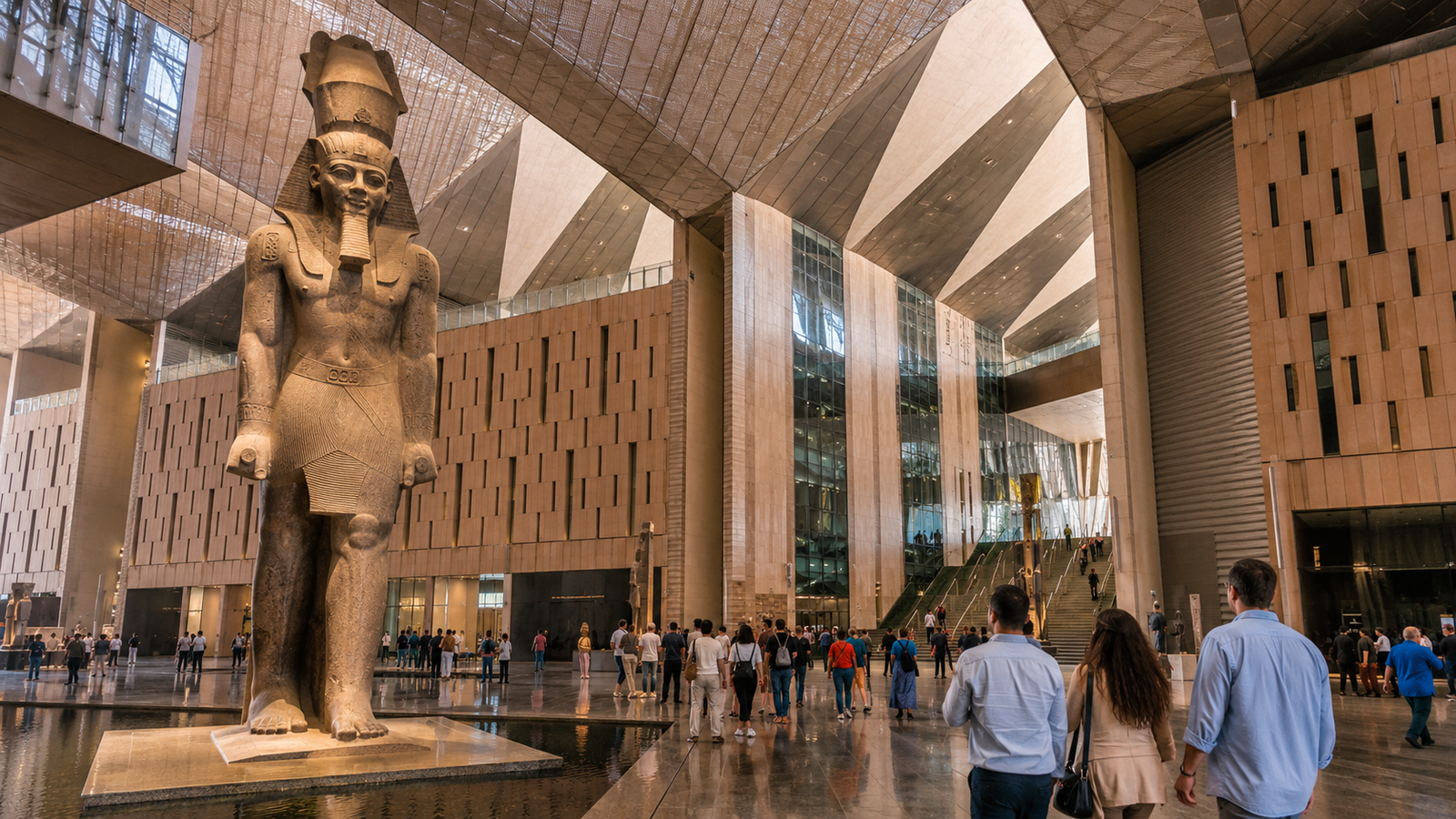
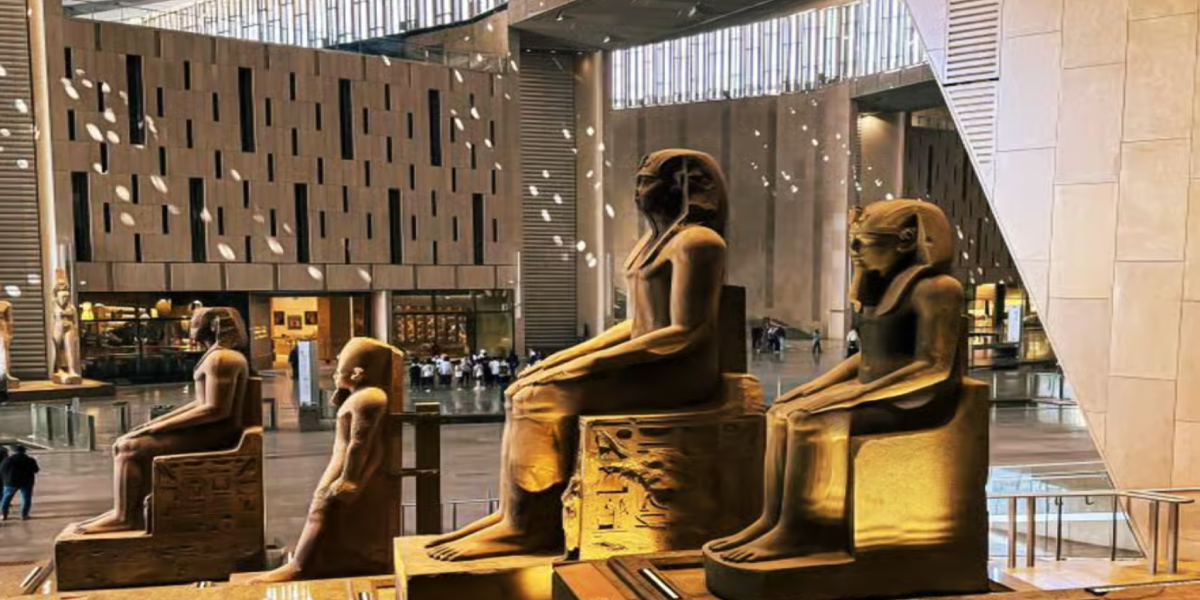
The main entrance to the museum is dominated by one of the most dramatic arrival experiences in any museum anywhere in the world. The Grand Staircase is flanked by 87 royal statues — a procession of ancient pharaohs that creates an overwhelming sense of historical depth and regal power.
The centerpiece of the staircase atrium is a monumental 11-meter tall statue of Ramesses II, one of the largest ancient Egyptian statues in existence. Discovered in Memphis, it originally stood in a temple courtyard and would have been visible from great distances.
The Atrium and Grand Stairs Light Experience
The GEM’s architects designed the building around natural light — the slanted glass facade of the atrium fills the interior with ever-changing patterns of light and shadow throughout the day. The late afternoon, when the low Egyptian sun streams through the facade and illuminates the Ramesses statue, is the most photogenic moment for this space.
Gallery of Egyptian Civilization through the Ages
A chronological journey through 7,000 years of Egyptian civilization, from Predynastic artifacts through the Pharaonic period, the Greek (Ptolemaic) era, the Roman period, and early Christian and Islamic Egypt. This gallery provides the essential context that makes everything else in the museum comprehensible.
Where are the royal mummies? Not at GEM
The Royal Mummies Hall is at the National Museum of Egyptian Civilization (NMEC), not the Grand Egyptian Museum. The royal mummies were transferred from the Egyptian Museum in Tahrir to NMEC in Fustat, Cairo. If you want to see them, plan a separate museum visit. Check NMEC visitor information for opening hours, tickets and photography rules.
The Children’s Museum
A dedicated wing designed for visitors ages 5–15, with interactive, age-appropriate exhibits, activities, and storytelling that makes ancient Egyptian history accessible and exciting for young visitors.
Conservation and research facilities
GEM has important conservation and research operations, but visitors should not assume that a standard admission ticket includes access to conservation laboratories or live work areas. Check the official museum information for public programmes and access conditions.
The GEM Gardens and Grounds
The outdoor grounds of the GEM contain ancient statues and architectural fragments displayed in the open air, including several large sphinx figures. The garden between the GEM and the Pyramids offers what is arguably the most spectacular view available in Egypt: the three Giza pyramids rising over the museum’s modern facade.
How Much Time Do You Need at the GEM?
This is the most frequently underestimated aspect of a GEM visit. First-time visitors routinely plan 2 hours and find they’ve barely scratched the surface.
Practical recommendation: Plan for a minimum of 4 hours. If you find yourself wanting more, the GEM has an excellent restaurant and café where you can recharge before returning to the galleries.
Tips for Visiting the Grand Egyptian Museum
Book your timed admission in advance. The official GEM ticketing website currently includes the Tutankhamun Galleries within the standard admission ticket. Choose your entry time online before arrival and check the official booking page for any special experiences or add-ons.
Visit on a weekday. Weekends (Friday and Saturday in Egypt) are significantly busier. Tuesday and Wednesday mornings are the quietest times.
Start with the Grand Staircase. The staircase arrival sets the psychological and emotional context for everything that follows. Don’t rush past it.
Hire an Egyptologist guide. The GEM’s scale and depth rewards expert guidance. A licensed guide can focus your visit on the pieces that matter most, provide context that signage alone cannot supply, and ensure you don’t miss significant objects in large galleries.
The Tutankhamun gallery requires time. Don’t rush through. Allow at least 1.5 hours for the Tutankhamun collection and ideally 2 hours. Reading the labels and taking in each object properly makes the experience transformative rather than merely impressive.
Visit the Conservation Center. It’s one of the most unique features of the GEM and one that most visitors overlook. Check when conservators are working (typically weekday mornings).
The café and restaurant are good. The GEM has a food court, a mid-range restaurant, and a coffee shop. All are well-designed and food quality is notably higher than typical museum catering.
Photography is permitted in most galleries. Bring your best camera. The lighting in the Tutankhamun galleries is designed to be photographable without flash.
GEM vs. Egyptian Museum in Tahrir: Which to Visit?
For travelers visiting Egypt in 2027, the Grand Egyptian Museum is the clear first choice. The complete Tutankhamun collection, the superior presentation, the better facilities, and the proximity to the Pyramids all favor the GEM.
That said, the Egyptian Museum in Tahrir has over a century of accumulated atmosphere, its own significant collection, and an historic character that the new GEM cannot replicate. Travelers with 2+ days in Cairo can and should visit both.
If you can only visit one museum: The Grand Egyptian Museum.
Combining the GEM with the Pyramids
The Pyramids and the GEM are just 2 km apart — making a combined visit entirely logical and the most popular full-day experience in all of Egypt. The optimal structure:
Arriving by 8:00 AM at the Pyramids:
- 8:00–11:00 AM: Giza Pyramid Complex (pyramids, Sphinx, Valley Temple)
- 11:00 AM–12:00 PM: Short drive to the GEM and lunch or a short break
- 12:00–5:00 PM: Grand Egyptian Museum using your pre-booked timed admission
This structure maximizes the day — the Pyramids in the cool morning, the climate-controlled museum in the hot afternoon.
15 People Also Ask Questions About the Grand Egyptian Museum
1. Is the Grand Egyptian Museum open?
Yes. As of 1 October 2026, the Grand Egyptian Museum is open to visitors and its official ticketing website lists access to the Tutankhamun Galleries, Main Galleries, Grand Hall, Grand Stairs and Khufu’s Boats Museum. Check the official GEM website for any temporary closures or changes before your visit.
2. Where is the Grand Egyptian Museum located?
The Grand Egyptian Museum is located at Al Remaya Square in Giza, approximately 2 kilometers from the main entrance of the Giza Pyramid Complex. By road it’s a 5-minute drive from the pyramids or a 30–45-minute drive from central Cairo.
3. How much does it cost to visit the Grand Egyptian Museum?
As of 1 October 2026, the official GEM ticketing platform lists standard adult admission for Arab or other nationalities at EGP 1,590. The standard ticket includes the Tutankhamun Galleries. Prices can change, so verify the amount on the official ticketing page before booking.
4. What is the best highlight of the Grand Egyptian Museum?
The undisputed highlight is the complete collection of Tutankhamun’s treasures — over 5,000 objects displayed together for the first time in history. The golden death mask, the solid gold innermost coffin, and the golden throne are among the most significant artifacts in human history. The Grand Staircase with its Ramesses II statue is the second most impressive experience.
5. How long does it take to visit the Grand Egyptian Museum?
A minimum visit covers the main highlights in 2–3 hours. A thorough visit takes 4–5 hours. A complete visit of most galleries requires 6–8 hours. Plan for at least 4 hours to experience the museum properly, including the Tutankhamun galleries.
6. Is the Grand Egyptian Museum better than the Egyptian Museum in Tahrir?
For most visitors, yes. The GEM offers far superior presentation, vastly more space, better facilities, and most importantly, the complete Tutankhamun collection that the Tahrir museum could not display in its entirety due to space limitations. The Tahrir museum retains historic character and some significant pieces not yet transferred, but for a first-time visitor, the GEM is the clear choice.
7. Can I visit the Grand Egyptian Museum and the Pyramids in one day?
Yes — and this is the recommended approach. The GEM is just 2 km from the Pyramids, making a combined visit entirely practical. Visit the Pyramids in the morning (arriving at 8:00 AM opening) and the GEM in the afternoon (1:00–6:00 PM). This creates one of the finest single days available in all of Egyptian tourism.
8. Is photography allowed in the Grand Egyptian Museum?
Photography is permitted in most areas of the GEM including the main galleries and the Tutankhamun collection. Flash photography is prohibited to protect the artifacts. Some specific areas (particularly near mummies) may have photography restrictions — follow signage and guard instructions.
9. Where is Tutankhamun’s golden mask displayed?
Tutankhamun’s famous golden death mask is displayed in the Grand Egyptian Museum’s Tutankhamun galleries in Giza. It was previously displayed in the Egyptian Museum in Tahrir Square, where it was one of the most visited objects in the world, before being transferred to the GEM as part of the complete Tutankhamun collection.
10. Is the GEM suitable for children?
Yes, the Grand Egyptian Museum is very suitable for children. The dedicated Children’s Museum wing provides interactive, age-appropriate exhibits. The scale and spectacle of the main galleries — particularly the towering Ramesses II statue and the gold of the Tutankhamun collection — captivates children of all ages. Younger children (under 6) enter free.
11. What is the GEM’s conservation center?
The GEM’s Conservation Center is a working scientific laboratory where archaeologists and conservators restore, clean, and preserve ancient artifacts. Uniquely, visitors can observe the work through transparent glass windows — a fascinating glimpse into the ongoing science of Egyptology and artifact preservation.
12. Does the GEM have a restaurant?
Yes, the Grand Egyptian Museum has a food court, a mid-range restaurant, and a coffee shop. Food quality is good by museum standards and the setting — with views toward the Pyramids — is spectacular. Prices are higher than Cairo city restaurants but reasonable for a museum setting.
13. What is the difference between the Grand Egyptian Museum and the Egyptian Museum?
The Egyptian Museum in Tahrir Square, opened in 1902, is Cairo’s historic antiquities museum. The Grand Egyptian Museum is a purpose-built museum near the Giza Pyramids with a much larger modern exhibition complex. The two are separate museums, and the Egyptian Museum in Tahrir remains open.
14. How do I get from Cairo to the Grand Egyptian Museum?
The museum is reached most directly by car, taxi, hotel-arranged transfer or tour vehicle. The official GEM website says public-transport details are still being updated and does not currently list a dedicated metro connection. Allow extra time for Cairo traffic and confirm your route on the day of travel.
15. Are there guided tours of the Grand Egyptian Museum?
Yes, licensed Egyptologist guides are available at the museum or can be arranged in advance through tour operators. A guided tour of the GEM is highly recommended — the scale of the collections is vast and a knowledgeable guide ensures you spend your time on the most significant pieces and understand what you’re seeing. Egypt Travel Ways offers private GEM tours with expert guides tailored to your specific interests.
Book Your Grand Egyptian Museum Tour with Egypt Travel Ways
The Grand Egyptian Museum deserves your full attention, proper preparation, and expert guidance. Egypt Travel Ways offers private GEM tours combined with the Giza Pyramids — a full-day Giza experience that covers the ancient wonders above the ground and the ancient treasures within the museum.
Our licensed Egyptologist guides are among the finest in Egypt — academics who have spent careers studying these artifacts and who can bring 5,000 years of history to life for every visitor, from children discovering ancient Egypt for the first time to seasoned travelers returning to deepen their understanding.
Contact Egypt Travel Ways today to book your Grand Egyptian Museum visit — and prepare to be genuinely astonished.