Islamic Cairo Walking Tour Guide 2027 – Mosques, Gates & Hidden Streets
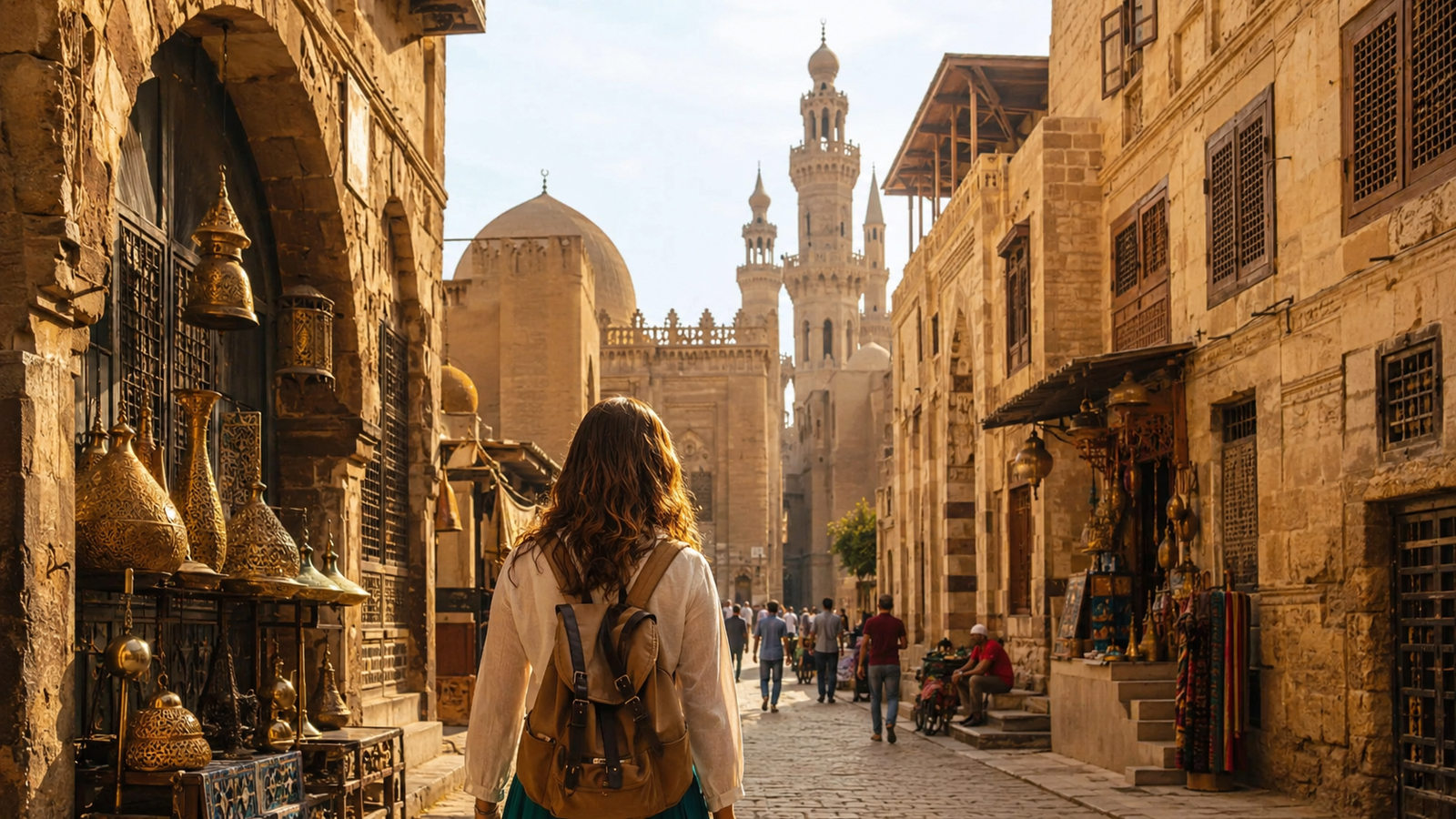
There is a Cairo that most visitors never fully explore — a Cairo of medieval gates and minarets, of centuries-old markets still selling the same goods they have sold since the Fatimid caliphate, of mosques that rank among the greatest architectural achievements of the Islamic world, of streets so old that their cobblestones were laid when the Crusades were still ongoing. This is Islamic Cairo — and a walking tour through its streets is one of the most extraordinary urban experiences available anywhere in the world.
UNESCO designated Historic Cairo as a World Heritage Site in 1979, recognizing it as “one of the world’s oldest Islamic cities” and home to “outstanding mosques, madrasas, bathhouses and fountains” — the finest concentration of medieval Islamic architecture on Earth.
This complete 2027 guide gives you the optimal walking route, the key monuments to see, the hidden alleys worth finding, the best cafes for rest stops, and the practical logistics that make the experience seamless.
For planning context, see our Egypt 10-Day Itinerary and our Khan El Khalili Bazaar Guide which covers the commercial heart of Islamic Cairo. For Coptic Cairo nearby, see our Coptic Cairo Guide.
A Brief History of Islamic Cairo
Cairo as we know it did not exist before the Islamic conquest of Egypt in 641 CE. The Arab general Amr ibn al-As established a garrison city called Fustat south of the Roman Fortress of Babylon. Over subsequent centuries, successive ruling dynasties established new settlements north of Fustat, each creating their own royal city.
The Fatimid Caliphate (969–1171 CE): The Fatimids, a Shia Muslim dynasty from North Africa, conquered Egypt in 969 CE and established Al-Qahira (the Victorious) — the walled royal city that gave modern Cairo its name. They built the two great mosques of Al-Azhar and Al-Hakim, the grand gates of Bab Zuweila and Bab al-Futuh, and the long processional street that still bisects the old city: Al-Muizz Street.
The Ayyubid Period (1171–1250 CE): Saladin (Salah ad-Din al-Ayyubi) — the famous warrior-statesman who recaptured Jerusalem from the Crusaders in 1187 — built the Citadel of Saladin on a rocky spur above Cairo, establishing the political heart of the city that remained dominant for 700 years.
The Mamluk Period (1250–1517 CE): The greatest period of Islamic architectural achievement in Cairo. The Mamluks — a military caste of former slaves who ruled Egypt for over 250 years — were extraordinary patrons of architecture. The Sultan Hassan Complex, the Madrasa of Barquq, and dozens of other monuments from this period represent the pinnacle of medieval Islamic architecture.
The Ottoman Period (1517–1798 CE): Egypt became a province of the Ottoman Empire. The Alabaster Mosque of Muhammad Ali — the dominant element of Cairo’s famous skyline — was built by the Albanian-born Ottoman governor Muhammad Ali Pasha in the early 19th century, though in a style influenced by Ottoman Imperial mosques in Istanbul.
For authoritative Islamic Cairo history: UNESCO Historic Cairo World Heritage.

Experience the charm and energy of Khan El Khalili
The Optimal Walking Route
The following route covers Islamic Cairo’s greatest highlights in a logical sequence. Total walking distance: approximately 3–4 km. Total time: 4–6 hours depending on depth of visit.
Starting point: The Citadel (accessible by taxi from central Cairo — approximately 15 minutes)
Stop 1: The Citadel of Saladin and the Alabaster Mosque
History: The Citadel was begun by Saladin in 1176 CE as the primary fortification and governmental center of medieval Cairo. Positioned on a rocky spur of the Muqattam Hills, it commands panoramic views of the entire city — a strategic position chosen both for defense and for visibility.
For nearly 700 years, the Citadel served as the seat of Egyptian power. Every major ruler from Saladin through Muhammad Ali governed from here.
The Mosque of Muhammad Ali (Alabaster Mosque): The dominant visual element of Cairo’s skyline, this Ottoman-style mosque was built by Muhammad Ali Pasha between 1830 and 1848. Its twin minarets rise 82 meters above the Citadel; its interior is lined with the alabaster that gives it its name. The domed interior, inspired by Sinan’s great Ottoman mosques in Istanbul, is extraordinarily imposing.
The views: The Citadel’s ramparts offer the most comprehensive panoramic view of Cairo available anywhere — from the medieval minarets of the old city to the modern suburbs extending to the desert horizon, with the Pyramids of Giza visible on clear days.
Sultan Hassan Mosque (visible from below the Citadel): Before leaving the Citadel area, walk down to the Mosque-Madrasa of Sultan Hassan — considered by many architectural historians to be the greatest Islamic building in Egypt. Built 1356–1363 CE, it is monumental in scale (the entrance doorway is 38 meters tall) and extraordinarily refined in detail. The entire building functions as a mosque and a four-court madrasa (Islamic school), with each court dedicated to one of the four Sunni schools of jurisprudence.
Stop 2: Al-Muizz Street — The Historic Spine
Al-Muizz Li-Din Allah Street is the main north-south processional street of Fatimid Cairo, running 1 kilometer from Bab Zuweila (southern gate) to Bab al-Futuh (northern gate). Named after the Fatimid Caliph who established Cairo, it is lined on both sides with medieval Islamic monuments — mosques, madrasas, caravanserais, fountains, and palaces spanning nine centuries of continuous urban history.
The pedestrianized section — several hundred meters of the street — is now closed to vehicles in the evenings and is among the most atmospherically extraordinary urban spaces in the world.
Key monuments along Al-Muizz Street:
Sebil-Kuttab of Abd al-Rahman Katkhuda (18th century): A combined water fountain and Quranic school, beautifully restored, at the southern end of the best-preserved section.
Madrasa of Al-Nasir Muhammad (14th century): A Mamluk masterpiece with one of the most beautiful entrance portals in Egypt — Gothic columns (taken from a Crusader church in Acre) supporting a marble-inlaid doorway.
Qalawun Complex (1284–1285 CE): A complex containing a mosque, madrasa, and mausoleum built by the Mamluk Sultan Qalawun. The mausoleum interior, with its extraordinarily intricate geometric woodwork and stained glass windows, is one of the most beautiful interiors in Islamic Cairo.
Madrasa of Al-Nasir Muhammad ibn Qalawun: Stunning portal decoration combining pharaonic, Gothic, and Islamic elements — evidence of the cosmopolitan cultural world of medieval Cairo.
Al-Hakim Mosque (Fatimid, founded 990 CE): One of the oldest mosques in Cairo. The Fatimid structure has been substantially modified but retains much of its original plan. The massive square minarets are among the oldest surviving in Egypt.
Stop 3: Khan El Khalili and Al-Azhar
At the northern end of the Al-Muizz Street pedestrianized section, you’ll reach the Khan El Khalili bazaar area — the commercial heart of Islamic Cairo, established in 1382 CE. For a comprehensive guide to shopping, eating, and navigating Khan El Khalili, see our dedicated Khan El Khalili Guide.
Al-Azhar Mosque and University: Immediately adjacent to Khan El Khalili is one of the most significant institutions in the Islamic world. Al-Azhar (the Resplendent) was founded by the Fatimids in 970 CE, making it one of the oldest universities in continuous operation in the world. It became and remains the most prestigious center of Sunni Islamic scholarship globally — its religious rulings (fatwas) carry authority throughout the Muslim world.
The mosque is open to non-Muslim visitors except during prayer times. Women visitors are required to cover their hair. The atmosphere is extraordinary — one of the few places in the Islamic world where you can genuinely feel the weight of over 1,000 years of continuous scholarly tradition.
Al-Hussein Mosque: Directly opposite Al-Azhar, this mosque is one of Egypt’s most important religious sites — the reputed burial place of the head of Hussein ibn Ali, grandson of the Prophet Muhammad, a figure of immense veneration in both Sunni and Shia Islamic traditions. Non-Muslims may visit outside prayer times.
Stop 4: Bab Zuweila — The Southern Gate
Returning south along Al-Muizz Street (or via a parallel route through the market alleys), reach Bab Zuweila — the magnificent southern gate of Fatimid Cairo, completed in 1092 CE. Its two massive towers, rising to 24 meters, are topped with the minarets of the Mosque of al-Mu’ayyad (a later addition) creating one of Islamic Cairo’s most iconic silhouettes.
Climb the minarets: For approximately $3–5 USD, you can climb to the top of the Bab Zuweila minarets — one of the best panoramic views of Islamic Cairo’s roofscape available anywhere. The view over the medieval domes, minarets, and market roofs is extraordinary.
Historical significance: Bab Zuweila served as the main public execution site in medieval Cairo. Important criminals and enemies of the state were beheaded or hanged here — their heads displayed on the gate as public warning. The gate’s grim history makes it one of Islamic Cairo’s most historically resonant sites.
Stop 5: The Tanneries, Tentmakers’ Market, and Hidden Alleys
South of Bab Zuweila lies the Tentmakers’ Market (Khayamiya) — a covered market where craftsmen produce the brilliantly colored appliqué fabric panels used for tents, weddings, and funerals. These panels are an extraordinary traditional art form unique to Egypt, with intricate geometric and floral patterns stitched in vivid colors. The market is one of the few remaining places in Cairo where traditional craft production is still commercially active.
The Tanning District: Further south, the medieval tanning industry that once defined this area can still be partially glimpsed. Cairo’s urban geography is still organized along the medieval trade-quarter lines that defined the medieval city.
The Best Cafes and Rest Stops
El Fishawy Café: Inside the Khan El Khalili alleys — the most famous café in Egypt, reportedly open since 1773. Mint tea, Turkish coffee, and shisha in an atmosphere of gilded mirrors and centuries of conversation.
Naguib Mahfouz Café: Named after Egypt’s Nobel Prize-winning novelist, a slightly more formal café near Khan El Khalili serving Egyptian food and good coffee.
Rooftop cafes near the Citadel: Several cafes near the Citadel entrance offer panoramic views. Ask locally for current recommendations.
Practical Tips for Your Islamic Cairo Walking Tour
Start at the Citadel, not Khan El Khalili. The Citadel requires a taxi to reach; Khan El Khalili is the natural endpoint. Going north-to-south creates a logical flow through the historic street.
Hire a licensed guide. Islamic Cairo’s history spans 1,100 years and involves dozens of dynasties, architectural styles, and religious traditions. A licensed Egyptologist or Islamic Cairo specialist guide transforms the walk from impressive to genuinely understood.
Dress modestly. Covered shoulders and knees for women; modest dress for men. You’ll be entering active mosques where modesty is required.
Visit in the late afternoon. The light on the medieval limestone monuments is most beautiful from 3–6 PM. Avoid midday crowds and heat.
Carry cash. Some monuments require small entrance fees; tips for guides and mosque attendants are expected.
Allow plenty of time. A thorough Islamic Cairo walking tour takes 4–6 hours. Don’t try to rush it — the point is immersion, not ticking boxes.
External Resources
- UNESCO Historic Cairo World Heritage — World Heritage documentation
- Aga Khan Trust for Culture — Islamic Cairo conservation documentation
- Al-Azhar University Official Website — History and significance of Al-Azhar
- Lonely Planet — Islamic Cairo — Practical visitor guide
15 People Also Ask Questions About Islamic Cairo
1. What is Islamic Cairo?
Islamic Cairo (Historic Cairo) is a UNESCO World Heritage Site in the southern part of central Cairo, containing the world’s finest concentration of medieval Islamic architecture. Key monuments include the Citadel of Saladin, the Mosque-Madrasa of Sultan Hassan, the Al-Azhar Mosque and University, Al-Muizz Street, the gates of Bab Zuweila and Bab al-Futuh, and the Khan El Khalili bazaar. The area was the heart of one of the medieval world’s greatest cities.
2. How do I get to Islamic Cairo?
Take a taxi or Uber or another currently available ride-hailing service to the Citadel of Saladin (start of the recommended walking tour), or to Khan El Khalili / Al-Azhar area. From central Cairo, the journey takes approximately 15–20 minutes. Some parts of Islamic Cairo are accessible from the Ataba or Al-Sayed Zeinab metro stations.
3. How long does a tour of Islamic Cairo take?
A thorough walking tour of Islamic Cairo’s main monuments takes 4–6 hours. A focused visit covering just the Citadel and Sultan Hassan Mosque takes 2–3 hours. Allow extra time for Khan El Khalili if you want to shop or sit at El Fishawy Café.
4. What is Al-Azhar?
Al-Azhar is one of the oldest continuously operating universities in the world, founded in Cairo by the Fatimid Caliphate in 970 CE. It is the most prestigious center of Sunni Islamic scholarship globally — its religious rulings carry authority throughout the Muslim world. The Al-Azhar Mosque attached to the university is open to respectful non-Muslim visitors outside prayer times.
5. What is the Sultan Hassan Mosque?
The Mosque-Madrasa of Sultan Hassan (1356–1363 CE) is considered by many architectural historians to be the greatest Islamic building in Egypt. Its monumental scale (entrance doorway 38 meters tall) and refined detail make it one of the world’s masterpieces of medieval architecture. It functions as both a mosque and a four-court Islamic school (madrasa).
6. Can non-Muslims enter mosques in Islamic Cairo?
Yes — most mosques in Islamic Cairo welcome respectful non-Muslim visitors outside prayer times. Women are required to cover their hair (a scarf or headcovering is usually available to borrow at the entrance). Shoes must be removed before entering the prayer hall. Modest dress (covered shoulders and knees) is required.
7. What is Bab Zuweila?
Bab Zuweila is the magnificent southern gate of Fatimid Cairo, completed in 1092 CE. Its two towers are topped with the minarets of the Mosque of al-Mu’ayyad, creating one of Islamic Cairo’s most distinctive silhouettes. Visitors can climb the minarets for panoramic views of Islamic Cairo’s roofscape. Historically, Bab Zuweila was Cairo’s primary public execution site in the medieval period.
8. What is the best time to visit Islamic Cairo?
Late afternoon (3:00–6:00 PM) is ideal — the light is warm, many monuments are beautifully lit, and the market alleys are at their most atmospheric. The Al-Muizz Street pedestrianized section is particularly beautiful in the early evening. Avoid midday for outdoor walking due to heat and noon prayer closures.
9. Is Islamic Cairo safe for tourists?
Yes — Islamic Cairo is safe for tourists. The area has tourist police presence and is regularly visited by international tourists. As with any busy market area, standard precautions (secure valuables, be aware of surroundings) apply. Using a licensed guide significantly reduces any navigation uncertainty.
10. What is Al-Muizz Street?
Al-Muizz Li-Din Allah Street is the main historic spine of Fatimid Cairo — a 1-kilometer street named after the Fatimid Caliph who established Cairo in 969 CE. Lined with extraordinary medieval Islamic monuments spanning nine centuries, it is one of the world’s most architecturally dense historic streets. A pedestrianized section is open to foot traffic and is most atmospheric in the evenings.
11. How do I visit the Citadel of Saladin?
Take a taxi or Uber to the Citadel entrance on Salah Salem Road. Entrance is approximately $5–8 USD. Within the Citadel, the Mosque of Muhammad Ali (the Alabaster Mosque) is the main attraction — free to enter the mosque once inside the Citadel grounds. Allow 1–1.5 hours for the Citadel.
12. Can I combine Islamic Cairo and Coptic Cairo in one day?
Yes — this is one of Cairo’s classic full-day experiences. Islamic Cairo in the morning/afternoon, Coptic Cairo in the afternoon (or reverse). The two areas are 15–20 minutes apart by taxi. Together, they give an extraordinary overview of Cairo’s multi-religious historic layers. See our Coptic Cairo Guide.
13. What is Khan El Khalili?
Khan El Khalili is Cairo’s famous medieval bazaar, established in 1382 CE as a trading center within Islamic Cairo. It is one of the largest and most historic markets in the Middle East, known for its labyrinthine alleys, traditional crafts, spice markets, and the legendary El Fishawy Café. For a complete guide, see our Khan El Khalili Bazaar Guide.
14. Do I need a guide for Islamic Cairo?
A licensed guide is strongly recommended for Islamic Cairo. The history spans over 1,100 years, involves multiple dynasties and architectural styles, and requires context to be fully appreciated. Without a guide, most visitors see extraordinary buildings without understanding why they were built, who commissioned them, or what made them significant. A good guide transforms the experience.
15. What is the best Islamic Cairo walking route?
The optimal route starts at the Citadel (for context and panoramic views), moves north through the Sultan Hassan area, up Al-Muizz Street through the medieval monument corridor, through Khan El Khalili and Al-Azhar, and ends at Bab Zuweila or continues to Bab al-Futuh in the north. This 3–4 km walk takes 4–6 hours with proper visits at each stop.
Book Your Islamic Cairo Tour with Egypt Travel Ways
Egypt Travel Ways offers private Islamic Cairo walking tours with licensed guides specializing in Islamic architecture and medieval Egyptian history.
Contact Egypt Travel Ways today to book your Cairo Islamic & Coptic Heritage Tour.