Karnak Temple vs Luxor Temple 2027 – Which Should You Visit First?
Last fact-checked: 1 October 2026. Ticket prices and last-entry times below use the official Ministry of Tourism & Antiquities booking platform.
Luxor’s East Bank contains two of the most important ancient religious sites in the world — Karnak Temple and Luxor Temple. Both stand on Egyptian soil that has been sacred for over 3,500 years. Both were built by pharaohs who considered themselves living gods. Both are architecturally extraordinary. And both are, without question, worth your time.
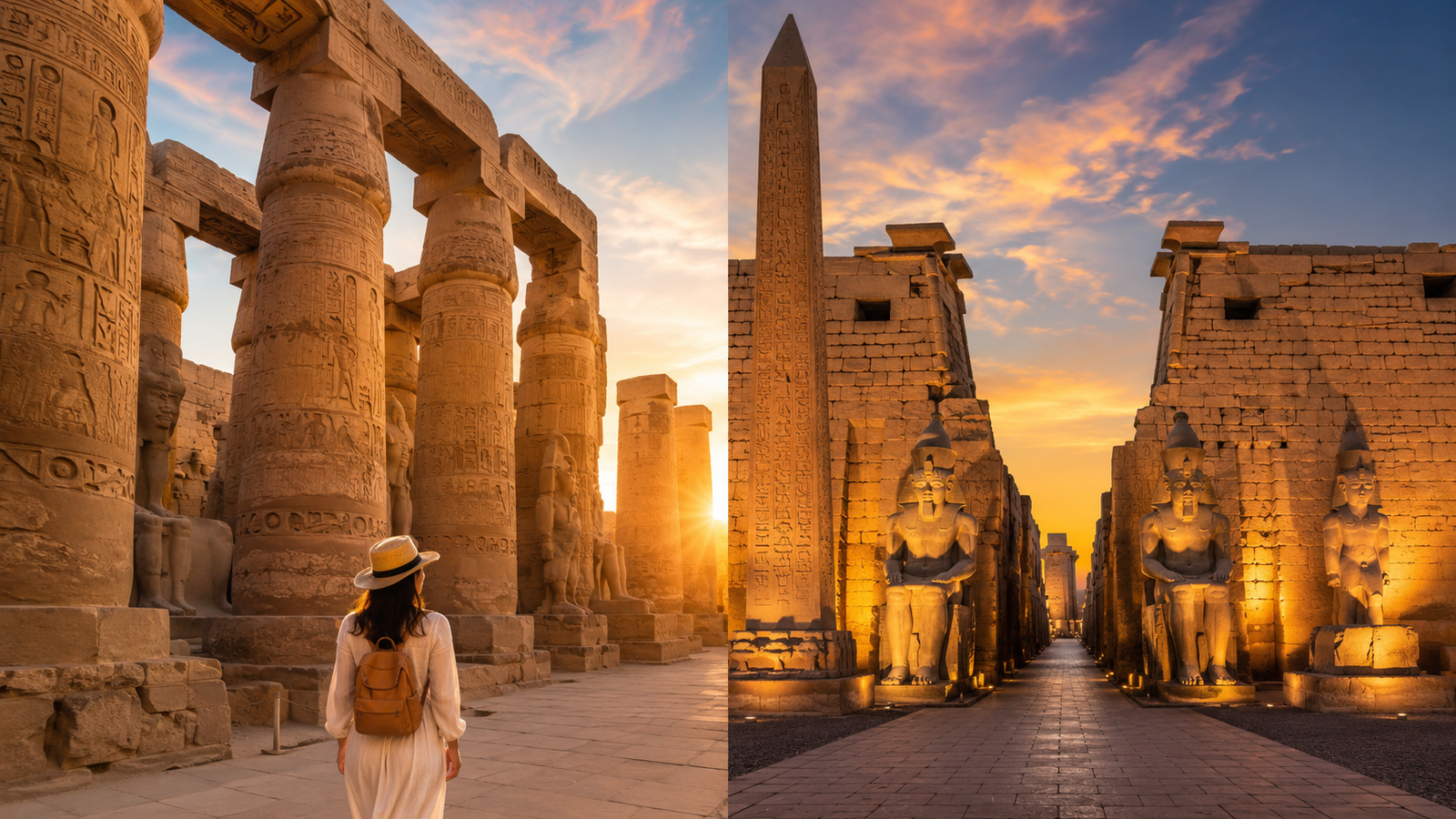
But they are profoundly different places. Karnak overwhelms with scale — it is the largest ancient religious complex ever built, a city of temples constructed over 2,000 years that makes individual human beings feel like ants. Luxor Temple seduces with beauty — it is more intimate, more coherent, and most magnificent at night when golden floodlights illuminate its columns and the ancient limestone seems to glow from within.
This comprehensive guide tells you everything about both temples — their history, their highlights, what to see first, how long to spend, and how to combine them into the perfect Luxor East Bank day.
For the West Bank counterpart, see our Valley of the Kings Guide. For Nile context, see our Nile Cruise Luxor to Aswan Guide.
Quick Comparison
Karnak Temple — The World’s Largest Religious Complex
History and Significance
Karnak is not one temple. It is a vast complex of temples, chapels, pylons, obelisks, sacred lakes, and processional avenues covering over 100 hectares — roughly the size of a medium European city center. Construction began around 2055 BCE during the Middle Kingdom and continued for approximately 2,000 years, with virtually every major pharaoh adding their own structures.
The main complex is dedicated to the Theban Triad — Amun-Ra (king of the gods), his consort Mut (the mother goddess), and their son Khonsu (the moon god). In ancient Egypt, Karnak was known as Ipet-isut — “the Most Selected of Places.” It was the spiritual heart of the Egyptian empire for most of the New Kingdom and Middle Kingdom periods, receiving tribute from military campaigns, receiving religious processions, and serving as the residence of the country’s most powerful priests.
At its height, the temple complex employed thousands of priests, scribes, artisans, and servants. It owned enormous agricultural estates across Egypt. The High Priests of Amun at Karnak were so powerful that at certain points in Egyptian history, they effectively co-ruled the country.
The Great Hypostyle Hall
The single most impressive space at Karnak — and arguably one of the most extraordinary spaces ever created by human civilization — is the Great Hypostyle Hall of Seti I and Ramesses II.
134 massive sandstone columns fill a space of approximately 5,000 square meters. The largest columns, in the central aisle, stand 23 meters tall — each column so large that 10 people linking hands could not encompass its circumference. The outer columns are smaller — a mere 13 meters — and are arranged in lateral aisles that create a dimly lit forest of stone stretching in every direction.
The columns are covered in relief carvings and painted hieroglyphs depicting religious scenes, royal cartouches, and divine figures. In the slanting morning light, when sunlight streams through the windows above the central aisle, the effect is theatrical and overwhelming.
Understanding the scale requires reference points. The Hypostyle Hall alone is larger than the entire Notre-Dame Cathedral in Paris. The columns are taller than a six-story building. You are not visiting architecture here — you are visiting a manufactured landscape.
Photography at Karnak: Morning light between 8–10 AM creates dramatic shadows and beam effects in the Hypostyle Hall. A wide-angle lens captures the full column height; a 50mm captures column details. The best shots are from the central aisle looking toward the sanctuary.
The Sacred Lake
Behind the main temples lies the Sacred Lake — a large rectangular pool used by ancient priests for ritual purification before performing ceremonies. In ancient times, priests bathed in the lake three times daily.
Today it’s a tranquil space surrounded by ancient stone, with a giant stone scarab on its northern bank — a traditional lucky charm that encourages visitors to walk around it three times for good fortune.
The Sacred Lake also serves as the venue for the Karnak Sound and Light Show, conducted on its shores after dark on specific evenings.
The Obelisks of Hatshepsut
Among Karnak’s most photographed features are the obelisks of Hatshepsut — the female pharaoh who ruled Egypt for approximately 20 years (around 1473–1458 BCE) as co-ruler with her stepson Thutmose III.
Hatshepsut erected four obelisks at Karnak; two survive. The tallest, at 29 meters, is the largest standing ancient obelisk in Egypt. They were originally coated in electrum (a gold-silver alloy) that would have blazed like beacons across the Nile Valley.
After Hatshepsut’s death, her name and images were systematically erased from her monuments by Thutmose III — for political reasons related to the succession. The obelisks were too large to demolish, so Thutmose had them walled up inside a stone casing. Paradoxically, this preserved them perfectly, and when the casing was eventually removed, the inscriptions were found in pristine condition.
The Avenue of Rams
The processional entrance to the main Karnak Temple precinct is lined with ram-headed sphinxes — criosphinxes — each protecting a small standing figure of the pharaoh between their paws. This avenue originally extended toward the Nile and connected Karnak to Luxor Temple via the Avenue of Sphinxes.
The Temple of Amun — the Core Complex
Beyond the Hypostyle Hall, successive halls and chambers lead to the inner sanctuary of Amun. Several key areas:
The Festival Hall of Thutmose III (Akh-Menu): One of the most unusual structures at Karnak — a tent-like hall with columns resembling tent poles, believed to be modeled on the pavilions of Thutmose’s military campaigns. Partially excavated reliefs here include the famous “Botanical Garden” scenes showing plants and animals encountered on Thutmose’s campaigns in Syro-Palestine.
The Temple of Ptah: A small gem tucked into the northern enclosure, containing a well-preserved statue of the goddess Sekhmet in a dark inner chamber.
The Open-Air Museum: On the northwestern edge of the complex, reconstructed kiosks and shrines — including the exquisite White Chapel of Senusret I — display some of Karnak’s finest small-scale carved reliefs.
Practical Tips for Karnak
Arrive at 6:00 AM opening. The temple is virtually empty and the light is magical. By 9–10 AM it’s crowded.
Hire a licensed Egyptologist guide. Karnak’s history spans 2,000 years of construction and involves dozens of pharaohs. Without expert guidance, you’re seeing beautiful stone without understanding what you’re looking at.
Allow 2–3 hours minimum. A rushed visit covers the Hypostyle Hall, Sacred Lake, and main court. A thorough visit requires 3 hours.
Attend the Sound and Light Show. Karnak’s Sound and Light Show is conducted on the Sacred Lake shores on specific evenings. The combination of illuminated columns and commentary makes for an extraordinary theatrical experience.

Luxor Temple — Beauty at the Heart of the City
History and Significance
While Karnak was the great state temple of Amun, Luxor Temple had a specific and extraordinary function: it was the setting for the Opet Festival — the most important religious celebration in the New Kingdom Egyptian calendar.
Once a year, during the Nile flood season, the sacred statues of the Theban Triad (Amun, Mut, and Khonsu) were transported from Karnak in elaborately decorated processional barques along the Avenue of Sphinxes to Luxor Temple, where the divine marriage of Amun and Mut was celebrated and the pharaoh’s divine power was ritually renewed.
The festival lasted 27 days and involved feasting, music, dancing, and the distribution of food to the population. It was Egypt’s greatest religious holiday — and Luxor Temple was its stage.
Unlike Karnak’s accumulation of structures from multiple eras, Luxor Temple has a more unified character. It was built primarily by two pharaohs: Amenhotep III (around 1380 BCE), who constructed the main sanctuary and inner courts, and Ramesses II (around 1250 BCE), who added the enormous entrance pylon and the famous obelisk.
The Main Highlights
The Obelisk of Ramesses II
Originally, two identical red granite obelisks flanked the entrance pylon. Today, one remains — the other was gifted to France in 1833 by Muhammad Ali Pasha and now stands in the Place de la Concorde in Paris, where it has stood since 1836. Seeing the remaining obelisk at Luxor, you realize what Paris got: a 25-meter, 250-ton monument carved with intricate hieroglyphs celebrating the military victories of Ramesses II.
The Colossal Statues and Pylon of Ramesses II
Six colossal statues of Ramesses II flank the entrance pylon — four seated and two standing. The reliefs on the pylon itself depict the Battle of Kadesh (1274 BCE) — Ramesses’ famous military campaign against the Hittites, depicted as a great Egyptian victory despite being, historically, more of a stalemate.
The Abu El Haggag Mosque
One of the most remarkable sights at Luxor Temple is a medieval mosque built directly atop the temple complex — the Mosque of Abu El Haggag, a local saint. The mosque dates from the medieval period, when centuries of accumulated debris had buried the temple floor to a level near the tops of the columns. The mosque sits on this accumulated layer, visually appearing to float above the ancient reliefs below it.
This is one of Egypt’s most powerful demonstrations of its layered history — Christian church, mosque, and pharaonic temple occupying the same sacred ground across millennia.
The Colonnade of Amenhotep III
A processional avenue of 14 massive papyrus-bud columns, each 19 meters tall, forming a corridor of extraordinary grandeur. The walls flanking this colonnade were decorated under Tutankhamun with scenes from the Opet Festival procession — some of the finest narrative relief carving from the New Kingdom period.
The Court of Amenhotep III
The inner courtyard, built by Amenhotep III, is surrounded by double rows of papyrus-bundle columns. This is where the sanctuary of Amun lay, the innermost sacred space of the Opet celebration.
The Roman Chapel
In a remarkable moment of cultural overlap, Alexander the Great had one of the inner sanctuary rooms rebuilt in his own image — reliefs show him as a pharaoh making offerings to Amun. Later, during the Roman period, part of the sanctuary was converted into a chapel for the Roman emperor cult — still visible in the distinctive Roman-style painted decoration.
The Avenue of Sphinxes
Connecting Karnak and Luxor Temple is the recently restored Avenue of Sphinxes — a 2.7-kilometer processional road originally lined with over 1,000 human-headed sphinx figures, along which the sacred barques of the Opet Festival were carried.
The avenue, buried under centuries of urban development, was excavated and partially restored in recent decades. Walking or riding along this ancient processional route — which pharaohs and priests walked 3,300 years ago — is a uniquely powerful experience.
Luxor Temple at Night
The most photographed aspect of Luxor Temple is its evening illumination. The entire complex is beautifully lit after dark — warm golden light on the pale sandstone columns creates an atmosphere that photographs extraordinarily well and feels genuinely magical in person.
Many visitors make two visits: once in daylight to properly understand the archaeology, and once at night to experience the theatrical beauty of the illuminated complex reflected in the paving stones.
Photography at night: ISO 800–1600 with a tripod or monopod; 10–15 second exposures capture the ambient light beautifully. Aim for the entrance pylon with the obelisk — one of Egypt’s great night photographs.
Practical Tips for Luxor Temple
Visit in the late afternoon. Arrive around 4:00–5:00 PM for excellent late-light photography, then stay into the evening for the illuminated experience.
It’s smaller than you think — and that’s perfect. Luxor Temple takes 1–1.5 hours to see properly. Its compactness means you understand it as a whole, which Karnak never quite allows.
The entrance area is free to walk around. The obelisk, the front of the pylon, and the statue forecourt are visible without entering the ticketed site from the road outside — useful for photographs before paying admission.
The Ideal Combination: One Day, Both Temples
Morning at Karnak (7:00 AM – 10:00 AM):
Arrive at Karnak at opening for the best experience. Hire a guide for 2–2.5 hours. Focus on the Hypostyle Hall, the Sacred Lake, the Hatshepsut obelisks, and the open-air museum.
Midday (10:30 AM – 12:30 PM):
Walk or take a short taxi ride to Luxor Temple for a daytime visit (1–1.5 hours). The Avenue of Sphinxes is directly en route.
Afternoon:
Rest, lunch, and any other East Bank activities.
Evening (6:00–8:00 PM):
Return to Luxor Temple for the evening illumination — the perfect end to an extraordinary day.
For those with a full Luxor day including the West Bank, see our Valley of the Kings Guide and Hot Air Balloon Luxor for optimal day planning.
External Resources
- Ancient Egypt Online — Karnak — Detailed Karnak complex information
- UNESCO World Heritage — Ancient Thebes — World Heritage documentation for the Luxor area
- Egyptology Online — Academic resources on New Kingdom temples
- EgyptAir — Flights to Luxor — Cairo to Luxor domestic flights
15 People Also Ask Questions About Karnak and Luxor Temple
1. Which is better — Karnak or Luxor Temple?
They offer completely different experiences and both are worth visiting. Karnak overwhelms with scale — 100+ hectares, 134 massive columns in the Hypostyle Hall, and 2,000 years of construction. Luxor Temple captivates with beauty and coherence — particularly stunning when illuminated at night. Most visitors find Karnak more impressive during the day and Luxor Temple more beautiful in the evening. Visit both for the complete East Bank experience.
2. How long does it take to visit Karnak Temple?
Allow a minimum of 2 hours for a basic visit. 3 hours gives you time for the Hypostyle Hall, Sacred Lake, Hatshepsut obelisks, Festival Hall, and the open-air museum without rushing. If you have an excellent guide with deep knowledge of the site, 3–4 hours passes very quickly.
3. What is the Hypostyle Hall at Karnak?
The Great Hypostyle Hall at Karnak is one of the most extraordinary architectural spaces ever created — 134 massive sandstone columns covering 5,000 square meters, built by Seti I and Ramesses II around 1290–1224 BCE. The central columns reach 23 meters tall, making them taller than a six-story building. The hall is larger than Notre-Dame Cathedral and is covered in hieroglyphic reliefs. It is considered one of the greatest architectural achievements in human history.
4. What is the best time to visit Karnak Temple?
The absolute best time is at 6:00 AM when the site opens — cool temperatures, dramatic early morning light streaming through the Hypostyle Hall windows, and minimal crowds. By 9–10 AM, large tour groups arrive and the experience changes significantly. In winter (November–February), morning visits are particularly pleasant with crisp, cool air.
5. Can you visit Karnak at night?
Karnak’s Sound and Light Show takes place on the shores of the Sacred Lake on specific evenings and provides a theatrical evening experience with the illuminated columns. The full complex is not open for free-access nighttime visits — the Sound and Light Show is the primary evening access. Check current show schedules and languages at the official Karnak ticket office.
6. Is the Luxor Temple free at night?
No — Luxor Temple requires a paid ticket for entry both day and night. Evening visits have the same entrance fee as daytime visits. However, the exterior obelisk and front pylon are visible from the road outside without entering, allowing some free photography from the street.
7. What is the Avenue of Sphinxes connecting Karnak and Luxor?
The Avenue of Sphinxes is a 2.7-kilometer processional road that originally connected Karnak Temple to Luxor Temple, lined with over 1,000 human-headed sphinx figures. It was used during the Opet Festival to carry the sacred barques of the Theban Triad between the two temples. Buried under centuries of development, the avenue was excavated and partially restored in recent decades. Walking along it is a moving experience — you’re following the same path used by ancient Egyptians 3,300 years ago.
8. What is the Opet Festival?
The Opet Festival was the most important religious celebration in New Kingdom Egypt — held annually during the Nile flood season for 27 days. The sacred statues of Amun, Mut, and Khonsu were carried in elaborate processional barques from Karnak to Luxor Temple along the Avenue of Sphinxes. At Luxor Temple, the divine marriage of Amun and Mut was celebrated and the pharaoh’s divine power was renewed. The festival involved feasting, music, and the distribution of food to the population — Egypt’s greatest holiday.
9. How much does it cost to visit Karnak and Luxor Temple?
Each temple charges approximately $10–15 USD for foreign visitors as of 2027. Budget $20–30 USD for both temples. Check current prices at the Egypt Ministry of Tourism website as fees are updated periodically.
10. Is Karnak Temple worth visiting?
Yes, absolutely. Karnak is consistently rated among the top 5 ancient sites in the world and is one of the most extraordinary places you can visit anywhere on Earth. The Hypostyle Hall alone is worth traveling to Egypt to see. Combined with Luxor Temple, the East Bank of Luxor provides one of the greatest single days of cultural sightseeing available to any traveler.
11. What is the obelisk at Luxor Temple?
Luxor Temple originally had two identical red granite obelisks flanking its entrance pylon, erected by Ramesses II around 1250 BCE. One remains at Luxor — 25 meters tall and covered in hieroglyphs. The second was given to France by Muhammad Ali Pasha in 1833 and erected in the Place de la Concorde in Paris in 1836, where it still stands today. The base of the Paris obelisk is decorated with a diagram showing how it was transported.
12. What is the Abu El Haggag Mosque at Luxor Temple?
The Mosque of Abu El Haggag is a medieval mosque built directly atop the Luxor Temple complex, sitting on the layer of accumulated debris that buried the temple for centuries. It was constructed to honor Abu El Haggag, a local Islamic saint. The mosque represents one of Egypt’s most visually striking demonstrations of its layered history — ancient pharaonic temple, Roman chapel, Christian church, and Islamic mosque all occupying the same sacred site across millennia.
13. Is Karnak bigger than the Pyramids?
Karnak Temple complex, at over 100 hectares, covers a significantly larger area than the Giza Pyramid Complex (approximately 14 hectares for the three pyramids and their enclosures). However, the pyramids are far taller — the Great Pyramid reaches 138 meters. Karnak’s Hypostyle Hall columns reach 23 meters. The two sites represent entirely different types of ancient Egyptian monumentalism.
14. Can I combine Karnak and the Valley of the Kings in one day?
Yes — and this is one of the most common full-day Luxor itineraries. Balloon at dawn (optional), West Bank (Valley of the Kings + Hatshepsut Temple) in the morning, East Bank (Karnak + Luxor Temple) in the afternoon and evening. It’s a long but extraordinary day. See our Valley of the Kings Guide for optimal West Bank planning.
15. What is the best way to get to Karnak Temple from Luxor city center?
Karnak Temple is approximately 3 km from Luxor city center and can be reached by taxi (5–10 minutes), horse-drawn calèche (15–20 minutes, negotiate price first), bicycle (15–20 minutes), or on foot along the Corniche (30–40 minutes, pleasant). Luxor Temple is in the city center itself and walkable from most East Bank hotels.
Book Your Luxor East Bank Tour with Egypt Travel Ways
Egypt Travel Ways offers private East Bank tours combining Karnak and Luxor Temple with licensed Egyptologist guides who bring 3,500 years of history to life.
Contact Egypt Travel Ways today to book your Luxor East & West Bank Full Day Tour.