Siwa Oasis Egypt Guide 2027 – How to Get There, What to See & Do
There are places in the world that feel genuinely apart from everything else — places where the rhythm of modern life dissolves, where the silence is physical, where the landscape is so extraordinary that your sense of what Egypt is must expand to include it. Siwa Oasis is one of those places.
Located 560 km west of Cairo in the Libyan Desert, just 50 km from the Libyan border, Siwa is accessible only by road — a journey across empty desert that makes the arrival feel like genuine discovery. The oasis itself is a paradise of fresh-water springs, date palm groves, salt lakes, ancient ruins, and the extraordinary Berber culture of the Siwan people, who have maintained their own language, traditions, and identity for millennia largely independent of the Arab culture that dominates the rest of Egypt.
Alexander the Great came here in 331 BCE to consult the famous Oracle of Amun and receive confirmation of his divine status. If it was good enough for Alexander, it’s good enough for anyone.
For planning context, see our Best Time to Visit Egypt Guide and Egypt 10-Day Itinerary.
Why Siwa Is Unlike Anywhere Else in Egypt
Most of Egypt’s tourism concentrates along the Nile Valley — a narrow corridor of ancient sites and modern cities. Siwa exists in an entirely different landscape, cultural universe, and historical tradition.
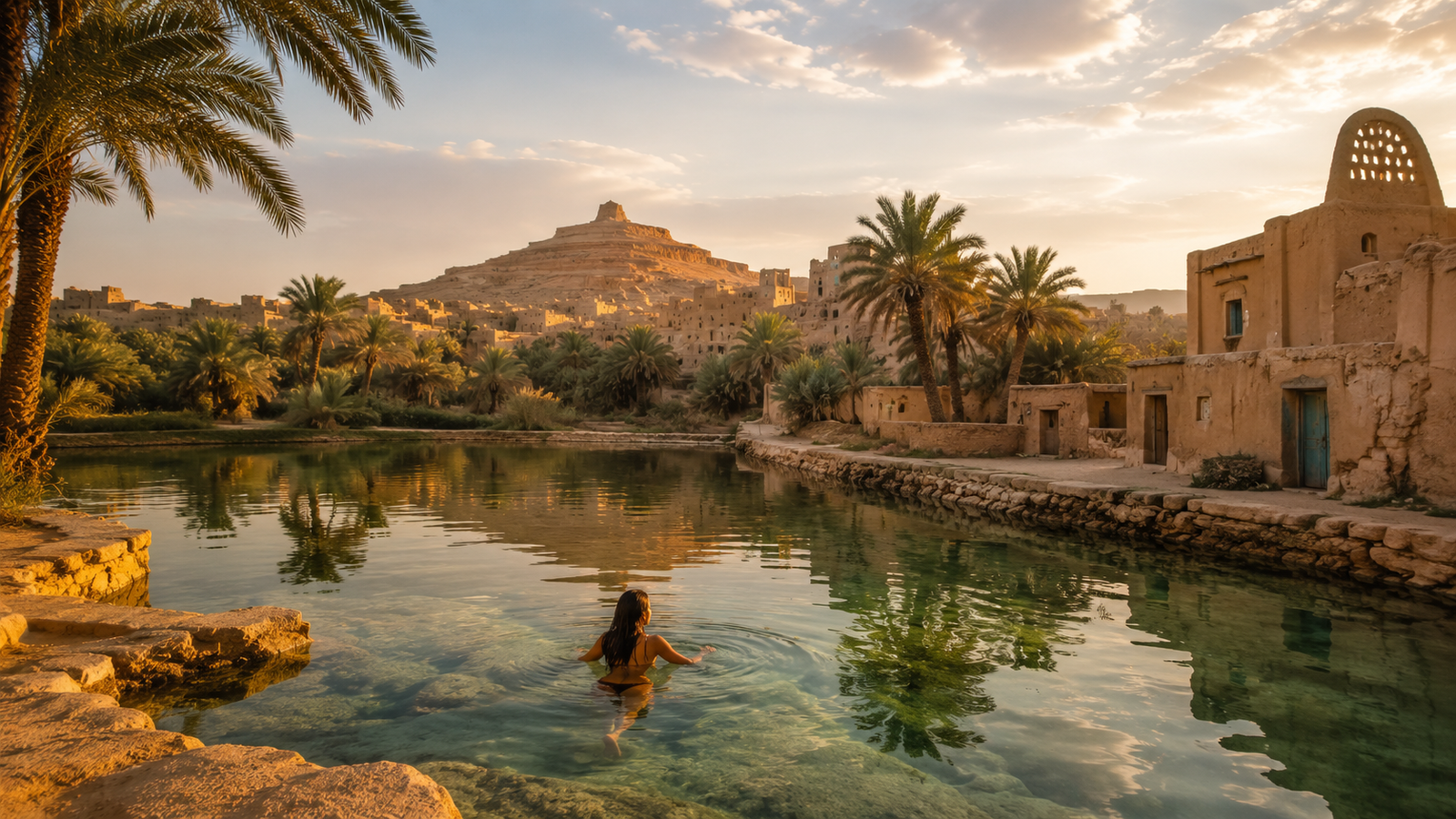
The landscape: A vast depression in the Libyan Desert, 19 meters below sea level in places, filled with fresh-water springs, shimmering salt lakes, date palm and olive groves, and surrounded on all sides by the golden dunes of the Great Sand Sea. The combination of blue water, green palm trees, white salt, and golden sand creates a visual contrast of extraordinary beauty.
The culture: Siwa’s inhabitants are Berber — ethnically and culturally distinct from Arab Egyptians, speaking their own language (Siwi, a Berber dialect), maintaining their own customary laws, architecture, and traditions. Siwan women wear distinctive embroidered robes; Siwan men have traditionally worn long white garments. The silver jewelry of Siwa is among the finest traditional jewelry produced anywhere in North Africa.
The silence: Away from the main town, Siwa is spectacularly quiet. The date palm groves absorb sound; the desert absorbs more. Stargazing from the dunes without light pollution is transformative — the Milky Way is simply visible in a way that most people have never experienced.
The history: Siwa’s Oracle Temple of Amun was one of the ancient world’s most famous consultation sites. Rulers from across the Mediterranean made the dangerous desert journey to ask the oracle questions of state. The visit of Alexander the Great in 331 BCE — and the oracle’s confirmation of his divine status as son of Amun — was one of the turning points of his conquest of Egypt and his subsequent self-identification as a living god.
How to Get to Siwa from Cairo
The journey to Siwa requires commitment — there are no flights to the oasis itself.
Option 1: Overnight Bus (Budget)
Company: West Delta Bus Company — book at Cairo’s Turgoman (Al Turgoman) Bus Station
Duration: 9–10 hours from Cairo (usually an evening departure, arriving in Siwa in the morning)
Cost: Approximately 200–300 EGP one way
Comfort: Air-conditioned, assigned seats, adequate comfort for an overnight journey. Bring food and water — stops are limited.
Book in advance: Particularly for Thursday/Friday departures (popular with Egyptian tourists heading to Siwa for weekends).
Option 2: Private Car/Driver
Duration: 6–7 hours from Cairo via the Desert Road (Alexandria → Marsa Matrouh → Siwa)
Cost: Approximately $150–250 USD for a private car, negotiated in advance
Advantages: Depart at your preferred time, stop for photographs, and more comfortable than the bus for groups
Route: Cairo → Alexandria (2.5 hours) → Marsa Matrouh (2.5 hours from Alexandria) → Siwa (3 hours from Marsa Matrouh)
Option 3: Fly to Marsa Matrouh + Transfer
Fly from Cairo to Marsa Matrouh (approximately 1 hour) on domestic routes, then arrange a shared taxi or private car for the 3-hour road transfer to Siwa.
Check EgyptAir domestic routes for Marsa Matrouh service availability.
What to See and Do in Siwa
1. The Oracle Temple of Amun (Aghurmi)
Siwa’s most historically significant monument — the temple where Alexander the Great consulted the oracle in 331 BCE. Built around 663 BCE by Pharaoh Psamtik I, the temple occupies an elevated rock platform in the village of Aghurmi.
The temple is partially ruined — earthquakes and time have taken their toll — but the atmospheric remains and the extraordinary views over the palm groves from the elevated platform are unforgettable. An inscription at the site records the oracle’s responses to various ancient rulers, though the specific words given to Alexander are lost to history.
Context: The British Museum’s Egypt resources provide background on the Oracle of Amun tradition.
2. Shali Fortress (Old Town)
The centerpiece of modern Siwa town is the ruins of Shali — a medieval mud-brick fortress that housed the entire Siwan community for centuries. Built from kershif (a local material made from salt rock and mud), Shali was designed as a defensive citadel accessible only by narrow gates that could be sealed.
A catastrophic rainstorm in 1926 softened the kershif and caused significant structural damage that the community was unable to repair. The surviving ruins — dramatic, organic, almost geological in appearance — rise above the modern town like an ancient acropolis.
Climbing to the top of Shali at sunset is one of Siwa’s most beautiful experiences — the panoramic view over the oasis, with date palms, salt lakes, and desert dunes extending in every direction, is extraordinary.
3. Cleopatra’s Bath (Ain Guba)
A natural fresh-water spring that feeds a circular pool — clear, cold, and deep enough for swimming. Despite the name, there is no established historical connection to Cleopatra — the name is a marketing invention of the tourist era. But the spring itself is ancient, having served as a bathing place for Siwans for thousands of years.
The water is crystal clear, constantly replenished from underground aquifers, and provides welcome relief in the desert heat. Swim early in the morning or late afternoon to avoid the midday heat and maximum tourist presence.
Note: Modest swimwear is expected — Siwa is a conservative community.
4. Lake Siwa and Fatnas Island
The largest of Siwa’s several salt lakes, Lake Siwa has a hypnotic quality — its surface perfectly mirrors the sky, creating a doubled landscape. The lake’s salt concentration makes swimming buoyant (similar to the Dead Sea experience) at certain access points.
Fatnas Island sits in the eastern arm of the lake, connected to the mainland by a causeway. A small café serves tea and simple food, and the island’s palm grove offers shade and extraordinary views of the lake and surrounding desert. Sunset from Fatnas is spectacular — the lake turns orange, then pink, as the sun drops behind the dunes.
5. The Great Sand Sea — Dune Safari
The Great Sand Sea is a vast erg (sand desert) extending hundreds of kilometers south and west of Siwa — one of the largest sand seas on Earth. The dunes near Siwa, rising up to 100 meters and stretching to the horizon, provide the backdrop for one of the oasis’s most popular activities: a 4WD dune safari.
A half-day or full-day safari typically includes:
- Driving through the dunes in 4WD vehicles with local guides
- Sandboarding down steep dune faces (simple boards provided)
- Desert picnic among the dunes
- Hot spring bathing (natural hot springs exist in the desert)
- Spectacular sunset photography from dune tops
- (For overnight safaris) Camping under the stars
The stars: Siwa has almost zero light pollution. On a clear night, the Milky Way is visible as a bright band across the entire sky — an experience that most people from urban environments have never witnessed. An overnight desert camp is worth the extra night in your itinerary.
6. Jabal Al-Mawta (Mountain of the Dead)
A rocky hillside near Siwa town containing a necropolis of Greco-Roman period tombs with well-preserved wall paintings. The Tomb of Siamun is the most impressive — brightly colored paintings of the deceased and Egyptian gods, remarkably vivid after 2,000 years.
Entry is included in the general Siwa sites ticket.
7. The Siwa Traditional House Museum (House of Siwa)
A small but beautifully curated museum in a traditional Siwan house, showcasing Siwan cultural artifacts: traditional silver jewelry, embroidered robes, wooden household objects, musical instruments, and historical photographs.
The silver jewelry: Siwan silver jewelry is extraordinary — massive, geometric, and laden with cultural meaning. Traditional Siwan brides wore kilograms of silver on their wedding day. The museum shows pieces that would cost thousands of dollars in the international market.
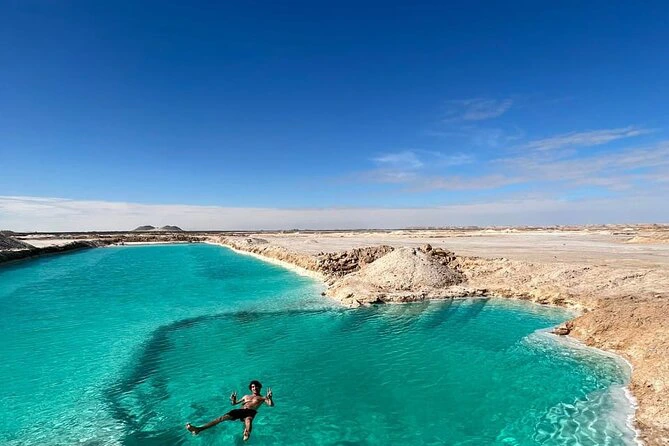
Fall in love with the silence, serenity, and soul of Egypt’s most peaceful oasis.
Practical Information
When to visit: October through April — comfortable temperatures (10–25°C). Summer (June–August) is extremely hot (35–42°C). Spring (March–May) can bring occasional sandstorms.
How long to stay: Minimum 2 nights; recommended 3–4 nights. Rushing Siwa defeats the purpose.
Getting around: The main town is navigable on foot or by bicycle (rentals widely available, approximately 30–50 EGP per day). For dune safaris and outer oasis sites, hire a local 4WD guide — do not venture into the Great Sand Sea without an experienced local driver.
Accommodation: Siwa has a range of guesthouses and eco-lodges. The extraordinary Adrère Amellal eco-lodge — built from local kershif with no electricity, lit entirely by candles and lanterns, with a fresh-water spring swimming pool — is one of the most remarkable hotels in Africa. At the other end, basic guesthouses offer clean, comfortable rooms from $15–25 USD per night.
Connectivity: Mobile signal in Siwa is limited and patchy. Some lodges have WiFi. This is a feature, not a bug — embrace the digital detox.
Tips for Visiting Siwa
Respect local conservative customs. Siwa is one of Egypt’s most conservative communities. Dress modestly throughout your visit (covered shoulders and knees at minimum). Photography of Siwan women without permission is never acceptable.
Hire a local guide for the dunes. The Great Sand Sea is disorienting and genuinely dangerous without local knowledge. Always hire a local guide and vehicle — never drive into the dunes independently.
Bring cash from Cairo. ATMs in Siwa are limited and can run out. Bring sufficient Egyptian pounds from Cairo.
Learn a few Siwi words. “Mashkur” (thank you in Siwi) is appreciated by locals who are used to visitors speaking only Arabic or English.
Buy Siwan products. Siwa produces some of Egypt’s finest dates (particularly the large, caramel-sweet Siwan variety), extraordinary extra-virgin olive oil from ancient olive groves, and distinctive handmade silver jewelry. All make exceptional souvenirs with genuine local provenance.
External Resources
- UNESCO — Siwa Oasis Cultural Heritage — Siwan cultural documentation
- Lonely Planet — Siwa — Comprehensive Siwa travel guide
- Alexander the Great’s Visit to Siwa (Ancient History Encyclopedia) — Historical context for the Oracle visit
- Egyptian Environmental Affairs Agency — Environmental protection information for the Western Desert
15 People Also Ask Questions About Siwa Oasis
1. Where is Siwa Oasis in Egypt?
Siwa Oasis is located in the Libyan Desert (part of the Sahara) in Egypt’s far northwest, approximately 560 km west of Cairo and 50 km east of the Libyan border. It sits in a natural depression 19 meters below sea level and is one of the most isolated inhabited places in Egypt.
2. How do you get to Siwa from Cairo?
The main options are: overnight bus from Cairo’s Turgoman Bus Station (9–10 hours, 200–300 EGP), private car/driver (6–7 hours, $150–250 USD), or flying to Marsa Matrouh and transferring by road (3 hours). There are no direct flights to Siwa.
3. How long should I spend in Siwa?
A minimum of 2 nights is needed to experience Siwa’s highlights (town, oracle temple, Fatnas Island, springs). Three to four nights is recommended for a relaxed pace including a dune safari and overnight desert camping. Rushing Siwa defeats the purpose of visiting.
4. Is Siwa Oasis safe?
Yes, Siwa is safe for tourists. Despite its proximity to Libya, the oasis itself is peaceful and welcoming. Siwan communities have a strong hospitality tradition and tourism is an important part of the local economy. The main consideration is cultural respect — dress modestly and ask permission before photographing individuals.
5. What is the Oracle Temple at Siwa?
The Oracle Temple of Amun at Siwa is a pharaonic temple built around 663 BCE that housed one of the ancient world’s most famous oracles. Rulers from across the Mediterranean, including Alexander the Great in 331 BCE, made the dangerous desert journey to consult it. The oracle’s confirmation of Alexander’s divine status as son of Amun influenced his self-presentation for the rest of his life.
6. Can you swim at Cleopatra’s Bath in Siwa?
Yes — Cleopatra’s Bath (Ain Guba) is a natural fresh-water spring with a swimming pool that visitors can swim in. The water is cool, clear, and constantly replenished. Modest swimwear is expected in Siwa’s conservative community context. Swim early morning or late afternoon to avoid the hottest part of the day.
7. What is the Adrère Amellal eco-lodge in Siwa?
Adrère Amellal is one of Africa’s most extraordinary hotels — built entirely from local kershif (salt rock and mud), with no electricity, lit by candles and oil lanterns, and surrounded by the silent oasis landscape with a natural spring swimming pool. It is one of the world’s premier eco-luxury hotels and a profoundly peaceful experience.
8. What are the best things to do in Siwa?
The top Siwa experiences are: visiting the Oracle Temple of Amun (where Alexander the Great consulted the oracle), climbing the Shali Fortress ruins at sunset, swimming at Cleopatra’s Bath, watching the sunset over Lake Siwa from Fatnas Island, taking a 4WD dune safari in the Great Sand Sea, and stargazing from the desert — the night sky at Siwa, with almost zero light pollution, is among the most spectacular in the world.
9. When is the best time to visit Siwa?
October through April offers the most comfortable temperatures (10–25°C). December through February is peak season in Siwa, with the best weather but some increase in visitors. March–April can bring occasional Khamsin sandstorms. Summer (June–August) is extremely hot (35–42°C) but possible if you limit outdoor activities to early morning and evening.
10. Is Siwa Oasis worth visiting?
Siwa is absolutely worth visiting — it offers an experience completely unlike the rest of Egypt and unlike most places in the world. The combination of extraordinary landscape, ancient history, distinctive Berber culture, near-total digital silence, and one of the world’s great night skies makes Siwa one of Egypt’s most profound travel experiences. Allow at least 3 nights.
11. What language do people in Siwa speak?
Siwans speak Siwi — a Berber language from the Afroasiatic language family, related to other North African Berber languages but distinct from Arabic. Most Siwans also speak Egyptian Arabic for communication with non-Siwans. English is spoken at tourist guesthouses and lodges. Learning a few Siwi phrases is genuinely appreciated.
12. Can I do an overnight desert safari from Siwa?
Yes — overnight desert safaris in the Great Sand Sea are one of Siwa’s most popular experiences. Local guide-drivers take small groups into the dunes by 4WD, set up camp, cook traditional food, and provide the extraordinary experience of sleeping in the silent desert under a sky full of stars. Book through your accommodation or a reputable Siwa tour operator.
13. What should I know about Siwan culture?
Siwa is home to a Berber (not Arab) community with its own language, traditional architecture, dress, and customs. The community is conservative — modest dress is required throughout the oasis. Women should cover shoulders and knees. Photography of Siwan women without explicit permission is never acceptable. Siwa produces outstanding dates, olive oil, and traditional silver jewelry — buying local products directly supports the community.
14. How far is Siwa from the Pyramids?
Siwa is approximately 560 km from Cairo and the Giza Pyramids — a 6–7 hour drive by private car or 9–10 hours by bus. Siwa is not typically combined with a Nile Valley itinerary in a single trip; most travelers visit Siwa as a standalone desert extension, either before or after their main Egypt circuit. For an itinerary combining both, see our Egypt 10-Day Itinerary.
15. What products is Siwa famous for?
Siwa is famous for: Medjool-style dates — particularly large, sweet, and caramel-flavored dates from ancient palm groves; extra-virgin olive oil — pressed from olive trees that are centuries old, with a distinctive flavor; handmade silver jewelry — massive, geometric traditional pieces worn by Siwan women; and kershif architecture — buildings made from the local salt rock and mud material that gives Siwa’s old town its distinctive organic appearance.
Book Your Siwa Oasis Tour with Egypt Travel Ways
Egypt Travel Ways organizes private Siwa Oasis tours from Cairo — including transport, accommodation in selected eco-lodges, guided site visits, and dune safari experiences.
Contact Egypt Travel Ways today to book your Siwa Oasis 4-Day Desert Tour from Cairo.