White Desert Egypt Tour Guide 2027 – Chalk Formations & Overnight Camping
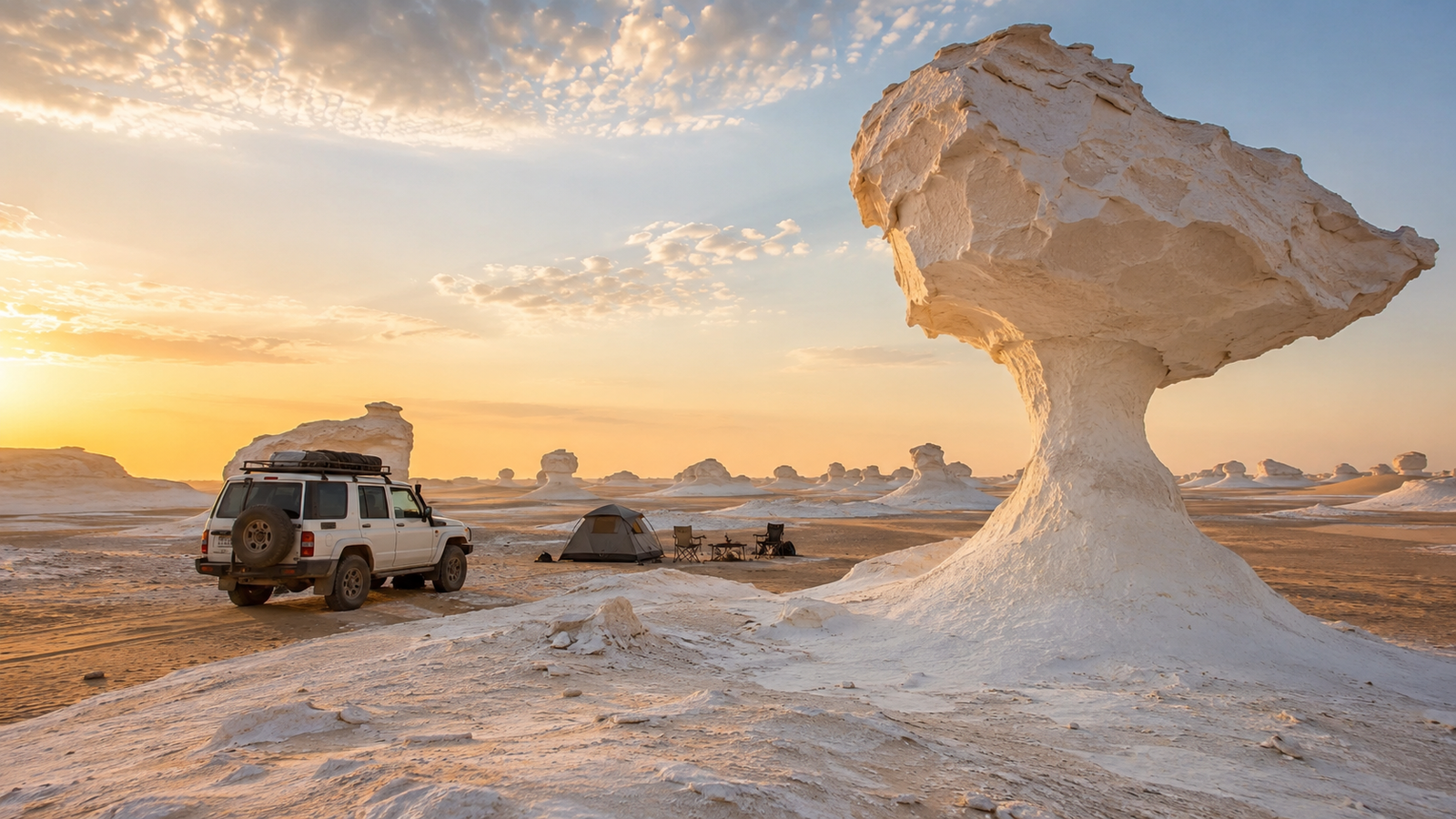
Egypt’s White Desert is one of the world’s most surreal landscapes. Located in the Farafra Depression of the Western Desert, approximately 500 km southwest of Cairo, it is a vast plateau scattered with enormous chalk-white rock formations sculpted by millions of years of wind erosion into impossible shapes — giant mushrooms, chicken-like figures, sleeping camels, abstract towers, and translucent white pillars rising from pale sand. In the afternoon sun they glow golden. At dawn they shimmer blue-white. By moonlight, the entire desert looks as if it has been dusted with snow.
This is Egypt’s best-kept secret from mass tourism. While thousands of visitors crowd the Pyramids and Karnak Temple daily, the White Desert remains a destination for travelers who want something genuinely different — absolute solitude, unearthly natural wonder, and the extraordinary experience of camping beneath one of the world’s darkest and most spectacular night skies.
For broader desert context, see our Siwa Oasis Guide. For trip planning, see our Egypt 10-Day Itinerary and Best Time to Visit Egypt.
Why the White Desert Is Extraordinary
The White Desert’s formations are composed of chalk — calcium carbonate deposited millions of years ago when this entire region was beneath a shallow sea. The erosion that created the formations is ongoing — wind, temperature change, and the occasional rain continue to reshape them. Formations that exist today will look different in a century; some will be gone entirely.
The visual contrast that makes the White Desert so dramatic: brilliant white chalk formations against the pale yellow and orange sand, the deep blue of the desert sky, and the dark shadow lines created by the low desert sun. No filter is required — the colors are naturally extraordinary.
At night, the transformation is complete. Without any artificial light for hundreds of kilometers in most directions, the night sky over the White Desert is among the most spectacular in Africa. The Milky Way is not a suggestion — it is a vivid, luminous band of light stretching from horizon to horizon. Star trails photograph magnificently. The chalk formations, lit by starlight and moonlight, take on an otherworldly quality.

The Classic White Desert Tour: 2 Days, 1 Night
The standard White Desert experience is a 2-day tour from Cairo, combining multiple distinct desert landscapes on the way to and from the main White Desert formations.
Day 1 — Cairo to the White Desert
Departure from Cairo (8:00–9:00 AM):
You depart Cairo in a 4WD vehicle with a local guide/driver. The journey takes 5–6 hours, crossing the Nile Valley and entering the Eastern and then Western Desert.
Stop 1: The Black Desert (around 3 hours from Cairo)
Your first taste of the extraordinary Western Desert landscapes — dark volcanic cones covered in black basalt pebbles that create a monochrome landscape of alien beauty, entirely different from the white desert ahead. The contrast between the black mounds and the blue sky is striking.
Stop 2: Crystal Mountain (Al-Quss Abu Said)
A small hill of almost pure quartz crystal, glittering in the sunlight. When the light is right, the entire hill seems to sparkle. Pieces of crystal litter the ground around the base — the site has suffered from unauthorized removal of crystals, and it’s now protected. Photography from a distance is spectacular; don’t take any crystals.
Stop 3: Agabat Valley (Valley of Agabat)
A dramatic canyon of yellow-ochre limestone formations cutting through the desert plateau. The rock colors — ochre, yellow, cream, deep orange in the lower strata — create an extraordinarily vivid landscape, especially in the late afternoon when the light turns golden.
Arrival at the White Desert (late afternoon):
Your guide drives into the heart of the chalk formation area. First sight of the white formations is genuinely startling — they appear suddenly as you crest a ridge, scattered across the desert like an abandoned alien city.
Camp setup (sunset):
Your team sets up camp among the formations — simple but comfortable: sleeping mats, sleeping bags, cooking equipment, lanterns. As the sun sets, the formations transform through every color of the sunset spectrum — white to gold to orange to pink to deep purple.
Dinner and stars:
A simple but excellent dinner cooked over a camp fire — typically grilled chicken or lamb, rice, bread, vegetables, and strong tea. Then the night sky. Even experienced travelers describe the White Desert night sky as one of the most beautiful things they have ever seen.
Day 2 — Morning in the White Desert, Return to Cairo
Sunrise:
Wake before dawn for the most beautiful hour of the entire tour. The chalk formations in the pre-dawn light are blue-white and utterly silent. As the sun rises, they transform through pink to gold to brilliant white. Most photographers rate this as the best photographic light of any experience in Egypt.
Morning exploration:
Walk among the formations freely. Your guide points out the named formations — “the Chicken,” “the Rabbit,” “the Mushroom” — though each person sees different shapes. The scale is larger than photos suggest.
Return to Cairo (via Bahariya Oasis):
Driving back toward Cairo, stop at Bahariya Oasis for lunch and a brief visit to the oasis market. Bahariya has its own antiquities — the Valley of the Golden Mummies (discovered 1999, containing hundreds of gilded mummies from the Greco-Roman period) can be visited on a slightly extended tour.
Return to Cairo in the early evening.
Key Formations to Know
The Chicken and the Tree: Two of the most recognizable formations in the White Desert — a squat, vaguely chicken-shaped chalk boulder and a tall, mushroom-like formation with a narrowed stem and broader top. They stand near each other and are the most frequently photographed formations.
The Rabbit: An uncanny resemblance to a seated rabbit, particularly in certain light conditions.
The Whale: A large, elongated boulder with a vaguely cetacean profile.
The Sphinx: Not connected to the Giza Sphinx — a locally named formation that suggests a sphinx-like silhouette from specific angles.
In reality, the named formations are just the most recognizable among hundreds of extraordinary shapes. The experience of walking through an entire landscape of strange white forms is more powerful than any individual formation.
Choosing a Tour Operator for the White Desert
Choosing the right operator is the single most important decision for a White Desert tour. Quality varies dramatically between operators, and in the desert, quality matters.
What distinguishes good from poor operators:
Guide knowledge and experience: Your guide should be a local Western Desert expert — someone who knows the specific formations, the desert navigation, the weather patterns, and the cultural context of the landscape. Ask specifically about guide experience before booking.
Vehicle quality: 4WD vehicles in good mechanical condition are essential for desert navigation. Old or poorly maintained vehicles in the desert are a genuine safety issue. Ask about vehicle age and maintenance.
Camp quality: Good operators provide comfortable sleeping mats, clean sleeping bags, fresh food cooked on-site, and sufficient warm layers for cool desert nights. Budget operators may provide minimal equipment that makes the overnight uncomfortable.
Group size: Smaller groups (4–8 people) provide a better experience than large groups. Larger tour buses also reduce the sense of solitude that makes the White Desert extraordinary.
Safety protocols: Good operators carry satellite phones, GPS, and emergency supplies. Ask about emergency procedures.
Reviews: Check TripAdvisor reviews from the past 6 months. TripAdvisor White Desert Egypt has current reviews.
What to Pack for the White Desert
The Night Sky — Egypt’s Greatest Astronomical Experience
The White Desert is one of Egypt’s best locations for stargazing and astrophotography — and in 2027, it intersects with an extraordinary astronomical event.
The 2027 Solar Eclipse (August 2) passes relatively close to the Western Desert region. While the path of totality crosses primarily over Luxor and Aswan (see our Solar Eclipse Egypt 2027 Guide), the White Desert will experience a partial eclipse — and the utterly dark sky backdrop of the desert makes it one of the most dramatic partial eclipse viewing environments possible.
For standard stargazing: the absence of light pollution means the Milky Way is visible to the naked eye as a bright band. Common naked-eye observations include: the Milky Way galaxy core (visible June–August), the Andromeda Galaxy (naked eye from dark-sky sites), Jupiter and Saturn when at opposition, and thousands of stars invisible from urban environments.
Astrophotography tips: Use a wide-angle lens (14–24mm), ISO 3200–6400, exposures of 15–25 seconds (wider lens = longer exposures before star trailing). Mount your camera on a stable tripod in the sand — press the ground firmly around the tripod legs. Include a chalk formation in the foreground for perspective.
Resources: Dark Sky Finder shows the White Desert area as one of the darkest in North Africa.
Practical Information
Distance from Cairo: 500 km (5–6 hours by road)
Best season: October–April (comfortable temperatures)
Summer visits: Possible but very hot (35–45°C) during the day; nights remain cooler
Accommodation: Camping in the desert (on the classic 2-day tour) or Bahariya Oasis guesthouses for non-camping alternatives
Entry to White Desert National Park: Approximately 20–30 EGP per person
Nearest town: Qasr el-Farafra (small town, basic facilities)
Combining with the Black Desert and Bahariya Oasis
The standard White Desert tour includes the Black Desert (volcanic dark landscape) and Crystal Mountain on the drive. Extended tours add:
Bahariya Oasis (from Cairo, 4 hours): A fertile depression in the desert with hot springs, palm groves, and the remarkable Valley of the Golden Mummies — a necropolis of Greco-Roman period mummies discovered in 1999, some gilded with gold leaf. The associated museum in Bahariya displays extraordinary examples.
Farafra Oasis: The small town nearest to the White Desert — traditional Egyptian oasis town with minimal tourist infrastructure but extraordinary character.
The Great Sand Sea Extension: A multi-day extension west from Farafra into the dunes of the Great Sand Sea — for serious desert adventurers only, requiring experienced desert guides and complete self-sufficiency.
External Resources
- Egyptian Environmental Affairs Agency — White Desert National Park management
- Lonely Planet — Western Desert Oases — Comprehensive guide to the Western Desert
- NASA Solar Eclipse 2027 — Eclipse path data relevant to Western Desert viewing
- Light Pollution Map — Confirms White Desert dark sky quality for stargazing planning
- TripAdvisor White Desert Tours — Recent operator reviews
15 People Also Ask Questions About the White Desert Egypt
1. Where is the White Desert in Egypt?
The White Desert (Sahara el-Beyda) is in the Farafra Depression of Egypt’s Western Desert, approximately 500 km southwest of Cairo. It is located within the White Desert National Park, established in 2002. The nearest town is Qasr el-Farafra; the closest major city is Bahariya Oasis (165 km north).
2. How do I get to the White Desert from Cairo?
The White Desert is reached by road — approximately 5–6 hours from Cairo in a 4WD vehicle. Most visitors join a 2-day organized tour that handles all transport. Self-driving is possible but not recommended due to navigation complexity and the need for desert-capable vehicles.
3. What are the white rock formations in Egypt’s White Desert?
The formations are composed of chalk (calcium carbonate) deposited millions of years ago when the Western Desert was submerged beneath a shallow sea. Wind erosion over millions of years has sculpted the chalk into the extraordinary shapes visible today — mushrooms, towers, animals, and abstract forms. The erosion continues; the formations change gradually over centuries.
4. Is the White Desert safe?
Yes — the White Desert is safe for tourists traveling with reputable local guides. The main practical risks are navigational (getting lost without a guide) and mechanical (vehicle breakdowns in a remote area). Both are effectively eliminated by choosing a reputable, well-equipped tour operator.
5. Can I camp in the White Desert?
Yes — camping among the chalk formations is the quintessential White Desert experience and the main reason most visitors make the trip. Tour operators provide camp equipment, sleeping gear, and food cooked on-site. The overnight stay allows you to experience both the extraordinary sunset and sunrise light on the formations and the stunning night sky.
6. How cold does the White Desert get at night?
In winter (December–February), desert nights can be genuinely cold — temperatures sometimes dropping to 5–10°C after midnight, occasionally near freezing in January. A warm jacket, fleece, and warm sleeping bag are essential in winter. In spring and autumn (March–May, October–November), nights are cool (10–18°C). Summer nights are warmer (20–25°C).
7. How long does the White Desert tour take?
The classic tour is 2 days and 1 night from Cairo — departing in the morning of Day 1, camping overnight among the formations, and returning to Cairo in the evening of Day 2. Extended tours of 3–5 days incorporate Bahariya Oasis, the Valley of the Golden Mummies, and other Western Desert sites.
8. What makes the White Desert formations white?
The formations are white because they are composed primarily of chalk — nearly pure calcium carbonate. Chalk is naturally white when clean. The formations appear brilliantly white because the chalk surfaces are relatively clean (no soil, minimal biological staining) and because the intense desert sun illuminates them from angles that maximize reflected light.
9. Is the White Desert good for photography?
The White Desert is extraordinary for photography. The most photogenic moments are dawn and dusk (golden and pink light on the white forms), moonlit nights (chalk glowing silver-white against a starry sky), and midday (brilliantly white forms against deep blue sky). Bring a wide-angle lens, extra batteries, and plenty of memory cards.
10. Can I visit the White Desert without a tour?
Technically yes, if you have a suitable 4WD vehicle. In practice, it’s strongly discouraged — the desert navigation is challenging, communication is difficult in this remote area, and a broken-down vehicle in the White Desert is a serious situation. Local guide expertise and properly maintained vehicles are genuinely important here.
11. What else can I see near the White Desert?
The Black Desert (volcanic dark landscape, visible on the drive to the White Desert), Crystal Mountain (quartz crystal formations), Agabat Valley (yellow ochre limestone canyon), Bahariya Oasis (palm groves, hot springs, Valley of the Golden Mummies), and Farafra Oasis are all accessible on extended Western Desert itineraries.
12. What is the best time of year to visit the White Desert?
October through April is ideal — comfortable daytime temperatures (15–25°C) and cool but not excessively cold nights. December through February is peak season. March and April can bring occasional sandstorms (Khamsin). Summer (June–August) is very hot during the day but nights are warm enough for comfortable camping.
13. Is the White Desert suitable for children?
For children aged 8 and above with some adventure tolerance, the White Desert can be extraordinary — the camping experience, the unusual formations, and the extraordinary night sky create vivid memories. Very young children (under 5) are not well-suited to the journey and camping conditions. Families should bring warm layers for their children regardless of season.
14. How much does a White Desert tour cost?
A standard 2-day White Desert overnight tour from Cairo costs approximately $150–250 USD per person (including transport, guide, camping equipment, and food). Prices vary by group size (smaller groups cost more) and operator quality. Budget $50–80 USD more per person for higher-quality operators with better vehicles and camp equipment.
15. Can I stargaze at the White Desert?
The White Desert is one of Egypt’s — and Africa’s — finest stargazing locations due to its extreme distance from light pollution. On a clear night (particularly in winter), the Milky Way is visible as a bright band across the entire sky, the Andromeda Galaxy is visible to the naked eye, and thousands of stars invisible from urban environments become apparent. For astrophotography, a stable tripod, wide-angle lens, and ISO 3200–6400 with 15–25 second exposures produces spectacular results.
Book Your White Desert Tour with Egypt Travel Ways
Egypt Travel Ways organizes 2-day White Desert overnight safaris from Cairo with experienced Western Desert guides, high-quality camping equipment, and vehicles maintained to desert standards.
Contact Egypt Travel Ways today to book your White Desert Overnight Safari — 2 Days from Cairo.