


Dahabiya vs Nile Cruise: Which Should You Choose?
Choose a dahabiya if you want a small, quiet boat and a slower trip with quieter stops. Choose a standard Nile cruise if you want more facilities, a lower typical price and a shorter schedule. Both can link Luxor and Aswan and visit major temples. The right choice depends mostly on your budget, your time and how much you value privacy.
Dahabiya vs Nile Cruise at a Glance
| Dahabiya | Standard Nile cruise | |
|---|---|---|
| Boat | Traditional sailing boat | Larger motorized ship |
| Guests | Usually a small group | Often many more guests |
| Typical length | Around 4 to 6 nights | Commonly 3 to 4 nights, with longer options |
| Stops | Can reach smaller moorings | Mainly the main temple stops |
| Facilities | Simple deck and fewer shared spaces | Often a pool, restaurant and lounge |
| Typical budget | Usually higher per person | Wide range, including lower-cost options |
These are general patterns. Boats differ, so check the exact itinerary, cabin and inclusions before you book.
What Is a Dahabiya Like?
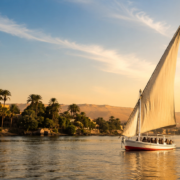
A dahabiya is a traditional Nile sailing boat with a small number of cabins. It relies on sail where conditions allow, and many boats use a tug when needed to keep to the schedule. Days are slower, with more time on deck and fewer people around you.
Because the boat is small, it can often stop at quieter places. Depending on the route, these may include Gebel el-Silsila or El Kab, alongside Edfu and Kom Ombo.
What Is a Standard Nile Cruise Like?
Standard cruise ships are like floating hotels, with meals and guided excursions on a set schedule. Many travelers like the convenience, the range of facilities and the shorter time commitment. Temple visits can be busier, and departure times may be early. Read about what a Nile cruise includes and our Luxor to Aswan cruise guide.
Which One Suits You?
Choose a dahabiya if:
- You prefer a small group or could book the whole boat with family or friends
- You have enough days to travel slowly
- You would like to see some less-visited sites
- You do not need a pool or lots of onboard activity
Choose a standard cruise if:
- You have limited time
- You want more choice across budgets
- You prefer more facilities on board
- You are happy to travel with a larger group
Things to Check Before You Book
- Dates: the sailing direction and departure days decide how the trip fits your flights.
- Inclusions: confirm guides, entrance fees, drinks and tips.
- Sailing: ask what happens when there is no wind.
- Season: spring, autumn and winter are usually more comfortable than the summer heat. See our guide to the best time to visit Egypt.
- Mobility: small boats may have steeper stairs and no elevator, so ask if this matters for you.
A Short History of the Dahabiya
Long before modern cruise ships, wealthy visitors explored the Nile by dahabiya. These boats became especially well known in the 19th century, when European and American travelers would hire one for weeks or even months. The British writer Amelia Edwards described this kind of journey in her 1877 book, A Thousand Miles up the Nile.
Today’s dahabiyas take inspiration from those boats but offer modern cabins with private bathrooms. The experience still centers on what made them popular in the first place: a slow pace, an open deck and an uninterrupted view of river life.
What a Typical Day Looks Like
On a dahabiya
You might wake to breakfast on deck, then sail for a few hours while the riverbanks pass by. A guide takes you to a temple or a smaller site, and you return for lunch. The afternoon is often free for reading or watching village life before the boat moors for the evening. Timings depend on the wind and on the route, so the day feels less fixed.
On a standard cruise
Days usually follow a clearer timetable, with an early start to reach major sites before the heat. After lunch on board, the ship sails onward while you relax by the pool or on the sun deck. Evenings may include a themed dinner or entertainment. It is a convenient way to see a lot without much planning.
What You Can See Along the Way
Both options can include the major temples, but the differences appear in the smaller stops. Here are some places you may come across between Luxor and Aswan:
- Esna: the Temple of Khnum, where cleaning work has revealed vivid ceiling colors. It is reached through the town, and access can depend on the boat’s schedule.
- El Kab: an ancient site with rock-cut tombs that many larger ships pass by.
- Edfu: the very well preserved Temple of Horus, included on most itineraries.
- Gebel el-Silsila: ancient sandstone quarries that supplied stone for many temples, with shrines cut into the cliffs.
- Kom Ombo: a double temple beside the river, dedicated to Sobek and Haroeris.
Always check the day-by-day program. Not every boat stops at all of these, and access may change.
Cabins, Food and Life on Board
On a dahabiya, there are fewer cabins, so you get to know your fellow guests quickly. This can be lovely for friends and families, but it may feel less private if you prefer to keep to yourself. Booking the entire boat solves this for larger groups.
Meals tend to be simple, with fresh dishes served to the whole group. Larger ships commonly offer buffets and more choice, which helps if your group has different tastes. If you have dietary needs, share them before you book, particularly on a smaller boat with limited supplies.
Noise and motion also differ. A larger ship has engines and more people but can feel stable and spacious. A smaller boat is quieter when sailing, although cabins are closer together. Ask for a deck plan if your cabin location matters.
What Affects the Price?
Prices change with the season and the boat, so compare complete offers rather than headline rates. These factors usually matter most:
- Season: demand tends to be stronger in the cooler months and around holidays.
- Boat and cabin: newer boats and larger suites cost more.
- Length: a longer trip costs more overall but leaves time for extra stops.
- Inclusions: entrance fees, guiding, drinks and transfers can change the true cost a lot.
- Private charter: this costs more overall but can work well for a group sharing the boat.
For a wider view of your trip costs, see our Egypt travel budget guide.
Which Is Better for Families, Couples and Older Travelers?
Families: a standard ship often has a pool and more space for children to move around, which helps on hot afternoons. A private dahabiya can work well for a family who wants their own schedule, provided the children are comfortable on a small boat.
Couples: a dahabiya can feel especially peaceful and romantic, while a more luxurious ship offers more facilities. Our Egypt honeymoon guide covers other ideas for two.
Older travelers: ask about stairs, gangways and elevators. Some larger ships have elevators, while small boats usually do not. Moorings can also involve stepping across other boats, so ask your operator how boarding works.
Common Mistakes to Avoid
- Comparing only the headline price: check inclusions so you are comparing the same thing.
- Booking too short a dahabiya trip: the slower pace is the main appeal, so allow enough nights to enjoy it.
- Expecting constant sailing: wind varies, and some towing is normal on many boats.
- Forgetting flights: Luxor and Aswan start points and fixed departure days affect your whole itinerary.
- Ignoring the season: summer afternoons can be extremely hot, even on the water.
Dahabiya vs Nile Cruise FAQs
Is a dahabiya worth the extra cost?
It can be, if a quiet atmosphere and slower travel matter to you. If your main goal is seeing the main temples at a good price, a standard cruise is usually enough.
Do dahabiyas have air conditioning?
Many modern boats do, but it is worth confirming for the specific boat and cabin you are considering.
Can you get seasick on the Nile?
The river is generally calm, so most people have no trouble. If you are very sensitive to motion, bring your usual remedy.
Which direction is better?
Both Luxor to Aswan and Aswan to Luxor can work well. Choose based on your flights and the departure dates available.
Questions to Ask Before You Book
A few direct questions can prevent most surprises. Ask how many cabins the boat has and how many guests will be on your departure. Find out which sites are included and whether a qualified Egyptologist travels with you. It also helps to ask where the trip starts and ends, and what time you need to board and leave. Finally, ask for the cancellation terms in writing, particularly for peak dates.
Is a Felucca the Same as a Dahabiya?
No. A felucca is a small open sailboat usually used for short rides, while a dahabiya has cabins for multi-day trips. Read our felucca ride guide to learn more. Still deciding whether to sail at all? Compare a Nile cruise and a land tour.
Plan Your Nile Journey
See our 4-day Nile cruise from Aswan to Luxor or 5-day cruise from Luxor to Aswan. If you are interested in a dahabiya, tell us your dates and preferences and we will discuss what is available.

Recent Posts
Dahabiya vs Nile Cruise: Which Should You Choose?
Valley of the Kings: Which Tombs to Visit and How to Plan Your Time
Tipping in Egypt (2026–2027): Guides, Drivers, Nile Cruises & Hotels
All Categories
- Abu Simbel
- Abu Simbel from Aswan
- Airport
- Articles
- Aswan
- Best Time to Visit Egypt
- cairo
- Coptic Cairo
- Desert & Oasis
- Dive into the Magic of Sharm’s Underwater World
- Egypt Honeymoon Guide
- Egypt Safari
- Egypt Tourist Scams
- Egypt Travel Budget
- Egypt Travel Planning
- Felucca Ride on the Nile
- Grand Egyptian Museum
- Honeymoon
- hot air balloon luxor egypt
- Hurghada
- Is Egypt Safe for Tourists
- Islamic Cairo Walking
- Karnak Temple
- Khan El Khalili Bazaar
- luxor egypt
- Nile Cruise
- Nubian Village Aswan
- old cairo
- pyramids giza
- Sharm El Sheikh
- Siwa Oasis
- Siwa’s Simplicity
- Solar Eclipse Egypt
- The White Desert A Dream Sculpted by Time
- The Wonders of Saqqara
- Transport
- tutankhamun treasures
- Uncategorized
- White Desert Egypt Safari