

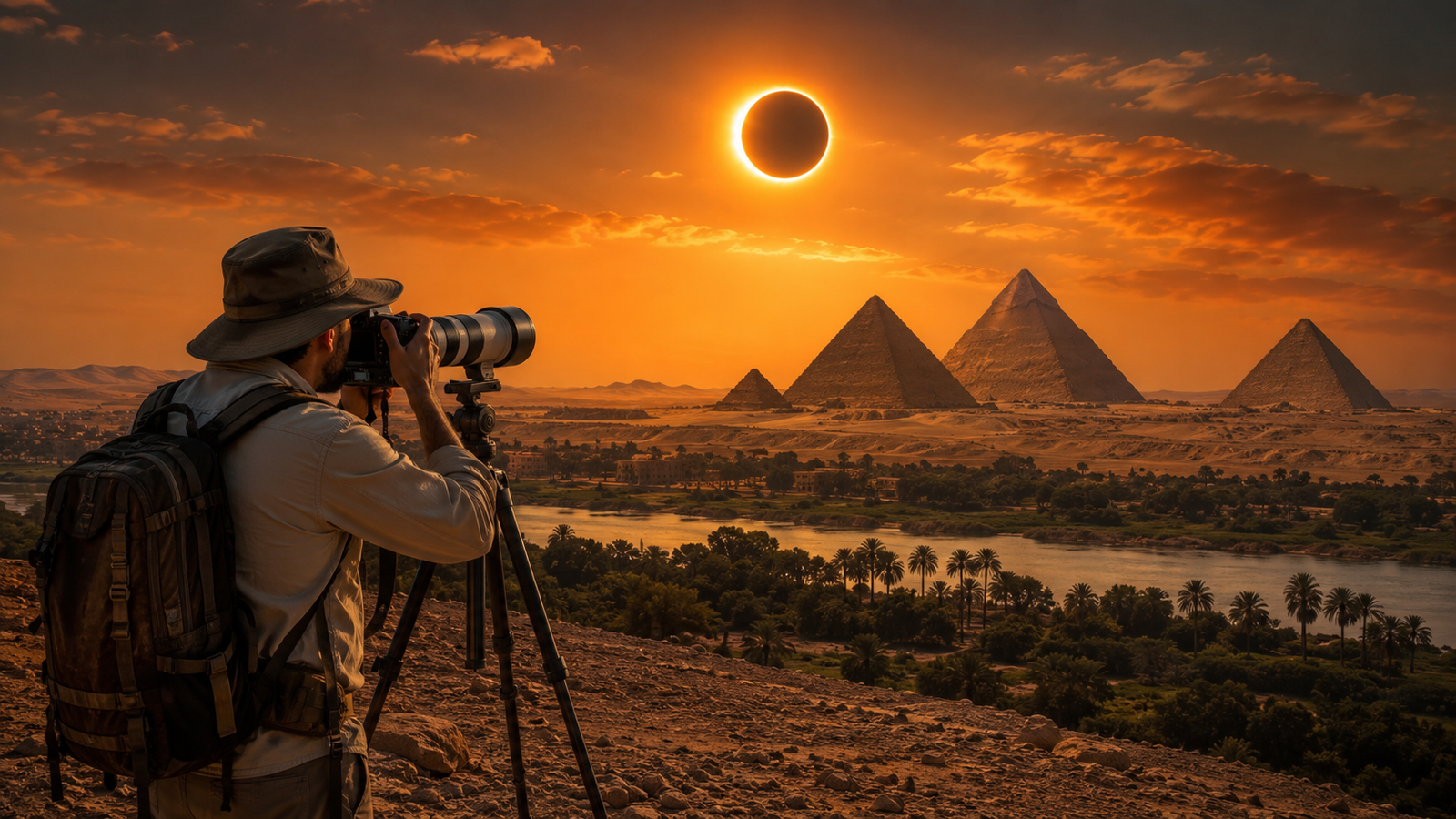
Solar Eclipse 2027 Egypt Photography Guide: Best Spots, Gear & Tips
Solar Eclipse 2027 Egypt Photography Guide: Luxor, Gear, Filters & Camera Settings
The August 2, 2027 total solar eclipse will create an exceptional photography opportunity in Egypt, especially around Luxor and other locations inside the path of totality. Luxor is expected to experience about 6 minutes 22 seconds of totality at the city reference point, while nearby coordinates can differ slightly.
This guide focuses on practical eclipse photography: where to base yourself, how to prepare cameras and filters, how to photograph the partial phases and totality, and how to avoid losing the experience behind the viewfinder.
For the complete travel picture, start with our Solar Eclipse Egypt 2027 complete travel and viewing guide.
First: Know Where Totality Is Actually Visible
Not every major Egyptian city is inside the path of totality. This matters enormously for photography because the corona is visible only during the total phase.
Before choosing a photography base, compare our best places to see the 2027 solar eclipse in Egypt for Luxor, Siwa Oasis, Asyut and the main travel differences between each totality location.
- Luxor: total solar eclipse, about 6 minutes 22 seconds at the city reference point.
- Siwa Oasis: total solar eclipse, about 5 minutes 31 seconds at the listed location.
- Asyut: total solar eclipse, about 6 minutes 8 seconds at the city reference point.
- Aswan city: deep partial eclipse, not totality.
- Cairo: partial eclipse, not totality.
Some locations within a governorate can have different eclipse types from the main city. For example, parts of Aswan Governorate farther north enter the totality band even though Aswan city itself does not. Always confirm the exact viewing coordinates before planning a photography setup.
Luxor Eclipse Timing for Photographers
For a broader Luxor travel view beyond camera setup, use our Luxor Solar Eclipse 2027 time and viewing guide.
Current calculations for Luxor show approximately:
- Partial eclipse begins: 11:40 AM local time.
- Maximum eclipse: around 1:05 PM.
- Totality duration: about 6 minutes 22 seconds at the city reference point.
- Partial eclipse ends: around 2:26 PM.
The exact contact times for totality depend on the final coordinates. Build your shooting plan using the confirmed viewing location rather than relying only on a general city time.
The Four Eclipse Phases You Need to Photograph
1. Partial Phase Before Totality
The Moon gradually covers the Sun. A proper solar filter must remain over the front of the camera lens throughout this phase.
2. Final Moments Before Totality
The final bright portion of the photosphere becomes extremely small. Advanced eclipse photographers may prepare for Baily’s beads and the diamond-ring effect, but filter removal must be timed carefully. If you are not experienced, prioritize eye and equipment safety rather than attempting a risky last-second sequence.
3. Totality
Only during totality is the Sun’s bright photosphere completely covered. This is when the solar corona becomes visible and the solar filter must be removed from the camera lens to photograph it.
Totality is also the best time for wide-angle environmental photographs showing the darkened landscape, horizon glow and observers reacting to the eclipse.
4. Partial Phase After Totality
As soon as the bright Sun begins to return, replace the solar filter before continuing to photograph the partial phase.
Solar Filters: The Most Important Safety Equipment
A solar filter is mandatory on camera lenses, telescopes and binoculars during all partial phases. The filter must be attached securely over the front of the optics.
For direct visual viewing, use proper eclipse viewers that conform to the ISO 12312-2 standard and come from a reputable supplier. Ordinary sunglasses are not safe for eclipse viewing.
Never use eclipse glasses as a replacement for a camera-lens filter. Magnifying optics concentrate sunlight and require their own properly fitted front-mounted filter.
Recommended Camera Equipment
- Camera: DSLR or mirrorless body with manual exposure control.
- Telephoto lens: useful for the Sun and corona. The exact focal length depends on whether you want a tight solar disk or a wider corona composition.
- Wide-angle lens: useful for landscape, observers and the darkened environment during totality.
- Stable tripod: especially important for telephoto work.
- Remote release or intervalometer: helps reduce camera movement and allows you to automate sequences.
- Proper front-mounted solar filter: required during partial phases.
- Spare batteries and memory cards: heat and long operating days make backups essential.
- Lens cloth and dust protection: useful in dry desert conditions.
Camera Settings: Use These as Starting Points, Not Fixed Rules
Exposure depends on the filter, camera, lens and atmospheric conditions. Test your exact setup before travel.
Partial Sun with a Solar Filter
Start with low ISO, a moderate aperture and a relatively fast shutter speed, then adjust while checking the histogram. The correct exposure varies substantially between solar filters.
Totality and the Corona
The inner and outer corona have very different brightness levels, so a bracketed exposure sequence is more useful than one fixed setting. Prepare a sequence in advance so you can capture several shutter speeds automatically without spending the full total phase adjusting the camera.
Wide-Angle Totality
A wide-angle camera can capture the darkened landscape, observers and horizon glow. Test low-light settings beforehand and avoid changing too many variables during totality.
Where to Photograph the Eclipse in Luxor
The most important rule is to use a location with confirmed access and an unobstructed view of the Sun. Archaeological sites should not be assumed to allow eclipse-specific tripods, special access or organized viewing unless that access is officially confirmed.
Do not build a photography plan around unconfirmed statements such as “Karnak will have reserved eclipse positions” or “hot-air balloons will operate during totality.” These are operational questions that depend on aviation rules, site management, permits and event-day arrangements.
A practical Luxor viewing site may be an open desert or rural area selected for safe access, traffic management and clear sightlines. The final location should be communicated with the confirmed eclipse operating plan.
Photography from Hurghada
If you are staying in Hurghada, you need to travel into the Luxor totality area rather than photograph the eclipse from Hurghada itself. Egypt Travel Ways currently offers two formats:
- Luxor Solar Eclipse small-group day tour from Hurghada — includes eclipse-focused transport plus a flexible guided sightseeing element.
- Transport-only eclipse option from Hurghada — focused mainly on reaching the viewing area and returning safely.
For the normal road journey and practical timing, read our Hurghada to Luxor travel-planning guide.
Longer Eclipse Trips for Photographers
Photographers who want more preparation time in Luxor may prefer the 3-Day Luxor Solar Eclipse Tour 2027. It allows a local stay before and after eclipse day rather than a same-day Red Sea transfer.
Travelers combining the event with a longer Upper Egypt itinerary can choose the 7-Day Nile Cruise & Solar Eclipse 2027.
Heat Management for Camera Gear and Photographers
Luxor in August is extremely hot, and the eclipse reaches maximum around early afternoon. Heat affects both people and equipment.
- Keep spare batteries and electronics out of direct sun where possible.
- Use shade for yourself and your setup when operationally practical.
- Carry enough water for a long wait.
- Avoid leaving cameras inside a closed vehicle exposed to direct sun.
- Allow equipment to acclimatize gradually when moving between strong air-conditioning and outdoor heat to reduce condensation risk.
Practice Before August 2, 2027
The most valuable photography preparation happens before travel. Practice the complete sequence at home:
- Mounting and removing the solar filter.
- Changing between filtered partial-phase exposure and totality settings.
- Running your bracket or interval sequence.
- Operating the camera without looking through menus for long periods.
- Replacing the filter immediately after totality.
The goal is to automate as much as possible so you can actually watch part of totality with your own eyes.
Don’t Photograph the Entire Six Minutes
The 2027 Luxor totality is unusually long, but it is still a brief experience. A well-prepared automated sequence can capture the corona while you spend part of totality looking at the sky rather than only at a screen.
Many eclipse observers consider direct visual experience during totality more memorable than any single photograph. Prepare the camera, let it work, and give yourself time to look.
Photography Packing Checklist
- Camera body and backup body if available.
- Telephoto and wide-angle lenses.
- Front-mounted solar filter for every lens used on the partial Sun.
- Tripod and remote trigger.
- Multiple batteries and memory cards.
- Power bank.
- Lens cloth and dust protection.
- Hat, sunscreen and breathable clothing.
- Water and personal medication.
- ISO-compliant eclipse viewers for direct visual observing.
For broader preparation, see our Solar Eclipse 2027 Egypt Safety Guide, Egypt packing list and Egypt visa requirements 2027 guide.
Frequently Asked Questions
How long is totality in Luxor?
About 6 minutes 22 seconds at the Luxor city reference point. Nearby coordinates can differ slightly.
Is Aswan a total-eclipse photography location?
Aswan city itself will see a deep partial eclipse, not totality. A total-eclipse photography plan needs a confirmed location inside the path.
Can I photograph the partial eclipse without a filter?
No. A proper front-mounted solar filter is required on the camera lens during partial phases.
Can I remove the filter during totality?
Yes, only while the Sun’s bright photosphere is completely covered. Replace it as soon as the bright Sun begins to return.
Are special photography positions at temples guaranteed?
No. Access to archaeological sites, tripod rules and eclipse-specific arrangements require official confirmation and should not be assumed in advance.
Plan Your Egypt Eclipse Photography Trip
First choose a confirmed viewing location inside totality. Then decide whether you want a Luxor hotel stay, a longer Nile journey or a same-day transfer from Hurghada. Build the photography plan around the confirmed coordinates, viewing access and operating schedule rather than around an unverified landmark promise.
Continue with the complete Solar Eclipse Egypt 2027 guide to compare all four eclipse programs and understand totality locations, travel logistics and viewing safety.

Recent Posts
Tipping in Egypt (2026–2027): Guides, Drivers, Nile Cruises & Hotels
What’s Included in an Egypt Nile Cruise? Cruise-Only vs Guided Packages
Grand Egyptian Museum vs Egyptian Museum vs NMEC: Which Should You Visit?
All Categories
- Abu Simbel
- Abu Simbel from Aswan
- Airport
- Articles
- Aswan
- Best Time to Visit Egypt
- cairo
- Coptic Cairo
- Desert & Oasis
- Dive into the Magic of Sharm’s Underwater World
- Egypt Honeymoon Guide
- Egypt Safari
- Egypt Tourist Scams
- Egypt Travel Budget
- Egypt Travel Planning
- Felucca Ride on the Nile
- Grand Egyptian Museum
- Honeymoon
- hot air balloon luxor egypt
- Hurghada
- Is Egypt Safe for Tourists
- Islamic Cairo Walking
- Karnak Temple
- Khan El Khalili Bazaar
- luxor egypt
- Nile Cruise
- Nubian Village Aswan
- old cairo
- pyramids giza
- Sharm El Sheikh
- Siwa Oasis
- Siwa’s Simplicity
- Solar Eclipse Egypt
- The White Desert A Dream Sculpted by Time
- The Wonders of Saqqara
- Transport
- tutankhamun treasures
- Uncategorized
- White Desert Egypt Safari